

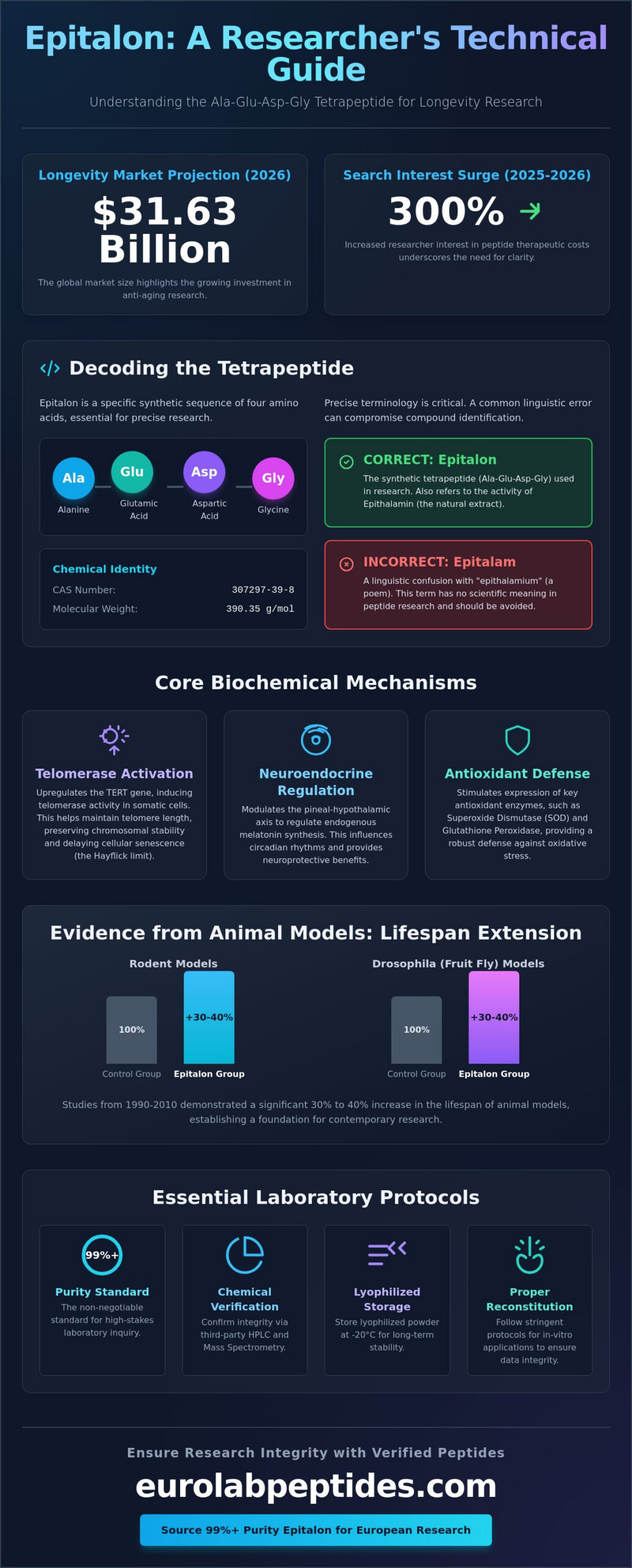
While the global longevity market is projected to reach $31.63 billion in 2026, many researchers remain hindered by the lack of standardized data regarding the tetrapeptide Epitalon. Between April 2025 and April 2026, search volume for peptide therapeutic costs surged by 300%, yet significant confusion persists between the linguistic term epitalam and the specific synthetic sequence of Epithalamin. You’ve likely encountered the challenges of inconsistent chemical purity and the absence of clear reconstitution protocols that frequently compromise the integrity of longitudinal cellular studies.
This technical review provides a comprehensive analysis of Epitalon’s role in telomerase activation and pineal gland regulation. You’ll gain a precise understanding of the biochemical mechanisms required to target aging at the cellular level, alongside stringent protocols for lyophilization and laboratory storage. We also detail the necessity of HPLC and mass spectrometry verification to ensure 99%+ purity, establishing the rigorous metrics required to identify a reliable European supplier for your specific research inquiry.
Key Takeaways
- Distinguish the Ala-Glu-Asp-Gly tetrapeptide sequence from the linguistic term epitalam to ensure precise compound identification in longevity research databases.
- Understand the biochemical pathways of telomerase induction and the modulation of the pineal-hypothalamic axis for regulating endogenous melatonin synthesis.
- Review the outcomes of lifespan extension studies in Drosophila and rodent models to determine the peptide’s impact on age-related biomarkers.
- Implement stringent laboratory handling protocols, including storage of lyophilized powder at -20°C and proper reconstitution techniques for in-vitro applications.
- Verify chemical integrity by identifying 99%+ purity standards through independent third-party HPLC and mass spectrometry analysis.
What is Epitalon (Epithalamin)? A Research Profile
Epitalon, chemically identified as L-alanyl-L-glutamyl-L-aspartyl-glycine, is a synthetic tetrapeptide designed to replicate the biological activity of Epithalamin. While the term epitalam frequently appears in search queries due to linguistic confusion with the poetic “epithalamium,” researchers must distinguish between these unrelated concepts. In the context of longevity science, this specific peptide sequence (Ala-Glu-Asp-Gly) is a precision tool used to investigate cellular senescence and telomere maintenance. Each batch’s identity is confirmed through mass spectrometry and HPLC analysis to ensure 99%+ purity, which remains the non-negotiable standard for high-stakes laboratory inquiry.
The Origins of Epithalamin Research
The development of Epitalon (Epithalamin) began in the 1980s at the St. Petersburg Institute of Bioregulation and Gerontology. Professor Vladimir Khavinson led Soviet-era investigations into peptide bioregulators, focusing on how specific short-chain amino acids could modulate endocrine function. These early studies transitioned from complex natural pineal extracts to the synthesis of pure Epitalon. Between 1990 and 2010, animal model research demonstrated significant results; some studies showed a 30% to 40% increase in the lifespan of rodents and Drosophila. These findings established the foundation for contemporary molecular defense research and the investigation of peptide-driven gene expression.
Chemical Nomenclature and Variants
Precision in nomenclature is vital for experimental reproducibility. Epithalamin refers to the natural peptide complex extracted from the bovine pineal gland, whereas Epitalon is the isolated, synthetic tetrapeptide. This synthetic variant is defined by CAS Number 307297-39-8 and has a molecular weight of 390.35 g/mol. These specifications are verified through stringent sequence validation protocols during the manufacturing process. For researchers establishing new laboratory frameworks, our comprehensive guide for researchers offers additional foundational data on peptide synthesis and handling. Linguistic variations such as epitalam don’t reflect the precise chemical identity required for peer-reviewed research.
The molecular structure of Epitalon is characterized by its short chain length, which facilitates efficient cellular uptake in in-vitro environments. Its stability in lyophilized form is a critical metric for long-term research. By utilizing high-resolution analytical chemistry, we ensure that the chemical footprint matches the established research profile, providing a reliable baseline for investigating telomerase activation and DNA repair mechanisms. This rigorous approach respects the researcher’s time and ensures that the data generated is based on an uncompromising standard of chemical integrity.
Biochemical Mechanisms: Telomerase Activation and Pineal Regulation
The biochemical activity of the Ala-Glu-Asp-Gly sequence is defined by its ability to modulate gene expression at the epigenetic level. While the linguistic term epitalam lacks scientific specificity, the synthetic tetrapeptide interacts directly with DNA structures to influence cellular aging. Research suggests that the Biochemical Mechanisms of Epitalon involve the induction of telomerase activity and the upregulation of endogenous antioxidant defenses. Specifically, the peptide stimulates the expression of Superoxide Dismutase (SOD) and Glutathione peroxidase, providing a robust defense against oxidative stress in various cellular models.
Telomere Length and Cellular Senescence
Epitalon’s primary research value lies in its capacity to facilitate the bypass of the Hayflick limit, the point at which a cell population stops dividing. This is achieved through the induction of telomerase activity in somatic cells, where the peptide upregulates mRNA expression of the TERT (Telomerase Reverse Transcriptase) gene. In long-term cell culture studies, this mechanism has been observed to preserve chromosomal stability and delay the onset of replicative senescence. By maintaining telomere length, the compound serves as a critical variable in studies investigating cellular longevity and the preservation of genomic integrity under stress.
Neuroendocrine and Circadian Modulation
The peptide’s influence extends to the pineal-hypothalamic axis, where it regulates melatonin synthesis. In aging research models, the restoration of nocturnal melatonin secretion rhythms has been documented, effectively returning hormonal profiles to levels observed in younger cohorts. This restoration suggests a balancing of the hypothalamic sensitivity threshold, which is often compromised during biological aging. Such modulation remains a focal point for researchers exploring sleep-wake cycle disruptions and associated metabolic dysregulation. For those conducting these complex trials, securing compounds with verified purity standards is necessary to ensure experimental accuracy.
Immune system normalization is also observed in Soviet-era and contemporary research. Studies in aging models indicate a consistent normalization of T-cell function, specifically enhancing the activity of thymic lymphocytes. This immune modulation, combined with the reduction of free radical damage, creates a multifaceted approach to investigating longevity. Each batch of the peptide must undergo stringent HPLC analysis to ensure that these biochemical interactions are not skewed by impurities. This commitment to chemical integrity allows for the collection of objective, standardized data in the pursuit of scientific advancement.
Primary Areas of Investigation in Longevity Research
Scientific inquiry into the Ala-Glu-Asp-Gly peptide sequence focuses on quantifying its impact on biological age markers. While casual searches for epitalam often yield non-scientific results, the laboratory application of this tetrapeptide is centered on cellular resilience. Current research protocols prioritize the measurement of telomere elongation and the reduction of age-associated protein carbonylation. In Drosophila and rodent models, investigators have documented a consistent increase in maximum lifespan, often exceeding control groups by 30% in standardized trials conducted over the last two decades. These studies provide a baseline for understanding how synthetic bioregulators interact with the genetic machinery of aging, specifically through the reduction of oxidative biomarkers like malondialdehyde and 8-oxoguanine.
Neuroprotective investigations constitute a growing sector of longevity science, where researchers examine the peptide’s role in maintaining cognitive function. Epitalon is being evaluated for its capacity to mitigate oxidative stress within neuronal tissues, specifically targeting the accumulation of amyloid-beta in neurodegeneration models. The synergy between this peptide and other longevity reagents is also under scrutiny. Researchers often analyze the combined effects of telomerase activators and metabolic regulators to identify potential additive benefits. Each compound used in such multi-variable trials must meet uncompromising 99%+ purity standards to ensure that observed outcomes are attributable solely to the active sequences. This level of precision is non-negotiable for serious inquiry.
Aging and Immune Function Research
A critical area of study involves the restoration of thymic activity, which naturally declines with age. Epitalon has been observed to normalize the morphology of the thymus gland in aging models, leading to increased lymphocyte proliferation and improved cytokine signaling. This immunomodulatory effect is distinct from the tissue-repair focus of BPC-157 research applications, which primarily target musculoskeletal and gastrointestinal healing. By comparing these disparate mechanisms, researchers can develop a more comprehensive map of systemic bioregulation. The data suggests that peptide-driven immune modulation may provide a more stable environment for long-term cellular studies.
Oncological Research Context
The relationship between Epitalon and Telomerase Activation is particularly relevant in oncological research. While telomerase is often associated with cellular immortality in malignant contexts, studies indicate that Epitalon may inhibit the development of spontaneous tumors by enhancing DNA repair mechanisms and maintaining genome integrity. This paradoxical effect suggests that the peptide’s role in suppressing age-associated pathologies is linked to its ability to stabilize the cellular environment. Stringent third-party verification of peptide identity remains a prerequisite for these investigations, as sequence fidelity is paramount when analyzing complex pathways like oncogenesis. Radical honesty in reporting lab results ensures that these findings remain a reliable resource for the scientific community.
Laboratory Handling: Lyophilization, Stability, and Reconstitution
The structural integrity of the Ala-Glu-Asp-Gly sequence is preserved through lyophilization, yet its stability in the laboratory is contingent upon stringent environmental controls. While linguistic searches for epitalam often yield non-technical results, the chemical handling of the synthetic peptide requires precise thermal management. For long-term preservation, lyophilized Epitalon must be stored at temperatures between -20°C and -80°C. While the peptide remains stable at room temperature during transit for up to 14 days, prolonged exposure to ambient heat can lead to the degradation of the peptide bonds. Researchers can source high-purity Epitalon to ensure baseline stability before beginning these protocols.
Maintaining an aseptic environment is a non-negotiable requirement for all handling procedures. Every interaction with the vial should occur within a laminar flow hood or a similarly controlled space to prevent microbial contamination. Peptide degradation is often accelerated by exposure to UV light and moisture; therefore, vials should remain sealed in their original desiccated packaging until the point of reconstitution. Radical honesty in laboratory practice dictates that any vial showing signs of seal compromise or moisture ingress must be discarded to protect the validity of the research data. Stringent adherence to these standards ensures that the 99%+ purity verified by HPLC is maintained throughout the experimental timeline.
Reconstitution Protocols for Researchers
The selection of an appropriate diluent depends on the specific in-vitro experimental design. Bacteriostatic water (0.9% benzyl alcohol) is typically preferred for multi-use vials due to its antimicrobial properties, though sterile saline is utilized for single-application studies where alcohol interference must be avoided. The diluent should be introduced by allowing it to flow slowly down the side of the vial wall. Shaking the vial induces mechanical stress and can lead to peptide denaturation; instead, gentle swirling is recommended until the solution is completely clear. Determining the exact concentration is essential for dosing accuracy in cellular research, requiring precise volumetric calculations during this phase.
Post-Reconstitution Storage and Shelf-Life
Once reconstituted, the solution is most stable when maintained at 2°C to 8°C. At these temperatures, the peptide typically retains its integrity for 7 to 21 days. Frequent freeze-thaw cycles must be avoided as they compromise the molecular sequence; if long-term storage of a reconstituted solution is required, the peptide should be aliquoted into single-use volumes and stored at -20°C. A visual inspection is a non-negotiable step before every application. The presence of particulate matter, cloudiness, or any discoloration indicates chemical degradation or contamination, necessitating the immediate disposal of the sample. This methodical approach to storage ensures that the epitalam sequence remains viable for high-stakes longevity research.
Sourcing Epitalon for In-Vitro Research in Europe
Procuring the Ala-Glu-Asp-Gly tetrapeptide within the European Union requires a meticulous verification of supplier credentials to ensure experimental reproducibility. While linguistic variations like epitalam may appear in informal contexts, the professional procurement process is driven by analytical chemistry metrics. As of April 2026, Epitalon remains classified strictly as a research chemical, intended for laboratory development and in-vitro applications only. Compliance with European regulatory standards is a mandatory requirement for all chemical suppliers, ensuring that reagents are handled with the precision necessary for scientific inquiry.
The integrity of a research project is dependent on the purity of the compounds utilized. Uncompromising standards dictate that every batch of Epitalon must be accompanied by a Certificate of Analysis (CoA). This document should provide verifiable evidence of 99%+ purity through High-Performance Liquid Chromatography (HPLC) and Mass Spectrometry. These analytical methods confirm the identity and concentration of the peptide, ensuring that no residual trifluoroacetic acid (TFA) or heavy metals compromise the cellular environment. Third-party laboratory verification serves as a non-negotiable layer of security, shielding the researcher from the inconsistencies often found in the global market.
Verifying Quality and Purity
Sequence validation is further established through Nuclear Magnetic Resonance (NMR) spectroscopy, which confirms the specific arrangement of the amino acid chain. Each batch is analyzed to ensure the molecular weight aligns with the theoretical value of 390.35 g/mol. Researchers should consult our 2026 guide to peptide sourcing for a detailed breakdown of laboratory standards and purity metrics. Radical honesty in reporting these results is the only method to establish absolute trust between the supplier and the scientific community. Any deviation from these stringent metrics necessitates the immediate rejection of the batch.
EuroLab Peptides: Your European Research Partner
EuroLab Peptides operates with a commitment to providing unrivaled tools for serious scientific inquiry. Our quality control protocols are modeled after the highest European manufacturing standards, where each peptide undergoes a sequence of validation before shipment. We provide efficient EU-based logistics, ensuring that sensitive reagents like epitalam are transported under stable conditions to minimize the risk of degradation. By prioritizing clinical accuracy over marketing hyperbole, we function as a reliable partner for researchers investigating the complex mechanisms of longevity. Our logistical framework is designed for high-stakes precision, providing secure handling and transparent tracking for every order within the European research network.
Advancing Cellular Longevity Through Standardized Research Protocols
The synthesis of the Ala-Glu-Asp-Gly tetrapeptide represents a significant milestone in the objective study of cellular senescence and neuroendocrine regulation. By standardizing the induction of telomerase activity and the restoration of circadian rhythms, researchers can move beyond the linguistic ambiguity of terms like epitalam to achieve verifiable, peer-reviewed results. This review has established that success in longevity research is predicated on two non-negotiable factors: the preservation of peptide integrity through stringent storage protocols and the use of compounds that meet uncompromising purity standards.
EuroLab Peptides provides the technical infrastructure required for these high-stakes investigations. Every batch of our Epitalon is analyzed through third-party independent laboratory testing to confirm 99%+ purity via HPLC and mass spectrometry. We utilize secure EU-based shipping and handling to ensure your reagents arrive without thermal or mechanical compromise, maintaining the rigorous metrics your laboratory demands. Radical honesty in chemical analysis remains our signature standard.
Explore High-Purity Epitalon for Your Research and secure a reliable partner for your next phase of scientific inquiry.
Frequently Asked Questions
Is Epitalon the same as the linguistic term epitalam?
Epitalon is the synthetic tetrapeptide Ala-Glu-Asp-Gly, which must be distinguished from the linguistic variant epitalam. While the latter often appears in non-scientific databases or informal translations, the professional researcher relies on the CAS registry number 307297-39-8 for precise identification. Ensuring the correct nomenclature is vital for cross-referencing Soviet-era clinical data with modern synthetic sequence validation. This distinction prevents the acquisition of unrelated biological extracts or poetic references during the procurement process.
What is the role of Epitalon in telomerase activation research?
In molecular biology research, Epitalon acts as a ligand that induces the expression of the TERT gene. This induction leads to the synthesis of the telomerase enzyme in somatic cells, which is otherwise typically suppressed. Researchers utilize this mechanism to investigate the extension of the replicative lifespan and the bypass of the Hayflick limit in various cellular models. These studies are critical for quantifying the compound’s impact on chromosomal stability and the prevention of replicative senescence.
How should Epitalon be stored to maintain maximum stability?
Lyophilized powder must be maintained at -20°C for short-term laboratory storage and -80°C for long-term preservation of the peptide bonds. While the compound remains stable at room temperature for a duration of 14 days during transit, it’s susceptible to degradation if exposed to ambient heat beyond this window. Maintaining these stringent thermal conditions is a non-negotiable requirement to ensure that the 99%+ purity verified at synthesis remains intact for the duration of the experimental timeline.
What diluent is best for reconstituting Epitalon for lab use?
Bacteriostatic water is the standard diluent for multi-use laboratory vials because the 0.9% benzyl alcohol content inhibits microbial growth. For specific in-vitro assays where the presence of alcohol might interfere with cellular signaling or viability, sterile saline (0.9% NaCl) is used as an alternative. The selection of the diluent should be based on the specific requirements of the experimental design and must be documented to ensure the reproducibility of the scientific data.
Are EuroLab Peptides third-party tested for purity?
Every batch of reagents is subjected to stringent third-party verification to ensure a standard of 99%+ purity. EuroLab Peptides utilizes independent laboratories to perform High-Performance Liquid Chromatography and mass spectrometry on all products. This process confirms the identity of the epitalam sequence and detects any residual solvents or synthesis byproducts. Such radical honesty in reporting analytical data is essential for maintaining the high-stakes precision required in modern longevity studies and longitudinal research.
Can Epitalon be used for human clinical trials?
Epitalon is classified exclusively as a research chemical and is intended solely for laboratory development and in-vitro research applications. As of April 2026, it’s not approved for human consumption, medical use, or clinical trials by the European Medicines Agency or other regulatory bodies. Researchers are responsible for adhering to all legal frameworks governing the handling of synthetic peptides. Its use is restricted to controlled environments where its biochemical properties can be analyzed without risk to human subjects.
What is the molecular sequence of the Epitalon peptide?
The molecular sequence of Epitalon is L-alanyl-L-glutamyl-L-aspartyl-glycine, represented by the amino acid sequence Ala-Glu-Asp-Gly. This short-chain tetrapeptide has a molecular weight of 390.35 g/mol and a molecular formula of C14H22N4O9. This structure is validated through NMR spectroscopy during the synthesis process to ensure sequence fidelity. The simplicity of this four-amino-acid chain is what allows for its efficient cellular uptake and interaction with the genetic machinery in research models.
How does Epitalon influence melatonin production in research models?
Epitalon acts on the pineal gland to modulate the secretion of endogenous melatonin, effectively regulating the pineal-hypothalamic axis. In aging research models, this restoration of nocturnal melatonin rhythms helps return hormonal profiles to levels observed in younger cohorts. This modulation is a focal point for investigators studying the synchronization of circadian systems and associated metabolic regulation. The data generated from these models provides a standardized baseline for understanding systemic neuroendocrine responses to synthetic peptide bioregulators.
