

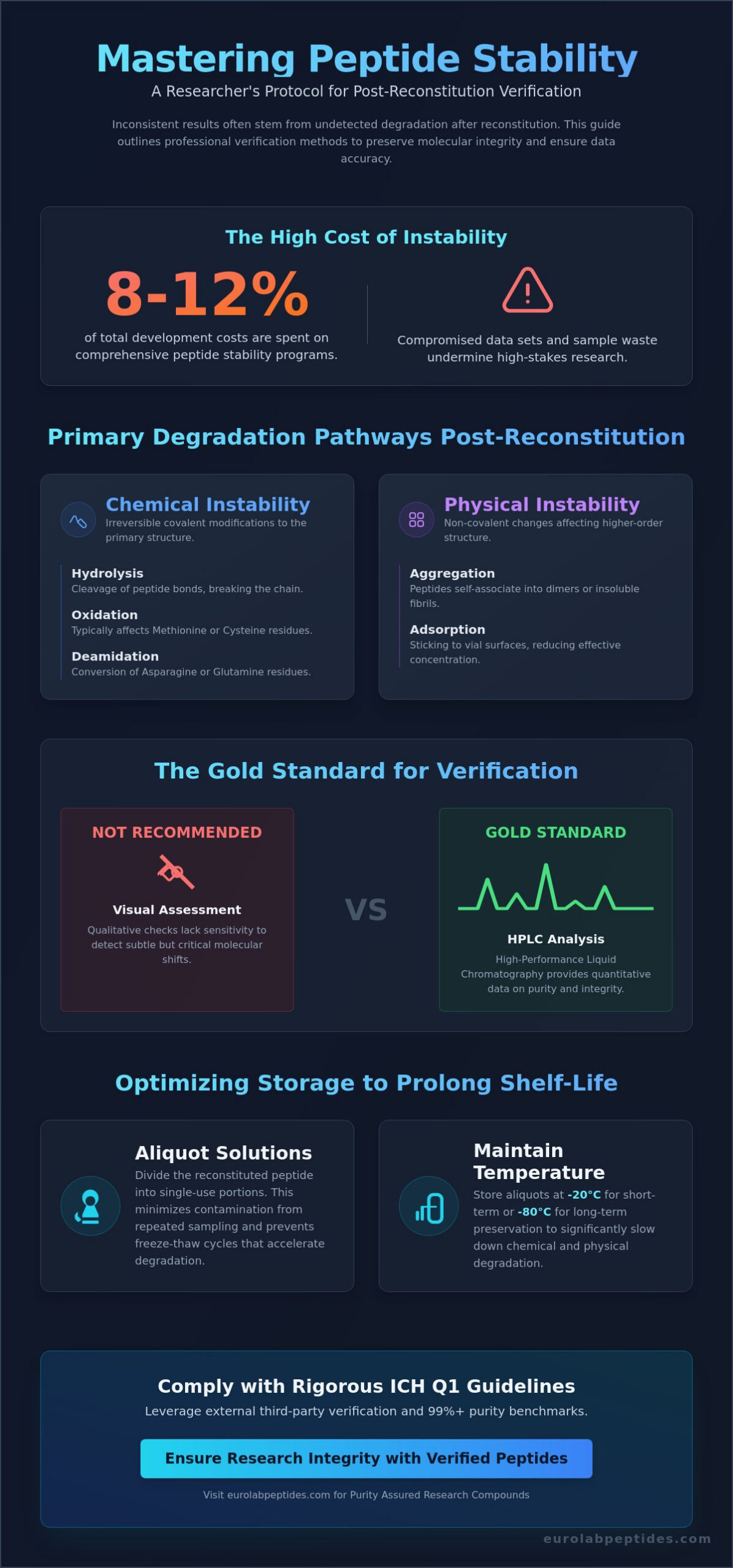
Comprehensive peptide stability programs account for 8% to 12% of total development costs as of early 2026. For the professional researcher, the primary technical challenge remains how to test peptide stability after reconstitution to ensure that molecular integrity is preserved throughout the analytical sequence. Inconsistent results often stem from undetected degradation, a variable that is frequently introduced during the transition from lyophilized powder to the aqueous phase. It’s understood that uncertainty regarding solvent compatibility and storage conditions can lead to significant sample waste and compromised data sets, undermining the precision required for high-stakes inquiry.
This protocol details the analytical verification methods and practical steps required to master the verification of reconstituted research peptides. You’ll gain a clear understanding of standardized laboratory SOPs for storage and the risk-based approach introduced by the new ICH Q1 guidelines implemented on April 1, 2026. By adhering to these rigorous analytical protocols, researchers can minimize sample loss and ensure that every sequence meets the non-negotiable standards of modern biochemical science. The following sections outline the precise metrics used to verify purity and shelf-life in a professional laboratory setting.
Key Takeaways
- Identify primary chemical degradation mechanisms, including hydrolysis and deamidation, that compromise molecular integrity during the transition to the aqueous phase.
- Master how to test peptide stability after reconstitution by utilizing High-Performance Liquid Chromatography (HPLC) to ensure rigorous analytical verification of chemical purity.
- Establish standardized storage protocols, such as aliquoting and maintaining temperature thresholds at -20°C or -80°C, to mitigate the volatility of reconstituted solutions.
- Distinguish between the limitations of qualitative visual assessments and the necessity of quantitative instrumental analysis for maintaining precise research standards.
- Leverage external third-party verification and 99%+ purity benchmarks to comply with the rigorous demands of the current ICH Q1 stability guidelines.
Understanding Peptide Degradation Pathways Post-Reconstitution
Lyophilization maintains peptides in a glassy, immobile state by removing water and limiting molecular motion. Reconstitution initiates a transition into a volatile aqueous phase where kinetic barriers to degradation are significantly lowered. This shift from a stable solid to a liquid solution represents a critical increase in molecular entropy. Determining how to test peptide stability after reconstitution requires a baseline understanding of these chemical and physical shifts. When a peptide is introduced to a solvent, it becomes susceptible to several degradation pathways that can compromise the accuracy of research data. The rate of this degradation is not uniform; it’s governed by the primary sequence, the pH of the environment, and the presence of reactive contaminants.
Chemical vs. Physical Instability in Solution
Chemical instability involves covalent modifications that alter the primary structure of the molecule. These changes often result in a shift in molecular weight and a total loss of biological activity. Primary mechanisms include hydrolysis, which involves the cleavage of peptide bonds, and oxidation, which typically targets methionine or cysteine residues. Deamidation is the conversion of asparagine or glutamine residues. These covalent alterations are irreversible and can be quantified using instrumental analysis. Research into peptide drug stability indicates that even minor structural shifts can lead to the formation of impurities that interfere with experimental outcomes.
Physical instability refers to non-covalent changes that affect the higher-order structure of the peptide. Aggregation is a common physical pathway where peptides self-associate to form dimers, oligomers, or larger insoluble fibrils. This process is often driven by hydrophobic interactions and can be accelerated by agitation or temperature fluctuations. Adsorption to vial surfaces is another physical risk. Peptides may stick to the plastic or glass walls of the storage container, leading to a significant decrease in the effective concentration of the solution. These physical changes don’t always alter the chemical formula, but they fundamentally change how the peptide behaves in a research environment.
The Impact of Sequence and Solvent Choice
The primary sequence of peptides dictates their inherent vulnerability to specific degradation pathways. Cysteine-rich sequences are particularly high-risk because they can form incorrect intra- or inter-molecular disulfide bridges in the presence of oxygen. Solvent selection is the most critical variable in mitigating these risks. Bacteriostatic water, which contains 0.9% benzyl alcohol, is frequently used to inhibit microbial growth, but the preservative itself can sometimes catalyze oxidation in sensitive sequences. Sterile water lacks these preservatives but offers no protection against bacterial contamination during repeated sampling.
Hydrophobic sequences often present solubility challenges that require specialized solvents. In cases where standard aqueous buffers fail, researchers utilize organic modifiers like Dimethyl Sulfoxide (DMSO) or dilute acetic acid (1% to 10%) to ensure complete dissolution. The choice of solvent affects the pH of the final solution, which is a primary driver of stability. Most peptides exhibit maximum stability near their isoelectric point, though this varies by sequence. Establishing a standardized protocol for solvent selection is a prerequisite for anyone learning how to test peptide stability after reconstitution effectively.
Analytical Methods for Verifying Peptide Stability
Analytical verification is the utilization of specialized instrumentation to confirm the chemical purity and structural integrity of a compound. While visual inspections provide a preliminary check, they lack the sensitivity to detect the subtle molecular shifts that occur post-reconstitution. Establishing a baseline chromatogram immediately after the initial dilution is essential for comparative stability analysis over time. Researchers often refer to standardized protocols to test peptide stability to ensure their analytical data remains robust across multiple experimental time points.
Reversed-Phase HPLC (RP-HPLC) Interpretation
High-Performance Liquid Chromatography remains the primary tool for monitoring peptide degradation in professional research settings. In a typical RP-HPLC run, the target peptide is identified by its specific retention time and the area under the primary peak. Degradation is signaled by the emergence of “impurity peaks” that appear as secondary shoulders or separate spikes on the chromatogram. A reduction in the area under the primary peak directly correlates with a loss of target concentration. A shift in retention time indicates chemical modification. This shift suggests that the molecule’s hydrophobicity has changed, which is a hallmark of side-chain alterations or backbone cleavage.
LC-MS for Molecular Integrity Verification
Liquid Chromatography-Mass Spectrometry (LC-MS) provides the high-resolution data required to identify the specific nature of chemical degradation. While HPLC detects that a change has occurred, MS quantifies the exact mass shift to confirm structural integrity. Oxidation is typically identified by mass increases of +16 Da or +32 Da, representing the addition of oxygen atoms to the sequence. Deamidation is identified via +1 Da mass increases in high-resolution spectra. This level of precision is critical when verifying the structural profile of complex compounds like bpc 157, where maintaining the exact pentadecapeptide sequence is vital for research consistency. Mastering how to test peptide stability after reconstitution through these instrumental methods ensures that experimental outcomes are based on viable, high-purity samples.
Standardizing these metrics allows laboratory personnel to determine the precise point at which a sample no longer meets the required purity threshold. For laboratories requiring materials that have already undergone rigorous external validation, sourcing from verified analytical-grade suppliers ensures a higher degree of initial stability. This proof-first approach to sample management minimizes the risk of data corruption caused by degraded research materials.
Practical In-Lab Assessment of Reconstituted Peptides
The establishment of a routine protocol for monitoring reconstituted samples ensures that experimental deviations are not the result of sample degradation. Every newly reconstituted vial must be assigned a “Time-Zero” baseline. This documentation includes the precise solvent volume, the resulting concentration, and a description of the solution’s clarity. While instrumental analysis is superior, bench-side monitoring serves as an immediate indicator of gross instability. Research integrity is maintained by correlating physical changes with experimental data points. Determining how to test peptide stability after reconstitution involves a methodical approach to identifying these early warning signs before they compromise an entire study.
Routine documentation of physical changes allows for the early detection of solubility issues that might otherwise be overlooked. If a peptide solution displays unexpected behavior during an active research phase, it’s often too late to salvage the sample. Standardized protocols for testing peptide stability suggest that physical observations should be recorded daily during the first week post-reconstitution. This rigorous tracking provides the empirical evidence needed to justify the disposal of a sample or the re-validation of a batch.
Visual Inspection and Solubility Monitoring
Visual inspections are performed against a dark background under high-intensity light to detect micro-precipitation. Observations for “salting out” are critical, especially when peptides are reconstituted in high-concentration buffers. This phenomenon occurs when the ionic strength of the solution exceeds the solubility limit of the peptide, leading to the formation of visible crystals. Identifying color changes or increased turbidity is equally vital. Cloudiness often indicates microbial growth or the formation of large non-covalent aggregates. The presence of “floaters” or particulate matter in high-concentration solutions suggests that the peptide is falling out of solution, which fundamentally alters the effective dosage in subsequent aliquots.
Monitoring pH and Conductivity
Small-scale analytical tools allow for the monitoring of chemical shifts without requiring full HPLC access. pH shifts can signal the breakdown of peptide bonds or the absorption of atmospheric carbon dioxide. Micro-pH probes are used to ensure the solution remains within its predetermined stability window, typically near the isoelectric point of the sequence. Any deviation of more than 0.5 pH units should be viewed with skepticism. Conductivity changes are also monitored, as they correlate with increased ionic degradation products. As peptide bonds undergo hydrolysis, the concentration of charged species in the solution increases. Measuring these shifts provides a quantitative metric for stability that bridges the gap between visual observation and high-resolution mass spectrometry. Mastering how to test peptide stability after reconstitution at the bench level provides a critical layer of quality control in the laboratory.
Optimizing Storage to Prolong Reconstituted Shelf Life
The transition from analytical verification to long-term maintenance requires rigorous control of the storage environment. While previous sections detailed how to test peptide stability after reconstitution, the objective data obtained is only valid if the sample’s environmental integrity is preserved. Degradation is an accelerated process in the aqueous phase. Stability is maximized by minimizing mechanical stress, thermal fluctuations, and electromagnetic radiation exposure. Standardized storage protocols are the primary defense against the rapid loss of molecular potency. Implementing these storage optimizations allows researchers to extend the window of viability, though periodic checks on how to test peptide stability after reconstitution remain necessary to confirm ongoing integrity.
The Aliquot Method for Research Consistency
Aliquoting is the process of dividing the total reconstituted volume into single-use portions immediately following the initial dilution. This technique is non-negotiable for maintaining batch consistency. Repeated entries into a single vial introduce atmospheric oxygen and potential microbial contaminants, both of which catalyze chemical degradation. Each aliquot should contain the exact volume required for a single experimental procedure. Air-tight seals are mandatory for frozen aliquots to prevent sublimation and the introduction of atmospheric moisture that catalyzes hydrolysis. This method effectively eliminates the deleterious effects of repeated freeze-thaw cycles, which induce mechanical shear stress and lead to molecular fragmentation.
Solvent Selection for Maximum Longevity
The choice of solvent directly dictates the shelf-life of the solution. Bacteriostatic water, containing 0.9% Benzyl Alcohol, is utilized to inhibit microbial proliferation, extending the viability of the solution when stored at 4°C for short-term use. For sequences requiring a physiological pH, phosphate-buffered saline (PBS) is often preferred, though it lacks the preservative properties of bacteriostatic solutions. Specific handling requirements are necessary for sensitive secretagogues like ipamorelin, where even minor pH deviations can trigger rapid deamidation. Long-term storage requires temperature thresholds of -20°C or -80°C. At these temperatures, molecular motion is sufficiently retarded to preserve the primary sequence for several months. Light sensitivity must also be addressed; amber vials or light-shielded storage containers are required to prevent UV-induced photodegradation of aromatic amino acid residues.
To ensure that your laboratory operates with the highest degree of precision, it’s essential to source materials that meet a 99%+ purity standard. You can buy analytical-grade research peptides that have undergone rigorous third-party verification to ensure baseline stability is guaranteed before reconstitution occurs.
EuroLab Peptides Quality Assurance and Stability Standards
EuroLab Peptides operates under a non-negotiable 99%+ purity standard, which is verified by a rigorous dual testing system. Every batch is first analyzed by the manufacturer’s in-house laboratory before being submitted to an independent third-party laboratory for final validation. This proof-first approach ensures that the baseline stability data provided to researchers is empirically sound and verifiable. When laboratory personnel evaluate how to test peptide stability after reconstitution, they must begin with a molecule that has been synthesized and stored under strict EU chemical regulations. High-purity starting materials are the only way to ensure that subsequent analytical data remains representative of the target sequence rather than its impurities.
Interpreting Our Third-Party Stability Reports
High-Performance Liquid Chromatography (HPLC) chromatograms are included with every batch to provide a transparent overview of the compound’s chemical profile. Researchers should examine the primary peak area to confirm it meets the 99%+ threshold. Any secondary peaks are identified as minor impurities, which are typically side-products of the synthesis process or early-stage degradation. Labels feature both “Expiration” and “Retest” dates. An expiration date defines the limit of guaranteed stability under optimal lyophilized storage conditions. A retest date indicates the mandatory interval for a new analytical verification to confirm that the molecular integrity remains intact. By utilizing these high-resolution data sets, laboratory personnel can calibrate their own internal systems to ensure that any subsequent degradation detected post-reconstitution is accurately measured against an absolute baseline.
Sourcing Certified Research Materials
Regional manufacturing standards in Europe provide a critical layer of reliability for the specialized community. These standards dictate strict protocols for handling, storage, and logistics, which significantly reduce the risk of pre-reconstitution degradation. Sourcing from transparent suppliers allows researchers to bypass the uncertainty often associated with global chemical markets. It’s established that the complexity of determining how to test peptide stability after reconstitution is greatly reduced when the initial lyophilized powder is free from reactive contaminants or moisture. Precise experimental outcomes depend on the moral consistency and technical rigor of the supply chain. Ensure your research precision by choosing to buy research peptides from EuroLab Peptides, where quality is a verifiable metric rather than a marketing claim. Our commitment to radical honesty and objective data provides the security required for high-stakes professional inquiry.
Establishing Long-Term Analytical Precision in Peptide Research
Mastering the protocol of how to test peptide stability after reconstitution ensures that experimental deviations are the result of biological variables rather than sample degradation. Integrating high-resolution HPLC verification with optimized storage techniques, such as single-use aliquoting and strict thermal control, preserves the structural integrity of complex sequences. The transition from a stable lyophilized powder to a volatile solution requires a proof-first approach that prioritizes objective instrumental data. Don’t rely on visual assessment alone when quantitative metrics are available to secure your data’s validity. Adhering to these standardized SOPs allows for the maintenance of molecular potency throughout the duration of a study.
Precision in research begins with the selection of certified materials. EuroLab Peptides maintains a multi-level quality control protocol and independent third-party laboratory verification to guarantee 99%+ purity on all research batches. This radical honesty in sourcing provides a stable baseline for every subsequent laboratory test, ensuring that your data remains robust and reproducible. You’re invited to browse our third-party tested research peptides for your next study to secure the high-stakes precision your inquiry demands. Reliable results depend on the uncompromising quality of your starting compounds.
Frequently Asked Questions
How long do peptides stay stable after reconstitution?
Stability duration ranges from several days to multiple weeks depending on the primary sequence and storage temperature. Most sequences remain viable for 14 to 28 days when maintained at 4°C. Long-term stability requires storage at -20°C or -80°C to retard molecular motion. Researchers must understand how to test peptide stability after reconstitution to determine the precise degradation rate of specific compounds within their unique laboratory environment.
Can I refreeze a peptide after it has been reconstituted?
Repeated freeze-thaw cycles should be avoided because they induce mechanical shear stress and molecular fragmentation. Once a sample is thawed, it should be used immediately or stored at 4°C for a limited duration. To maintain integrity, the total volume should be divided into single-use aliquots during the initial reconstitution phase. This protocol prevents the cumulative damage associated with multiple phase transitions and prevents sample loss.
What is the best solvent for maintaining peptide stability?
The optimal solvent is determined by the peptide’s solubility profile and the required experimental pH. Bacteriostatic water is standard for most research applications because the 0.9% benzyl alcohol content inhibits microbial proliferation. Hydrophobic sequences may require organic modifiers like DMSO or dilute acetic acid to ensure complete dissolution. Selecting the correct solvent is a prerequisite for any protocol regarding how to test peptide stability after reconstitution effectively.
What happens if a reconstituted peptide is left at room temperature?
Exposure to room temperature significantly accelerates chemical degradation pathways such as hydrolysis and deamidation. Kinetic energy increases at higher temperatures, which lowers the activation barrier for covalent bond cleavage. Prolonged exposure also facilitates the rapid growth of any microbial contaminants introduced during handling. Samples left at ambient temperatures for more than a few hours should be subjected to analytical re-verification to confirm purity.
Does the color of the peptide solution indicate its stability?
A clear, colorless solution is the expected baseline; any deviation typically indicates advanced degradation. Turbidity or a “milky” appearance suggests the formation of large non-covalent aggregates or microbial contamination. While some specific sequences or high-concentration buffers may exhibit slight coloration, unexpected shifts in opacity are a reliable indicator of physical instability. Visual changes are often late-stage markers that appear after significant chemical breakdown has occurred.
How can I tell if my BPC-157 has degraded?
Degradation in BPC-157 is confirmed through High-Performance Liquid Chromatography (HPLC) by identifying secondary impurity peaks or a reduction in the primary peak area. Physical indicators like micro-precipitation or increased turbidity also signal loss of integrity. Because BPC-157 is a pentadecapeptide, its structural stability is sensitive to pH fluctuations. Quantitative mass spectrometry remains the only definitive method to detect minute mass shifts caused by oxidation or deamidation.
Is bacteriostatic water better than sterile water for peptide stability?
Bacteriostatic water is generally superior for multi-use research vials because it contains a preservative that prevents bacterial growth. Sterile water lacks these antimicrobial properties, making the solution highly susceptible to contamination after the initial vial entry. For single-use applications where the sample is consumed immediately, sterile water is acceptable. Bacteriostatic solutions provide an additional layer of security for samples stored at 4°C over several weeks.
Can I use a peptide if the solution has become slightly cloudy?
Cloudiness indicates that the peptide has begun to aggregate or precipitate out of the solution, rendering the sample unsuitable for precise research. This physical instability means the effective concentration is no longer accurate and the molecular structure has likely been compromised. Using a cloudy solution introduces uncontrolled variables into the experimental data. Samples displaying visible particulate matter or turbidity must be discarded to maintain the rigor of the study.
