

The global peptide therapeutics market is projected to reach $163.98 billion in 2026, yet the availability of reagents with verified analytical purity remains a significant hurdle for specialized laboratories. Researchers frequently encounter the limitations of “grey market” suppliers, where inconsistent batch stability and opaque technical documentation can jeopardize months of in-vitro data. It’s understood that experimental reproducibility depends entirely on the chemical integrity of the compounds utilized. This guide serves as a technical framework for institutions that intend to buy longevity research peptide stack configurations, ensuring that procurement aligns with the highest standards of liquid chromatography and mass spectrometry validation.
You’ll gain a comprehensive understanding of the biochemical rationale behind specific synergistic pairings and the rigorous sourcing protocols required to maintain regulatory compliance. We’ll analyze the current landscape of research-grade longevity stacks, focusing on the transition of 14 key peptides to Category 1 status as of April 23, 2026. This analysis details the precise methodology for evaluating Certificates of Analysis (COAs) and the logistical benchmarks necessary for securing high-stakes laboratory assets.
Key Takeaways
- Define the biochemical rationale for multi-pathway synergy, addressing telomere maintenance and mitochondrial function in cellular models.
- Establish the analytical criteria for procurement, ensuring that when you buy longevity research peptide stack assets, they are validated by HPLC and LC-MS for sequence identity.
- Review the structural properties and research applications of primary components like Epitalon and GHK-Cu in regulating gene expression.
- Master Standard Operating Procedures for the reconstitution of lyophilized stacks, including the selection of appropriate diluents to maintain chemical stability.
The Science of Synergistic Cellular Longevity Research Stacks
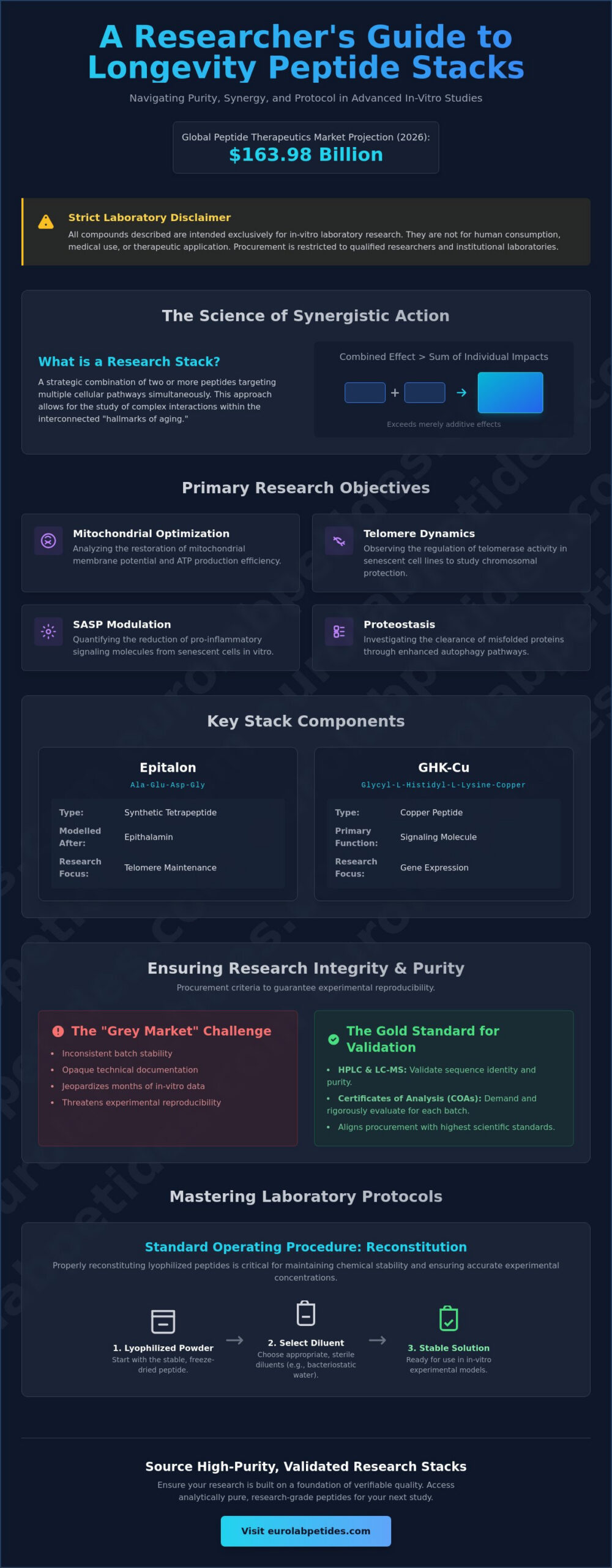
Longevity research stacks are defined as the strategic combination of two or more peptide sequences engineered to target multiple cellular pathways simultaneously. This methodology moves beyond the analysis of isolated compounds to address the interconnected “hallmarks of aging” within a single experimental framework. While individual peptides may influence specific biomarkers, the rationale for synergy lies in the ability to address concurrent mechanisms like telomere maintenance, mitochondrial respiration, and cellular senescence. When institutions choose to buy longevity research peptide stack configurations, they are typically prioritizing the ability to observe these complex interactions in longitudinal in-vitro studies. By referencing the scientific definition of peptides, researchers can better understand how these short chains of amino acids function as signaling molecules to modulate biological processes at the molecular level.
Strict Laboratory Disclaimer: All materials described in this guide are intended exclusively for in-vitro laboratory research. These compounds are not for human consumption, medical use, or therapeutic application. Procurement is restricted to qualified researchers and institutional laboratories that adhere to standardized safety and ethical protocols.
Molecular Mechanisms of Anti-Aging Synergy
Anti-aging synergy in a laboratory setting refers to a biological response where the combined effect of peptides exceeds the sum of their individual impacts. This is not merely an additive effect. By targeting the mechanistic target of rapamycin (mTOR) alongside 5′ adenosine monophosphate-activated protein kinase (AMPK), researchers can observe the complex interplay of nutrient sensing and proteostasis. Stacks are frequently utilized to investigate genomic instability and epigenetic alterations. For example, combining a telomerase activator with a mitochondrial-derived peptide allows for the simultaneous study of chromosomal protection and ATP production efficiency. This multi-level intervention is essential for quantifying the impact of combined peptide application in sophisticated laboratory models.
Common Research Objectives for Longevity Stacking
The primary objective for utilizing a longevity research stack is often the investigation of cellular rejuvenation and tissue repair mechanisms. Researchers aim to understand how specific combinations can mitigate oxidative stress and arrest the progression of mitochondrial decay. Another critical area of inquiry involves the Senescence-Associated Secretory Phenotype (SASP). Stacks are designed to analyze the impact of peptides on cellular senescence, specifically looking for the reduction of pro-inflammatory signaling molecules. These studies provide the empirical data necessary to map the biochemical pathways involved in cellular aging. When researchers buy longevity research peptide stack assets, they gain the tools required to conduct comprehensive inquiries into the following areas:
- Mitochondrial Optimization: Analyzing the restoration of the mitochondrial membrane potential.
- Telomere Dynamics: Observing the regulation of telomerase activity in senescent cell lines.
- SASP Modulation: Quantifying the secretion of inflammatory cytokines in vitro.
- Proteostasis: Investigating the clearance of misfolded proteins through enhanced autophagy pathways.
Key Components of a Comprehensive Longevity Research Stack
Precision in longitudinal studies requires a rigorous selection of peptide sequences that demonstrate high structural integrity and verifiable sequence identity. When investigators choose to buy longevity research peptide stack assets, they are selecting a multi-component system designed to analyze divergent but overlapping biological aging markers. These stacks typically integrate tetrapeptides, mitochondrial-derived sequences, and regenerative signaling molecules to provide a holistic view of cellular degradation and repair. Professional laboratories can access these high-purity components through the Longevity Research Stack provided by EuroLab Peptides, which ensures standardized concentrations for experimental consistency.
Epitalon and Telomere Research
Epitalon (Epithalon) is a synthetic tetrapeptide (Ala-Glu-Asp-Gly) modeled after epithalamin, a natural peptide produced in the pineal gland. Its primary research application involves the induction of telomerase activity in human somatic cells, which facilitates the study of telomere elongation and the potential extension of the Hayflick limit in cell cultures. By reversing the shortening of telomeres, researchers can investigate the postponement of replicative senescence. Detailed molecular data regarding its synthesis and biochemical properties is available in the Epitalon peptide profile.
Mitochondrial and Metabolic Peptides
MOTS-c, a 16-amino acid mitochondrial-derived peptide, is utilized to investigate the regulation of glucose metabolism and insulin sensitivity in-vitro. It acts as a metabolic-mimetic, making it a critical component for studying cellular energy homeostasis and exercise-mimetic effects at the molecular level. SS-31 (Elamipretide) is often included in these frameworks to study the stabilization of cardiolipin in the mitochondrial inner membrane, which is essential for maintaining the electron transport chain’s efficiency. Given the risks associated with unverified sourcing, Evaluating Research Peptide Purity and Safety is a prerequisite for any laboratory protocol involving these compounds. The decision to buy longevity research peptide stack configurations is often driven by the need for a standardized baseline in these comparative metabolic studies.
Regenerative Peptides in Longevity Models
GHK-Cu is a tripeptide-copper complex recognized for its genomic effects on skin remodeling and the up-regulation of antioxidant enzyme activity. Research indicates it can modulate the expression of over 4,000 human genes, shifting them toward a more youthful state. In tissue repair models, BPC-157 is frequently paired with GHK-Cu to analyze cytoprotection and angiogenesis. For a comprehensive analysis of its regenerative potential in-vitro, researchers should consult the BPC-157 technical guide. Additionally, Thymosin Alpha-1 is integrated into these models to analyze the mitigation of immune senescence, focusing on T-cell maturation and cellular defense mechanisms in aging cellular environments.
Evaluating Analytical Purity: Quality Benchmarks for Sourcing Research Stacks
Analytical integrity is the foundational requirement for any longitudinal in-vitro study. When a laboratory intends to buy longevity research peptide stack assets, the primary objective is to secure compounds that meet or exceed a 99% purity threshold. High-Performance Liquid Chromatography (HPLC) is employed as the primary quantitative method to verify this purity percentage by separating the target peptide from synthesis by-products. This is complemented by Liquid Chromatography-Mass Spectrometry (LC-MS), which confirms the molecular mass and sequence identity. Without these dual validations, the chemical identity of the stack remains speculative, and experimental outcomes cannot be verified.
The proliferation of “grey market” vendors introduces substantial experimental risks, including the presence of Trifluoroacetic acid (TFA) residue and incorrect peptide concentrations. TFA is often used as a counter-ion during the synthesis process, but excessive levels can induce unintended cytotoxicity in cell cultures, effectively skewing research results. Third-party testing serves as a non-negotiable standard in the professional community. It provides the external validation required for reproducible science, ensuring that the biochemical profile of the stack matches the technical specifications provided by the manufacturer.
Interpreting Certificates of Analysis (COA)
A Certificate of Analysis (COA) must be evaluated with technical scrutiny rather than passive acceptance. Researchers should analyze the HPLC chromatogram for sharp, symmetrical purity peaks. Significant baseline noise or the presence of secondary peaks indicates the existence of truncated sequences, deleted amino acids, or residual solvents. For a deeper understanding of these procurement protocols and the metrics of chemical validation, consult the institutional guide on how to buy research peptides. Identifying these contaminants early prevents the degradation of experimental data and protects the integrity of the laboratory’s longitudinal models.
Regional Manufacturing and Compliance
European-based peptide synthesis offers distinct advantages in logistical control and regulatory adherence. By maintaining a localized supply chain, institutions ensure that every longevity research peptide stack is produced under strict quality management systems that comply with regional chemical distribution standards. This commitment to manufacturing excellence reinforces moral consistency and ethical sourcing. It provides a transparent chain of custody from synthesis to laboratory delivery, which is essential for researchers who require absolute security in their supply chain. Standardized manufacturing protocols in Europe minimize batch-to-batch variability, a critical factor when conducting complex studies involving multiple peptide interactions.
Laboratory Protocols: Reconstitution and Storage of Peptide Stacks
Standard Operating Procedures (SOP) are mandatory for maintaining the structural integrity of complex peptide matrices. When a lab chooses to buy longevity research peptide stack assets, the transition from a lyophilized state to a liquid medium requires meticulous attention to solubility profiles. Solubility dictates the diluent choice. Bacteriostatic water, containing 0.9% benzyl alcohol, is typically preferred for multi-dose laboratory applications because it effectively inhibits microbial growth over extended periods. Sterile saline is a viable alternative; however, it lacks antimicrobial properties and may alter the osmotic pressure of the solution. It’s essential that researchers verify the specific solubility requirements for each peptide within the stack to avoid precipitation or incomplete dissolution.
Precision Reconstitution Techniques
Reconstitution is a critical phase where chemical degradation is most likely to occur. Researchers must calculate exact molar concentrations to ensure synergistic effects are accurately measured in-vitro. Utilizing a peptide reconstitution calculator is recommended to eliminate manual calculation errors during this delicate process. Stability is also influenced by environmental variables. Peptides are highly sensitive to light exposure and pH fluctuations. Rapid changes in these factors can lead to deamidation or oxidation, which compromises the 99% purity benchmark required for high-stakes research. Standardized protocols ensure that when you buy longevity research peptide stack components, the resulting data remains untainted by handling errors.
Long-Term Storage for Research Continuity
Long-term stability depends on rigorous temperature control. Lyophilized powders should be stored at -20°C or -80°C to mitigate the risk of hydrolysis. Once reconstituted, the degradation rate increases significantly, and shelf-life is reduced to days or weeks. Aliquoting the solution into single-use vials is a standard best practice. This avoids repeated freeze-thaw cycles, which can mechanically shear the peptide bonds and reduce potency. Monitoring shelf-life and potency over the course of an extended study is necessary for research continuity. Don’t assume stability remains constant; instead, implement a schedule for regular analytical verification.
Preventing cross-contamination is paramount in multi-peptide environments. Dedicated laboratory equipment and sterile environments are required for each specific stack configuration. Any residue from previous reconstitution cycles can introduce unwanted biochemical variables that invalidate experimental results. For laboratories requiring high-purity assets and technical documentation, the Longevity & Vitality Research catalog provides validated stacks that meet these rigorous handling standards.
EuroLab Peptides: Sourcing High-Purity Longevity Research Stacks in 2026
EuroLab Peptides operates with a clinical commitment to analytical excellence, ensuring that every compound distributed meets the rigorous demands of the specialized scientific community. When investigators intend to buy longevity research peptide stack configurations, they require empirical validation rather than anecdotal assurance. Our 2026 Longevity Research Stack represents a validated combination of Epitalon, GHK-Cu, and MOTS-c, specifically engineered for institutions conducting multi-pathway cellular inquiries. Every batch undergoes multi-level quality control, prioritizing the structural integrity of the lyophilized matrix from synthesis to laboratory delivery.
Logistics are managed within a strictly controlled European framework, ensuring cold-chain integrity and rapid delivery to prevent thermal degradation during transit. This regional focus eliminates the uncertainties often associated with global “grey market” procurement, where batch stability is frequently compromised. Access to third-party testing data is a non-negotiable standard for EuroLab Peptides. This transparency allows researchers to verify the sequence identity and purity of their reagents before commencing experimental protocols, which is a prerequisite for reproducible science.
Why Researchers Choose EuroLab
EuroLab provides direct access to technical support and comprehensive scientific documentation for all its assets. Batch-specific HPLC and LC-MS reports accompany every order, confirming that each vial meets the target purity threshold of >99%. By maintaining a specialized focus on research-grade peptides, the brand serves as a reliable partner for professional inquiry. This focus ensures that laboratory results are based on verified chemical baselines rather than inconsistent or contaminated reagents, which often plague lower-tier suppliers.
Procurement and Institutional Support
The procurement process is streamlined to accommodate the specific needs of research institutions and private laboratories. Bulk procurement options are available for long-term longitudinal studies, ensuring that researchers can secure a single batch for the duration of a project to minimize inter-batch variability. This logistical consistency is vital for maintaining the integrity of multi-year in-vitro models. It’s understood that experimental accuracy depends on the quality of the starting material. Qualified investigators are invited to review our Longevity Research Stack specifications today to ensure their laboratory procurement aligns with the highest analytical standards in the industry.
Advancing Analytical Precision in 2026 Longevity Studies
The transition toward multi-pathway cellular analysis necessitates a shift in procurement standards. Experimental reproducibility in-vitro is contingent upon the structural integrity of the chemical reagents utilized. As detailed in this guide; the biochemical rationale for synergy is only as robust as the analytical purity of the underlying compounds. Verification through third-party HPLC and LC-MS analysis remains the definitive standard for identifying sequence accuracy and eliminating synthesis by-products. By adhering to rigorous SOPs for reconstitution and storage, researchers can effectively mitigate the risk of deamidation and maintain the long-term stability of their models.
Institutions that intend to buy longevity research peptide stack assets must prioritize vendors that offer batch-specific transparency and secure European-based logistics. EuroLab Peptides provides strictly research-grade quality control and external validation for every batch produced. Accessing these high-stakes tools allows for a higher degree of precision in longitudinal inquiries. View the EuroLab Longevity Research Stack and Technical Specifications to align your laboratory procurement with the highest industry benchmarks. We look forward to supporting your next phase of scientific discovery.
Frequently Asked Questions
What is a longevity research peptide stack?
A longevity research stack is a strategic combination of two or more synthetic peptide sequences designed to target multiple cellular aging pathways simultaneously. These configurations allow researchers to analyze the interplay between different biological mechanisms, such as telomerase activation and mitochondrial respiration, within a single in-vitro model. These products are intended strictly for laboratory inquiry and are not for human consumption.
Why should peptides be stacked for longevity research instead of used individually?
Stacking is utilized to observe synergistic biological effects that cannot be captured through the study of isolated compounds. Cellular aging is a multi-faceted process involving genomic instability, epigenetic alterations, and proteostatic stress. By using a combined approach, laboratories can more accurately model the complex interactions occurring within aging cellular environments, providing a more comprehensive data set for longitudinal studies.
How do I verify the purity of a longevity peptide stack?
Purity verification requires the analysis of High-Performance Liquid Chromatography (HPLC) and Liquid Chromatography-Mass Spectrometry (LC-MS) reports. When you buy longevity research peptide stack assets, every batch must be accompanied by these documents to confirm a purity threshold of at least 99%. These reports ensure the sequence identity is accurate and that the sample is free from truncated sequences or residual synthesis solvents.
What are the common peptides included in a longevity stack?
Standard stacks frequently incorporate Epitalon for its role in telomerase induction research and GHK-Cu for investigating gene expression and tissue remodeling. Mitochondrial-derived peptides like MOTS-c are also common components, as they allow for the study of metabolic homeostasis and cellular energy signaling. These sequences are selected based on their documented ability to modulate specific hallmarks of aging in laboratory settings.
Are longevity peptide stacks legal for laboratory research in Europe?
Peptide stacks are legal for procurement and use within European laboratories when they are designated for “Research Use Only” (RUO). These compounds are classified as laboratory chemicals and are subject to regional regulatory standards governing the distribution of synthetic peptides. It’s the responsibility of the purchasing institution to ensure that all research protocols comply with localized legal and ethical guidelines.
How should I store a multi-peptide longevity stack for maximum stability?
Lyophilized peptide stacks should be stored at temperatures of -20°C or -80°C to minimize the risk of hydrolysis and structural degradation. Once the stack is reconstituted into a liquid medium, it becomes significantly more sensitive to thermal fluctuations and light. Standard laboratory practice involves aliquoting the solution into single-use vials to prevent repeated freeze-thaw cycles, which can shear the peptide bonds and reduce potency.
Can I customize a peptide stack for my specific research model?
Customization is often a requirement for specialized in-vitro studies that target unique biochemical markers. Professional suppliers allow researchers to buy longevity research peptide stack configurations tailored to specific molar concentrations or sequence combinations. This flexibility is essential for laboratories that need to adjust experimental variables to match their specific research objectives or tissue models.
What diluent is best for reconstituting a longevity research stack?
Bacteriostatic water is the standard diluent for most multi-component stacks because the 0.9% benzyl alcohol content effectively inhibits microbial growth. While sterile saline is sometimes used, it lacks these antimicrobial properties and may alter the osmotic pressure of the solution. The choice of diluent should always be cross-referenced with the solubility profile of each peptide sequence within the stack to ensure complete dissolution.
