

The absolute reliability of a tissue regeneration model is fundamentally dependent on the chemical stability of the peptide sequence, yet many laboratory outcomes are compromised by subpar reagent purity. You likely recognize the frustration of inconsistent results and the absence of standardized stability data when investigating bpc-157 for tissue regeneration studies. These variables introduce unnecessary noise into sensitive data sets, complicating the objective validation of complex repair pathways. While the FDA currently classifies BPC-157 as a Category 2 substance for compounding due to identified safety risks, its utility in strictly controlled laboratory research remains a focal point for understanding regenerative mechanisms.
This technical review establishes a rigorous framework for understanding BPC-157’s dual-action influence on VEGF expression and collagen deposition within controlled in-vitro environments. By prioritizing empirical data over anecdotal claims, we provide a comprehensive analysis of the peptide’s systemic stability and its role in accelerating angiogenic processes. You’ll find a detailed examination of validated handling protocols and the technical specifications required to maintain research-grade excellence in specialized biochemical inquiries. This analysis serves as a definitive guide for professionals seeking to navigate the complex landscape of peptide-driven tissue repair with absolute precision and verifiable metrics.
Key Takeaways
- Identify the primary molecular mechanisms, specifically the upregulation of Vascular Endothelial Growth Factor (VEGF) and Nitric Oxide (NO) pathways, involved in regenerative biochemical models.
- Evaluate the quantitative impact of bpc-157 for tissue regeneration studies, focusing on accelerated tendon-to-bone healing and skeletal muscle recovery metrics.
- Review technical protocols for the reconstitution of lyophilized peptides to ensure sequence stability and maintain standardized laboratory environments.
- Analyze stability data comparing bacteriostatic water and saline solvents to optimize the chemical integrity of BPC-157 during in-vitro analysis.
- Implement rigorous quality assurance criteria for interpreting third-party Certificates of Analysis to ensure empirical reproducibility in high-stakes research.
The Role of BPC-157 in Tissue Regeneration: A Biochemical Overview
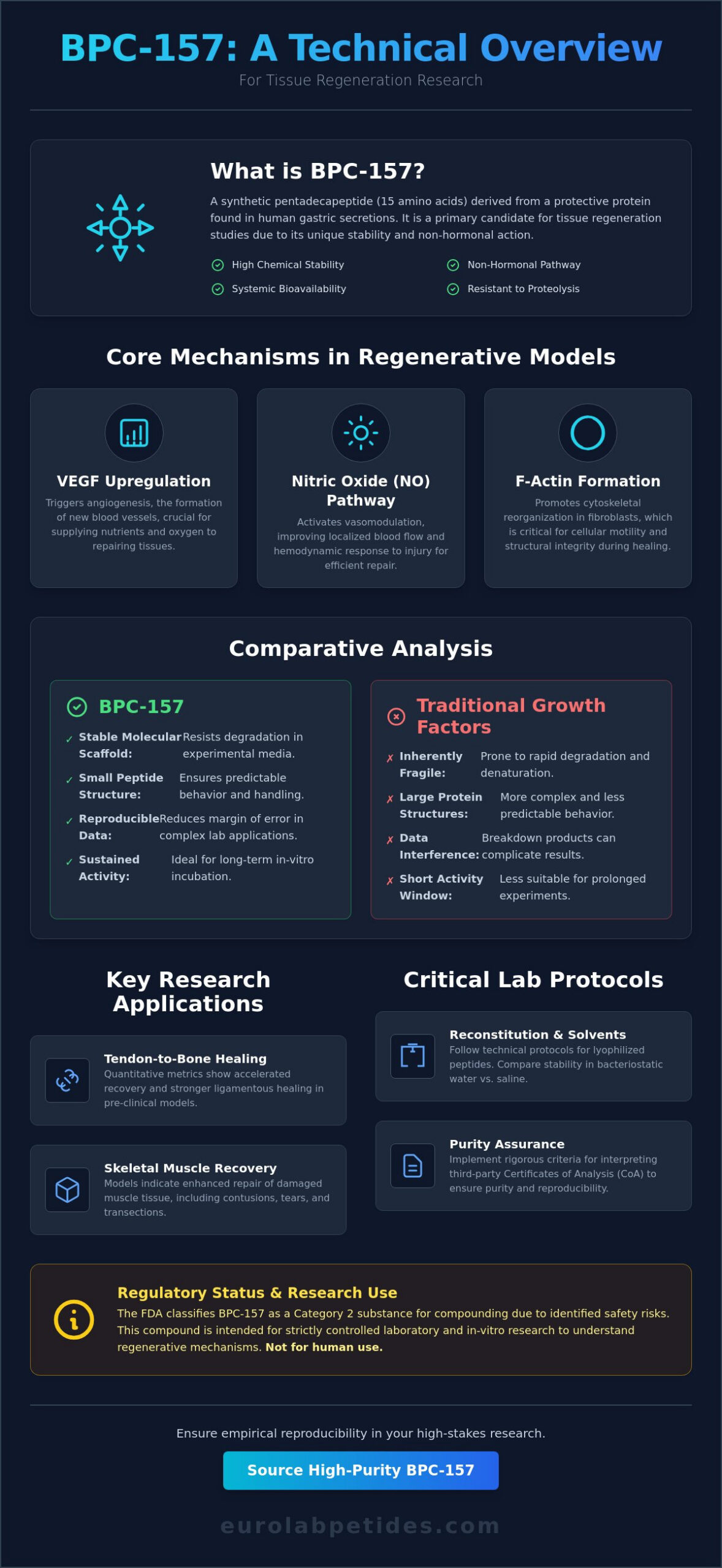
Body Protection Compound 157 (BPC-157) is a synthetic pentadecapeptide derived from a protective protein found in human gastric secretions. It is defined by its specific 15-amino acid sequence and was originally isolated for its role in mucosal integrity. This BPC-157 Overview provides the necessary historical context regarding its discovery and subsequent classification as a stable gastric pentadecapeptide. Unlike many endogenous proteins that are inherently fragile, this compound exhibits high levels of stability in the presence of digestive enzymes. This characteristic catalyzed a significant shift in research focus, moving from localized gastric protection to its current status as a primary candidate for bpc-157 for tissue regeneration studies.
The biochemical mechanism of BPC-157 is distinct from traditional anabolic agents because it doesn’t rely on hormonal or steroidal pathways to influence cellular behavior. Instead, experimental models indicate it operates through the direct modulation of healing cascades and the activation of specific signaling pathways. This objective, non-hormonal profile is essential for researchers who require isolated variables in their study designs. Its transition to a systemic regenerative tool is supported by its ability to remain bioavailable across diverse laboratory conditions, ensuring that the compound reaches target tissues without premature degradation.
Molecular Structure and Sequence Stability
The precise sequence of BPC-157 is Gly-Glu-Pro-Pro-Pro-Gly-Lys-Pro-Ala-Asp-Asp-Ala-Gly-Leu-Val. This specific arrangement is engineered for high-stakes precision; it confers a significant resistance to proteolysis that exceeds the stability of most linear peptides. In laboratory settings, this resistance is critical. It allows for sustained activity in various experimental media where other signaling molecules might fail or denature. In-vitro models benefit from this stability because it ensures the compound doesn’t lose its conformation during long-term incubation periods. Standardized testing protocols frequently cite this resilience as a non-negotiable metric for achieving reproducible data in bpc-157 for tissue regeneration studies.
BPC-157 vs. Traditional Growth Factors
Traditional regenerative research often utilizes large proteins such as Platelet-Derived Growth Factor (PDGF) or Transforming Growth Factor-beta (TGF-beta). While these factors are effective, they are notoriously fragile and prone to rapid degradation. Peptides are increasingly central to regenerative biochemistry due to their predictable behavior and ease of handling. BPC-157 offers a technical advantage over larger protein structures by providing a more stable molecular scaffold. This stability reduces the margin of error in complex laboratory applications, allowing for more accurate observations of cellular repair pathways without the interference of protein breakdown products.
Molecular Mechanisms of BPC-157 in Regenerative Models
The molecular efficacy of BPC-157 is characterized by the simultaneous modulation of several distinct biochemical pathways. Central to this process is the upregulation of Vascular Endothelial Growth Factor (VEGF), which serves as a primary driver for angiogenesis in experimental environments. This activity is complemented by the activation of the Nitric Oxide (NO) pathway, facilitating essential vasomodulation and improving the localized hemodynamic response to injury. Unlike isolated growth factors, the coordinated influence of BPC-157 mechanisms in tissue repair ensures a more robust regenerative outcome by addressing both blood flow and structural cell recruitment. These synergistic effects are foundational for the use of bpc-157 for tissue regeneration studies where multiple repair variables must be controlled.
Beyond vascular responses, BPC-157 influences the structural integrity of cells by promoting F-actin formation within fibroblasts and endothelial cells. This cytoskeletal reorganization is critical for cellular motility and the physical contraction of wound margins in laboratory models. Additionally, the peptide modulates growth hormone receptor expression. This doesn’t increase systemic growth hormone levels but rather sensitizes the target cells to existing signals, facilitating more efficient cellular migration to the site of damage. Researchers focused on Tissue Repair & Recovery Research often prioritize these metrics to validate the peptide’s systemic influence across various cell lines.
Angiogenesis and Endothelial Cell Migration
The formation of new blood vessels is a complex, multi-stage process that’s significantly accelerated by BPC-157. In damaged tissue zones, the peptide triggers the migration of endothelial cells, which then organize into functional capillaries. This process is vital for the development of granulation tissue, providing the nutrient-rich foundation required for secondary repair phases. Laboratory observations demonstrate that bpc-157 for tissue regeneration studies is particularly effective in overcoming impaired healing conditions, such as those found in compromised or ischemic research environments where traditional signaling is often blunted.
Collagen Synthesis and Fibroblast Function
Structural recovery in laboratory models is largely driven by the peptide’s impact on collagen dynamics. It specifically influences the production and ratio of Collagen Type I and Type III, which are the primary components of the extracellular matrix (ECM). BPC-157 facilitates the recruitment of fibroblasts to the injury site, where they begin the synthesis of these collagenous proteins. The resulting ECM organization is characterized by improved tensile strength and a more ordered fiber arrangement compared to untreated control groups. This systematic organization of the matrix is a verifiable metric of the peptide’s ability to restore functional tissue architecture in a laboratory setting.
Evaluating BPC-157 Across Specialized Tissue Repair Studies
BPC-157 exhibits a broad efficacy profile across diverse tissue types, extending beyond basic cutaneous wound repair models. In the context of bpc-157 for tissue regeneration studies, the focus often shifts to the specific anatomical challenges found in musculoskeletal, neurological, and osteogenic systems. A comprehensive review of BPC-157 for musculoskeletal healing emphasizes its capacity to facilitate repair in environments where natural vascularity is limited, such as dense connective tissues. By providing a stable molecular signal, the peptide ensures that regenerative cascades remain active in complex, multi-tissue injury environments that typically resist standard interventions.
The versatility of this pentadecapeptide allows researchers to observe systemic effects across various cell lines. While previous sections detailed the molecular pathways like VEGF and NO, this section analyzes the macroscopic outcomes within specialized laboratory models. Whether investigating the reattachment of a tendon to a bone or the regrowth of an axon, the peptide’s role remains consistent: it acts as a catalyst for structural reorganization and functional restoration. These applications provide a rigorous testing ground for validating the peptide’s potential in high-stakes biochemical research.
Musculoskeletal Applications: Tendon and Muscle
Tendon and ligament repair research represents one of the most documented applications of BPC-157. Studies focusing on the tendon-to-bone healing interface demonstrate accelerated attachment through enhanced fibroblast outgrowth and migration. In models involving transected muscles, BPC-157 facilitates the restoration of functional tension while minimizing the formation of non-contractile fibrotic tissue. Researchers frequently evaluate these outcomes against other regenerative tools like TB-500 to establish comparative benchmarks for musculoskeletal recovery research. This data is essential for optimizing experimental stacks designed to address crush injuries or systemic muscle trauma.
Nerve and Bone Regeneration Research
Neurological regeneration studies highlight the peptide’s neuroprotective effects, particularly in peripheral nerve repair and spinal cord injury models. Observations indicate that BPC-157 supports axonal regrowth, which is a critical metric for restoring signal transmission in damaged neural pathways. Simultaneously, its osteogenic potential is analyzed through its interaction with Bone Morphogenetic Proteins (BMP). In bone fracture models, the peptide facilitates faster callus formation and mineral density increases. These findings are particularly relevant for bpc-157 for tissue regeneration studies involving complex injuries where bone and soft tissue must heal concurrently to achieve a successful experimental outcome.
Methodological Considerations for BPC-157 Research
The technical precision of bpc-157 for tissue regeneration studies relies heavily on standardized methodological protocols. Inconsistent reconstitution or improper solvent selection can lead to peptide degradation, introducing confounding variables into the experimental data. To ensure empirical accuracy, the transition from a lyophilized state to an active aqueous solution must be executed with meticulous attention to chemical stability metrics. This process begins with a precise calculation of the required concentration, typically measured in micrograms per milliliter, to match the specific requirements of the in-vitro or in-vivo model being utilized. Every step of the handling process is designed to preserve the molecular integrity of the pentadecapeptide sequence.
Reconstitution and Stability Protocols
Reconstitution is performed by introducing the diluent slowly along the side of the glass vial to prevent peptide shear, which occurs if the liquid is injected directly onto the lyophilized powder. Vigorous agitation is avoided; instead, a gentle swirling motion is employed until the solute is completely dissolved. While BPC-157 exhibits inherent stability, research indicates that bacteriostatic water is often preferred over standard saline for multi-use laboratory vials because of its antimicrobial properties and specific osmotic profile. The structural stability of BPC-157 is optimally preserved in solutions maintained within a pH range of 6.0 to 8.0. Refrigeration at 2 to 8 degrees Celsius is mandatory for reconstituted peptides to minimize thermal degradation, as room temperature exposure beyond 24 hours can significantly compromise molecular integrity and biological activity.
Handling Lyophilized Research Chemicals
Long-term storage of lyophilized BPC-157 requires a controlled environment protected from UV light and moisture. Vials are ideally stored at -20 degrees Celsius to maintain a stable shelf life of up to 24 months, provided the seal remains intact. Before any experimental application, the identity and purity of the reagent are verified through High-Performance Liquid Chromatography (HPLC) and Mass Spectrometry (MS). These analytical reports provide a verifiable metric of quality, confirming a purity level of at least 99% to meet the rigorous demands of professional inquiry. It’s critical that the peptide remains in a desiccated state until the exact moment of use to prevent hydrolysis, which can alter the peptide’s chemical properties.
Achieving reproducible results in complex regenerative models requires access to reagents that have undergone extensive external validation. Researchers can secure high-purity research materials that adhere to these technical specifications, ensuring that the chemical synthesis meets the necessary benchmarks for bpc-157 for tissue regeneration studies. These protocols establish a foundation of objective, standardized excellence for any laboratory investigating regenerative pathways. By adhering to these strict research-only standards, the integrity of the scientific inquiry is maintained throughout the study duration.
Sourcing High-Purity BPC-157 for Precision Laboratory Analysis
Scientific reproducibility is fundamentally contingent upon the chemical purity of the reagents utilized. In the context of bpc-157 for tissue regeneration studies, even minor contaminants can skew molecular signaling data or interfere with the monitoring of VEGF expression pathways. The selection of a reagent supplier is therefore a critical component of the experimental design rather than a mere procurement task. Establishing a reliable supply chain ensures that the biochemical properties of the pentadecapeptide remain consistent across multiple study phases, preventing the introduction of confounding variables. Professional researchers prioritize suppliers that provide verifiable metrics of quality through exhaustive analytical documentation.
The integrity of a laboratory model depends on the stability of the compound being tested. When impurities are present, they may induce non-specific cellular responses that compromise the objective validation of regenerative cascades. This risk is particularly acute in studies involving sensitive cell lines or complex in-vitro environments. By securing high-purity materials, the focus of the inquiry remains strictly on the peptide’s influence on tissue repair pathways, ensuring that the results are a true reflection of the experimental variables.
Quality Assurance and Third-Party Testing
Peptide batches must undergo a rigorous, multi-level quality protocol to ensure they meet the demands of professional inquiry. High-Performance Liquid Chromatography (HPLC) is employed to determine the exact purity level, while Mass Spectrometry (MS) is used to confirm the molecular weight and sequence identity. For high-stakes bpc-157 for tissue regeneration studies, a purity threshold of 98% or higher is considered a non-negotiable standard. Certificates of Analysis (COAs) from independent, third-party laboratories provide the necessary external validation. These reports allow researchers to interpret HPLC chromatograms and confirm the absence of truncated sequences or residual solvents before beginning any laboratory application.
Logistics and Reliability for European Researchers
The European research landscape requires a sophisticated approach to regulatory compliance and localized distribution. When laboratories buy research peptides in Europe, they must prioritize suppliers that maintain strict cold-chain integrity throughout the shipping process. This prevents thermal degradation of the lyophilized product during transit, ensuring that the peptide arrives with its molecular conformation intact. EuroLab Peptides adheres to these regional standards, providing a shorthand for reliability in a market often characterized by variable quality. By emphasizing regional manufacturing excellence and transparent testing, the brand supports the rigorous demands of the specialized scientific community. Researchers can Source research-grade BPC-157 from EuroLab Peptides to ensure their materials meet the highest benchmarks for analytical precision and moral consistency in chemical synthesis.
Advancing Precision in Regenerative Biochemical Research
Integrating the molecular insights of BPC-157 into standardized laboratory protocols allows for a deeper understanding of angiogenic and collagenous repair pathways. Technical analysis confirms that the efficacy of bpc-157 for tissue regeneration studies is intrinsically linked to the maintenance of sequence stability and rigorous solvent selection. By adhering to established reconstitution and storage metrics, researchers can isolate cellular variables with high-stakes precision and ensure that structural reorganization in experimental models is documented with absolute accuracy. This methodical approach is essential for validating the peptide’s influence across musculoskeletal and neurological cell lines.
Achieving empirical reproducibility requires reagents that meet the most stringent analytical benchmarks. EuroLab Peptides provides chemicals that are third-party lab tested to ensure >99% purity, specifically specialized for in-vitro research and development applications. Our secure European shipping and logistics infrastructure guarantees the chemical integrity of your materials from the point of synthesis to laboratory delivery. This commitment to transparency and objective data supports the rigorous demands of the specialized scientific community. Order Research-Grade BPC-157 for Your Laboratory Studies and secure the technical foundation necessary for your next phase of professional inquiry.
Frequently Asked Questions
Is BPC-157 stable at room temperature for research purposes?
Lyophilized BPC-157 maintains structural integrity at room temperature for brief intervals during transport, but long-term stability requires temperature-controlled environments. Analytical data suggests that the peptide should be stored at -20°C for extended preservation in a desiccated state. Once reconstituted, the molecule becomes significantly more susceptible to thermal degradation. Standard laboratory practice dictates that room temperature exposure of liquid solutions shouldn’t exceed 24 hours to ensure empirical accuracy.
What is the recommended reconstitution solvent for BPC-157 in-vitro studies?
Bacteriostatic water is the primary solvent utilized for multi-use laboratory vials due to its antimicrobial properties and pH-stabilizing effects. Sterile 0.9% sodium chloride (saline) is an alternative for single-use in-vitro models where antimicrobial preservatives might interfere with sensitive cell lines. The choice of solvent depends on the specific requirements of the bpc-157 for tissue regeneration studies being conducted. Maintaining a consistent solvent profile is essential for data reproducibility.
How does BPC-157 differ from TB-500 in tissue regeneration models?
BPC-157 is a 15-amino acid pentadecapeptide that primarily modulates the VEGF and Nitric Oxide pathways to facilitate repair. In contrast, TB-500 is a synthetic fragment of Thymosin Beta-4 that focuses on actin-sequestering mechanisms to promote cellular migration. While both are used in tissue repair research, BPC-157 is characterized by superior gastric stability and a broader influence on the tendon-to-bone interface. Researchers often distinguish these compounds based on their specific molecular targets within the extracellular matrix.
Can BPC-157 be used in combination with other peptides in a research stack?
Combinatorial applications are frequently explored in specialized research stacks to analyze synergistic effects on multifaceted tissue injuries. For instance, the Muscle Research Stack often integrates BPC-157 with other signaling molecules to observe the concurrent restoration of vascularity and structural proteins. These combinations allow for a more comprehensive evaluation of regenerative cascades in complex laboratory models. Every component in a research stack must be verified for individual purity to prevent confounding chemical interactions.
What are the common purity standards for BPC-157 research chemicals?
Professional-grade BPC-157 must adhere to a minimum purity threshold of 98% as verified by High-Performance Liquid Chromatography (HPLC). High-stakes bpc-157 for tissue regeneration studies often require purity levels exceeding 99% to eliminate the risk of truncated sequences or residual synthesis solvents. This level of precision is confirmed through Mass Spectrometry (MS) data provided in the Certificate of Analysis. Absolute purity is a non-negotiable metric for ensuring that observed cellular responses are attributable solely to the target peptide.
What happens if BPC-157 is exposed to UV light in a laboratory setting?
Exposure to ultraviolet (UV) light triggers photodegradation, which can lead to the cleavage of specific peptide bonds within the pentadecapeptide sequence. This structural alteration renders the compound biologically inactive and compromises the validity of the experimental data. Vials are typically manufactured with amber glass or stored in light-protective containers to mitigate this risk. Standard operating procedures in analytical laboratories mandate that peptide handling occurs in environments with minimized UV exposure to preserve molecular conformation.
How long can reconstituted BPC-157 be stored in a refrigerator?
Reconstituted BPC-157 maintains its functional integrity for approximately 7 to 14 days when stored in a refrigerated environment at 2 to 8 degrees Celsius. Beyond this window, the risk of hydrolysis and gradual degradation of the peptide sequence increases significantly. For studies requiring longer durations, aliquoting and freezing the solution at -20°C is a common strategy to prevent repeated freeze-thaw cycles. Precise documentation of the reconstitution date is a requirement for maintaining standardized laboratory conditions.
Is BPC-157 intended for human clinical use in 2026?
BPC-157 is strictly classified as a research chemical and isn’t approved by the FDA for human consumption, medical use, or as a dietary supplement. As of May 2026, it remains designated as a Category 2 substance for compounding, indicating significant safety risks. While a Phase 2 clinical trial for hamstring muscle strain is currently recruiting, the lack of comprehensive human safety data restricts its application to in-vitro and animal research models. It’s illegal to market this compound for human therapeutic purposes.
