
The 2026 biochemical landscape dictates that the margin for analytical error has reached a definitive zero. You likely recognize that the primary obstacle when you seek to buy research peptides Europe isn’t just availability, but the verifiable integrity of the compound itself. Unreliable purity levels and the persistent risk of customs seizures for non-EU shipments frequently compromise the continuity of longitudinal studies. This guide acknowledges that for the serious researcher, quality isn’t a subjective preference; it’s a quantifiable metric required for data reproducibility.
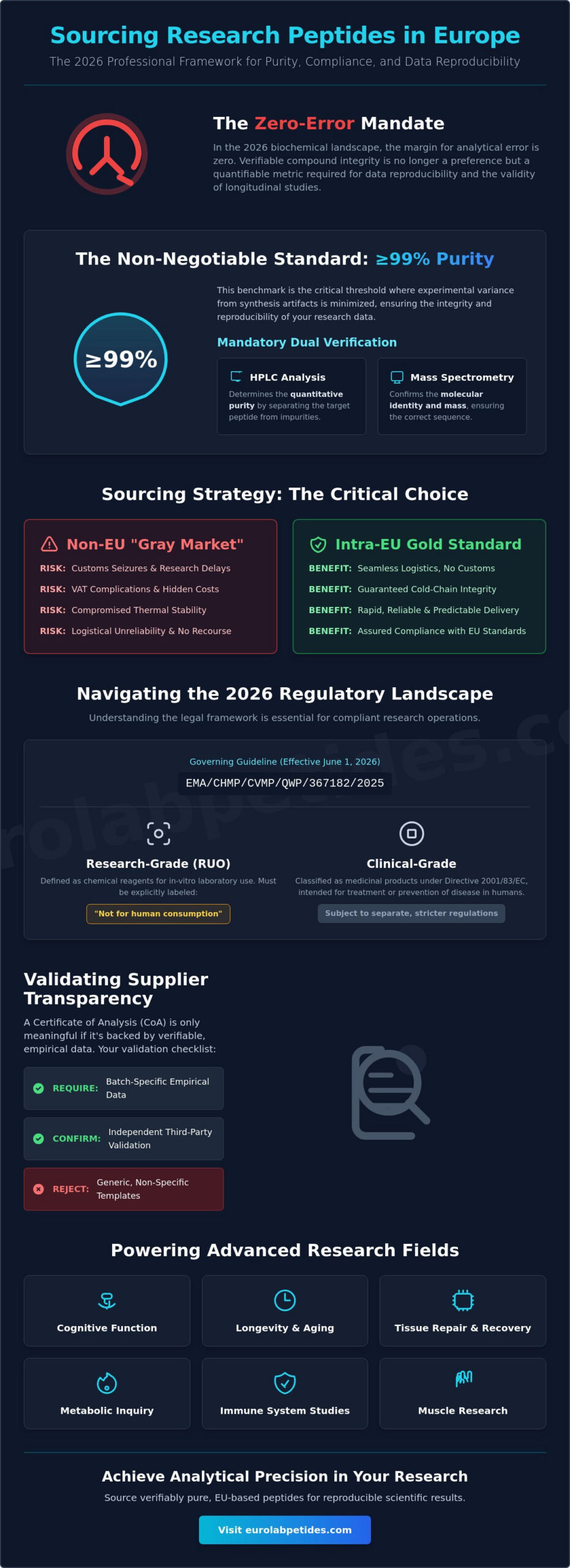
This technical guide provides a professional framework for evaluating peptide purity through the lens of the EMA/CHMP/CVMP/QWP/367182/2025 guideline, which took effect on June 1, 2026. You’ll gain the specific criteria needed to secure 99%+ pure materials, including the rigorous interpretation of batch-specific HPLC and Mass Spectrometry data. We’ll examine the shift toward regional procurement standards that ensure seamless, EU-to-EU logistics without the interference of international customs. This overview establishes a proof-first methodology for sourcing high-stakes research tools, from cognitive function compounds to recovery and tissue repair sequences.
Key Takeaways
- Establish a 99%+ purity benchmark as a non-negotiable requirement for data reproducibility, verified through concurrent HPLC and Mass Spectrometry analysis.
- Navigate the 2026 EMA regulatory landscape by distinguishing between clinical-grade pharmaceuticals and research-grade chemicals intended for laboratory use.
- Optimize procurement workflows to buy research peptides Europe via intra-EU logistics, effectively eliminating customs inspections and ensuring cold-chain integrity.
- Develop an analytical framework to validate Certificates of Analysis (CoA), ensuring that every batch is supported by third-party empirical data rather than generic templates.
- Align research objectives with high-precision sequences and stacks designed for longevity, cognitive function, and advanced metabolic inquiry.
The Landscape of Peptide Research Procurement in Europe
The European peptide therapeutics market is projected to reach a valuation of USD 17.67 billion in 2026. This expansion reflects a broader shift toward high-precision in-vitro models in longevity, metabolic, and cognitive function research. As the industry matures, the methodology used to buy research peptides Europe has evolved from simple procurement to a rigorous technical vetting process. Researchers now operate within a landscape where the EMA/CHMP/CVMP/QWP/367182/2025 guideline, effective as of June 1, 2026, has elevated the expectations for impurity control and manufacturing characterization across the continent.
A primary distinction must be maintained between clinical-grade pharmaceuticals and research-grade chemicals. Under Directive 2001/83/EC, research peptides aren’t classified as medicinal products because they aren’t intended for the treatment or prevention of disease in humans. Instead, they’re defined as chemical reagents for laboratory use. This classification requires that materials are explicitly labeled as “not for human consumption.” Maintaining this legal and technical boundary is essential for the continued operation of European research facilities. High-purity compounds are the foundation of reproducible data; without ≥99% purity, experimental results in tissue repair or immune system studies are often compromised by unidentified peptide impurities.
Modern European facilities rely on advanced chemical peptide synthesis to meet these demands. Solid-Phase Peptide Synthesis (SPPS) remains the dominant technique, as it allows for the efficient production of complex sequences with high crude purity. This technical precision ensures that the molecular identity of each batch is consistent with the theoretical sequence.
Defining Research-Grade Standards
The “Research Use Only” (RUO) designation dictates the operational framework for laboratories. It’s a standard that ensures the material is suitable for biochemical assays and specialized research stacks. For those seeking a fundamental technical overview of these molecular chains, our comprehensive guide on what are peptides provides the necessary biochemical context. Standardization in 2026 focuses on the elimination of synthesis artifacts and residual solvents, which can interfere with cellular response in muscle research or metabolic studies. Regional manufacturing within the EU adheres to these strict chemical standards, ensuring that RUO materials meet the high-stakes demands of the scientific community.
The Necessity of Regional EU Sourcing
Procuring materials within the European Economic Area (EEA) has become the gold standard for logistical reliability. Sourcing from non-EU “gray market” suppliers introduces significant risks, including customs seizures and VAT complications that can stall research for weeks. Intra-EU shipments bypass these hurdles, moving freely within the single market. Regional sourcing also addresses the critical issue of thermal stability. Many sensitive sequences used in longevity research require strict temperature control. Shorter transit times within Europe reduce the window for product degradation, ensuring that the lyophilized powder maintains its secondary structure until it reaches the laboratory. This proximity allows for a level of quality assurance that international shipping cannot provide.
Decoding Quality Metrics: Purity, Identity, and Stability
The pursuit of empirical reliability begins with the verification of chemical purity when you buy research peptides Europe. For the professional investigator, the decision to buy research peptides Europe hinges on the supplier’s ability to demonstrate a purity level of ≥99%. This benchmark isn’t an arbitrary figure; it represents the threshold where experimental variance from synthesis artifacts is minimized. Materials that fail to meet this standard introduce exogenous variables that can interfere with sensitive signaling pathways, particularly in cognitive function research where baseline precision is critical.
Quality is assessed through two distinct but complementary analytical techniques. High-Performance Liquid Chromatography (HPLC) is utilized to determine the quantitative purity by separating the target peptide from truncated sequences. While HPLC provides the percentage of the main peak, Liquid Chromatography-Mass Spectrometry (LC-MS) is required to confirm the molecular identity. This dual-validation process ensures that the synthesized material matches the theoretical molecular weight exactly. Adherence to USP Peptide Reference Standards provides the necessary framework for these quality control measures, ensuring that reagents meet international expectations for analytical precision.
Analytical Methodologies Explained
HPLC analysis identifies the presence of deleted peptides that may have occurred during the coupling phase of synthesis. These impurities, if not removed, can act as competitive inhibitors in receptor-binding assays. LC-MS subsequently verifies the molecular weight, providing a definitive fingerprint of the compound. For instance, the detailed analysis found in our BPC-157 technical profile illustrates how these metrics are applied to a specific pentadecapeptide sequence to ensure its identity.
The presence of residual Trifluoroacetic acid (TFA) or heavy metals can significantly compromise experimental integrity. TFA is frequently used as a cleavage agent during synthesis; however, its retention in the final product can alter the pH of the research environment, leading to unintended cellular responses. Rigorous purification protocols are employed to reduce these contaminants to negligible levels, which is vital when conducting recovery, muscle tissue, and inflammation research. Researchers focusing on metabolic inquiry often utilize a pre-formulated Longevity Research Stack to ensure consistent baseline data across multiple trials.
Lyophilization and Long-Term Stability
Lyophilization is the removal of solvent through sublimation under vacuum. This technique is the industry standard for maintaining the long-term stability of research peptides. By removing moisture, the peptide’s secondary structure is protected from degradation pathways such as hydrolysis or deamidation. Lyophilized powders are significantly more stable than peptides in solution, which are prone to rapid aggregation and oxidation. To maintain these 2026-level stability benchmarks, materials should be stored at -20°C to ensure the continuity of longitudinal data.
Evaluating Supplier Transparency and Third-Party Validation
The decision to buy research peptides Europe necessitates a robust verification protocol that extends beyond surface-level marketing claims. In the 2026 research environment, a legitimate Certificate of Analysis (CoA) serves as the primary instrument of accountability. It isn’t merely a document; it’s a technical record that must be scrutinized for structural integrity. A valid report must include the testing laboratory’s full credentials, a unique report identifier, and a timestamp that aligns with the synthesis date. If a supplier provides “representative” testing—using a single analytical report to cover multiple synthesis batches—the data’s relevance to your specific vial is effectively neutralized.
Independent, accredited third-party laboratories play a vital role in the current market by providing an objective buffer between the manufacturer and the end-user. These facilities utilize standardized protocols to ensure that the material’s purity and identity are verified without bias. When you buy research peptides Europe, the presence of an unredacted, third-party report is the only way to confirm that the 99%+ purity benchmark is a verifiable reality rather than a projected figure. This transparency is especially critical for complex formulations like the Advanced Metabolic Stack, where the interaction of multiple sequences requires absolute baseline purity to ensure experimental accuracy.
Audit Framework for Research Suppliers
Verification requires a systematic check of several key data points. Every analytical report should feature a verifiable signature from the lab technician and a batch number that matches the physical product label. Discrepancies between these numbers often indicate a failure in the chain of custody or the use of outdated results. For a deeper analysis of these requirements, see our 2026 guide on how to buy research peptides. Establishing this audit trail ensures that the materials used in cognitive research or immune system studies meet the rigorous demands of modern biochemistry.
Red Flags in the Peptide Industry
Identification of deceptive practices is essential for maintaining laboratory standards. Redacted company names or anonymized lab reports are significant indicators of non-compliance. These redactions prevent researchers from contacting the lab to verify the report’s authenticity. Pricing that deviates significantly from the industry average for high-purity synthesis should also be viewed with skepticism. The cost of reagents and the labor involved in multi-stage purification for sequences like SLU-PP-332 are fixed variables. If a supplier’s price is suspiciously low, it’s likely that the material contains synthesis artifacts or hasn’t undergone the necessary purification steps. A lack of transparency regarding the synthesis methodology or the origin of the reagents is a final indicator that the supplier may not adhere to European manufacturing standards.
Logistics and Compliance for European Research Facilities
The logistical framework within the European Union is designed to facilitate the rapid movement of chemical reagents between member states. When investigators buy research peptides Europe, the primary advantage is the elimination of the border formalities that typically delay non-EU shipments. Intra-EU transit bypasses the intensive customs inspections that often result in prolonged exposure to ambient temperatures or package seizures. This streamlined movement ensures that VAT complications are resolved at the point of origin, simplifying the procurement process for institutional and private research settings alike.
Legal compliance in 2026 remains centered on the “Research Use Only” (RUO) designation. Adhering to these protocols is a requirement for maintaining the standing of a research facility. Documentation must be meticulously maintained, especially when sourcing materials for high-stakes studies such as immune system research or tissue repair. These records provide a transparent chain of custody, confirming that the materials aren’t intended for human consumption or therapeutic application. This objective approach to compliance protects the integrity of the specialized community and ensures that all activities remain within the established biochemical regulatory framework.
The EU-to-EU Advantage
The speed of delivery is a critical variable in maintaining the analytical integrity of a compound. A 2-5 day transit window is standard for intra-European logistics, which is essential for sequences that are sensitive to environmental stressors. Professional labeling and discreet packaging are utilized to ensure that laboratory deliveries are handled with the necessary level of technical respect. Navigating the regional regulations within the Schengen area is significantly more efficient than managing international imports, allowing labs to buy research peptides Europe with a high degree of predictability. For facilities requiring consistent access to verified sequences, you can browse our catalog of high-purity research materials to ensure your study remains on schedule.
Handling and Reconstitution Protocols
Proper laboratory handling is required to prevent peptide shear stress, which can occur if the lyophilized powder or reconstituted solution is subjected to aggressive mechanical agitation. Reconstitution should be performed in a sterile environment using bacteriostatic water to maintain the stability of the peptide chain. Rapid temperature fluctuations must be avoided during transit because they can trigger premature degradation of the peptide’s structural bonds, potentially compromising the validity of in-vitro assays. Once the material has reached the facility, it’s recommended to aliquot the solution into single-use vials to minimize the number of freeze-thaw cycles, thereby preserving the secondary structure for recovery, muscle tissue, and inflammation research.
EuroLab Peptides: The Standard for Analytical Precision
EuroLab Peptides operates as a specialized partner within the chemical synthesis space, prioritizing empirical validation over marketing claims. When laboratories choose to buy research peptides Europe, the EuroLab Multi-Level Quality Protocol provides a framework for absolute certainty. This protocol is defined by the integration of in-house synthesis with mandatory independent third-party verification. While many suppliers view 99% purity as a maximum target, it’s maintained as the non-negotiable baseline for every sequence produced. This commitment supports the rigorous demands of European innovation by ensuring that every milligram of material is characterized with high-stakes precision.
The methodology employed by EuroLab reflects a meticulous approach to chemical identity and stability. By maintaining regional manufacturing standards, the brand ensures that the specialized community has access to elite tools for serious professional inquiry. This reliability is essential for researchers conducting complex studies in longevity and vitality or immune system research, where the chemical integrity of the reagent is the most critical variable. The personality of the brand is built on radical honesty, where every claim is supported by the objective data of technical analysis rather than anecdotal evidence.
Our 2026 Quality Assurance Framework
Analytical transparency is achieved through the provision of batch-specific HPLC and MS reports for every product. These documents aren’t merely supplementary; they’re the verifiable metric of quality that researchers require for data reproducibility. For example, the precision standards applied to our Ipamorelin research profile demonstrate how multi-stage purification is used to achieve superior purity levels. Beyond purity, strict bioburden and endotoxin screening protocols are applied to eliminate biological contaminants that could skew in-vitro results. This level of characterization ensures that the materials are suitable for advanced metabolic stacks and cognitive research.
Procurement and Institutional Support
The procurement process is designed to respect the time and intelligence of the professional user. Streamlined ordering systems are provided for European research institutions and private laboratories, ensuring that high-purity materials are accessible without logistical friction. Every transaction is handled through secure, encrypted channels to ensure the integrity of institutional data. By focusing on regional regulatory compliance and localized logistics, EuroLab serves as a shorthand for reliability in the global market. To secure high-purity materials for your next study, explore our full catalog of research-grade peptides.
Advancing Scientific Reproducibility through Analytical Excellence
Reproducible results in longevity and metabolic research depend on the absolute purity of the chemical reagents utilized. The 2026 regulatory environment has established that a 99%+ purity benchmark, validated through batch-specific third-party testing, is no longer optional for serious investigators. By prioritizing analytical transparency and regional logistics, laboratories can eliminate the variables that often compromise longitudinal data. This framework ensures that every sequence, from cognitive function compounds to recovery stacks, meets the rigorous demands of modern biochemistry.
When you buy research peptides Europe, the choice of a regional partner ensures that your materials are protected from the degradation risks of international transit and the unpredictability of customs inspections. This technical framework provides a pathway to high-stakes precision in every assay. EuroLab Peptides remains dedicated to providing these elite tools through a proof-first methodology that respects the user’s scientific intelligence. Secure your research materials with EuroLab Peptides and benefit from 99%+ purity guarantees, batch-specific HPLC/MS reports, and fast, customs-free shipping across the EU. Secure Your Research Materials with EuroLab Peptides to maintain the integrity of your next laboratory inquiry.
Frequently Asked Questions
Is it legal to buy research peptides in Europe for laboratory use?
Purchasing peptides for in-vitro laboratory research is legal across the European Union under current 2026 regulatory frameworks. These substances are classified as chemical reagents and fall outside the scope of Directive 2001/83/EC, provided they aren’t presented for treating or preventing disease. All materials must be explicitly labeled for “Research Use Only” and aren’t intended for human consumption or therapeutic applications.
What is the difference between 98% and 99% purity in research?
A 1% variance in purity represents a significant volume of unidentified synthesis artifacts and truncated sequences. In a 98% pure sample, 20mg of every gram consists of unknown impurities that can act as competitive inhibitors in receptor-binding assays. Achieving a ≥99% benchmark is required to ensure that experimental observations are the result of the target peptide rather than exogenous chemical variables.
How are peptides shipped to ensure they don’t degrade in transit?
Peptides are shipped in a lyophilized state within temperature-controlled, discreet packaging to maintain structural integrity. Intra-EU logistics are utilized to ensure a 2-5 day transit window, which minimizes the duration of exposure to ambient environmental stressors. This rapid delivery sequence is essential for preserving the secondary structure of sensitive compounds used in longevity and cognitive research.
Do you provide a Certificate of Analysis (CoA) for every batch?
Analytical transparency is maintained through the provision of batch-specific Certificates of Analysis for every product. This documentation includes both HPLC and Mass Spectrometry data to verify quantitative purity and molecular identity. It’s a non-negotiable standard for those who buy research peptides Europe to ensure that the material’s chemical fingerprint matches the theoretical sequence exactly.
What are the storage requirements for lyophilized peptides?
Lyophilized peptides should be stored at -20°C for long-term stability to prevent degradation pathways such as hydrolysis or deamidation. While short-term transit at ambient temperatures is acceptable for freeze-dried powders, the vials should be moved to a stable, sub-zero environment upon arrival. Once reconstituted, the solution’s stability decreases significantly, requiring storage at 4°C and use within a limited timeframe.
Can research peptides be shipped across all EU member states?
Shipment of research-grade chemicals is conducted across all EU member states within the Schengen area and the broader single market. This intra-EU movement eliminates the customs inspections and VAT complications that frequently delay international orders. When you buy research peptides Europe from a regional supplier, the logistical path is streamlined to ensure the continuity of institutional and private research projects.
Why is third-party testing more reliable than in-house testing?
Third-party validation provides an objective, unbiased verification of a compound’s purity and molecular weight. It eliminates the potential conflict of interest inherent in in-house reporting and ensures that the data is generated by an independent, accredited facility. This external audit is a critical requirement for establishing a persona of radical honesty and accountability in the chemical synthesis space.
What should I do if a peptide vial arrives with a different appearance than expected?
Variations in the appearance of the lyophilized “cake,” such as a solid plug versus a more granular powder, are common results of the freeze-drying process and don’t indicate a loss of integrity. These differences are often caused by the specific buffers or salts used during the final stabilization phase. The most reliable method for confirming quality is to cross-reference the batch number with the provided HPLC and MS data.
