

Peptide safety is a dual-purpose discipline that protects the researcher from exposure while simultaneously shielding the peptide from biochemical degradation. In a professional landscape where independent testing has revealed purity levels as low as 1.7% in unregulated samples, the integrity of your data depends on rigorous lab safety protocols for handling peptides. You’re likely aware that even minor handling errors can lead to the aerosolization of lyophilized powders or cross-contamination that invalidates months of multi-peptide research.
This guide establishes a technical framework for the safe handling, storage, and disposal of research-grade peptides to ensure absolute laboratory security and experimental integrity. We’ll provide a methodical overview of the July 2026 OSHA Hazard Communication Standard updates and the risk management shifts introduced by ISO 10993-1:2025. By following these validated procedures, you’ll maximize reproducibility and maintain the 99% purity benchmarks required for sophisticated biochemical inquiry while ensuring full compliance with the latest EPA and FDA regulatory mandates.
Key Takeaways
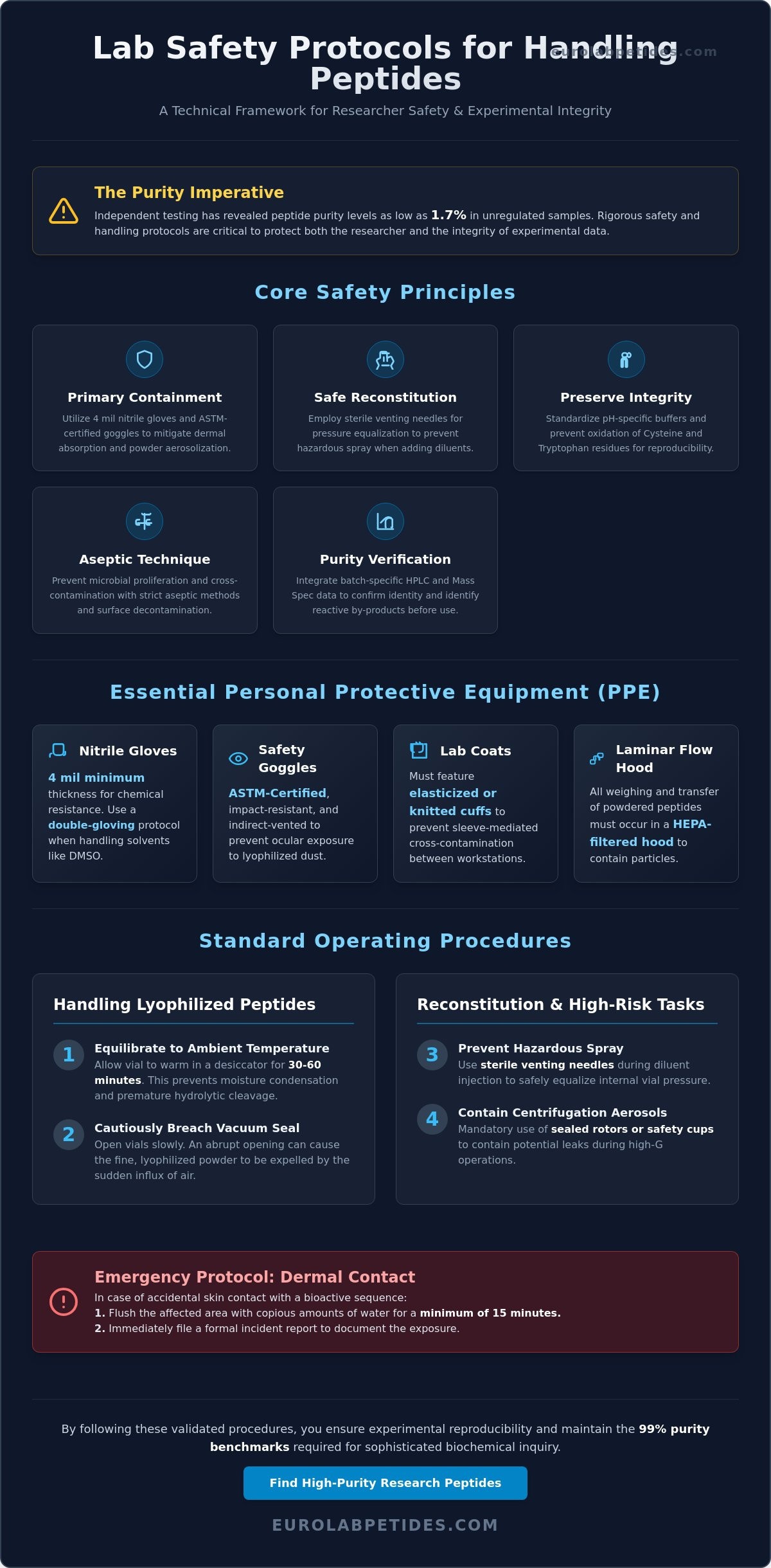
- Establish rigorous primary containment using 4 mil nitrile gloves and ASTM-certified goggles to mitigate the risks of dermal absorption and lyophilized powder aerosolization.
- Implement standardized lab safety protocols for handling peptides during reconstitution, specifically utilizing sterile venting needles for pressure equalization to prevent hazardous spray.
- Preserve the structural integrity and experimental reproducibility of delicate sequences by standardizing pH-specific buffer systems and oxidation prevention for Cysteine and Tryptophan residues.
- Mitigate microbial proliferation and cross-contamination through strict aseptic techniques and the application of sequence-specific decontaminants to all laboratory surfaces.
- Integrate batch-specific HPLC and Mass Spectrometry data into your safety framework to confirm peptide identity and identify potentially reactive synthesis by-products before laboratory use.
Essential PPE and Primary Containment for Peptide Laboratories
Effective lab safety protocols for handling peptides begin with the selection of personal protective equipment (PPE) that accounts for the specific physical properties of synthetic chains. Adherence to General Laboratory Safety Standards serves as the foundational layer, but peptide-specific hazards demand higher technical specifications. Unlike bulk chemicals, research peptides are frequently handled in micro-gram quantities where even minor exposure through inhalation or dermal contact can lead to significant biological interference.
Primary containment and individual protection are prioritized through the following requirements:
- Nitrile Gloves (4 mil minimum): Standardization on a minimum 4 mil thickness is required to ensure sufficient chemical resistance without compromising the tactile precision needed for micro-pipetting.
- ASTM-Certified Safety Goggles: The use of impact-resistant, indirect-vented goggles is mandatory to mitigate the risk of ocular exposure to lyophilized dust during vial opening.
- Elasticized Cuffs: Lab coats must feature elasticized or knitted cuffs. This design prevents sleeve-mediated cross-contamination when moving between workstations and ensures that the wrist area remains covered during reach-in procedures.
- HEPA-Filtered Laminar Flow Hoods: All weighing and transfer operations involving powdered research peptides must occur within a certified laminar flow hood to prevent the uncontrolled migration of particles into the laboratory atmosphere.
Respiratory Protection and Aerosol Mitigation
Lyophilized peptides are exceptionally light and prone to aerosolization upon the slightest disturbance of ambient air. When primary containment is unavailable or during large-scale transfers, the use of N95 or P100 respirators is required to prevent inhalation of bioactive dust. Laboratory personnel must minimize ambient air currents by closing nearby vents and restricting movement in the weighing area. High-speed centrifugation of peptide-solvent solutions also presents an aerosolization risk; therefore, the use of sealed rotors or safety cups is mandatory to contain potential leaks during high-G operations.
Dermal Protection and Solvent Compatibility
Selection of glove material must be guided by the solvents used for reconstitution. While nitrile provides excellent protection against many reagents, its permeability increases significantly when exposed to solvents like DMSO or Acetonitrile. Lab safety protocols for handling peptides in these mediums require a double-gloving protocol, especially when preparing high-concentration stock solutions. This provides a secondary barrier and allows for the immediate removal of the outer layer if a spill occurs. In the event of accidental dermal contact with a bioactive sequence, the affected area must be flushed with copious amounts of water for a minimum of 15 minutes, followed by a formal incident report to document the sequence involved.
Standard Operating Procedures for Lyophilized and Reconstituted Peptides
Standardized lab safety protocols for handling peptides must account for the transition from cryo-storage to the liquid phase. Failure to observe precise thermal and atmospheric equilibration steps often results in immediate sample degradation or the accidental release of bioactive material. Each step in the reconstitution process is a critical control point for both researcher safety and experimental validity.
Before a vial is opened, it’s mandatory to allow the lyophilized cake to reach ambient temperature within a desiccator. This process typically requires 30 to 60 minutes depending on the vial size. Opening a chilled vial in a humid environment causes instantaneous moisture condensation on the hygroscopic peptide cake. This initiates hydrolytic cleavage before the experiment begins. Once equilibrated, the vacuum seal must be breached with caution. Many research-grade vials are sealed under partial vacuum; an abrupt opening can cause the fine powder to be expelled by the sudden influx of air.
During reconstitution, the injection of a diluent increases internal vial pressure. To mitigate the risk of aerosol spray, a sterile venting needle should be inserted into the septum before the diluent is introduced. This ensures pressure equalization and protects the researcher from potential exposure. Once the liquid is added, the solution must be homogenized through gentle swivelling. High-energy vortexing is prohibited. The resulting shear forces and air-liquid interface expansion can lead to the irreversible denaturation of complex peptide structures. Successful reconstitution is verified when the solution is entirely clear and free of particulate matter or “fish-eyes” (undissolved gel-like clumps).
Handling Lyophilized Powders
Precision weighing of lyophilized powders is frequently complicated by static electricity, which can cause the material to jump from the spatula or weigh boat. The use of anti-static ionizers or grounding strips is recommended to ensure mass accuracy and containment. Because peptides are highly hygroscopic, they must be stored in desiccated environments. Exposure to atmospheric moisture during weighing should be minimized to prevent the formation of aggregates that resist subsequent dissolution.
Managing Reconstituted Solutions
Once in solution, peptides are significantly more susceptible to degradation. Researchers should implement aliquotting strategies to eliminate deleterious freeze-thaw cycles. Each aliquot should contain only the amount required for a single experimental session. Specific sequences, such as those found in an advanced metabolic stack, may exhibit extreme light sensitivity. Chromophore-containing peptides like GHK-Cu must be stored in amber vials or wrapped in foil to prevent photodegradation. Every vial must be clearly labelled with the sequence name, concentration, diluent type, and the exact date of reconstitution to ensure experimental traceability.
Chemical Stability and Preventing Experimental Degradation
Experimental integrity in peptide research is predicated on the maintenance of chemical stability. While primary containment addresses physical safety, lab safety protocols for handling peptides must also incorporate biochemical stabilization to prevent the formation of degradation products. These impurities don’t just compromise data; they can introduce unexpected reactive species into the laboratory environment. Ensuring that a peptide remains at the 99% purity benchmark requires a deep understanding of its specific sequence vulnerabilities.
Oxidation represents a primary pathway for structural failure, particularly in sequences containing Cysteine, Methionine, or Tryptophan residues. Cysteine-rich peptides are prone to the formation of non-native disulfide bonds, which irreversibly alter the molecule’s tertiary structure. To mitigate this, researchers should utilize degassed buffers and consider the addition of reducing agents or antioxidants when the experimental design allows. Similarly, the presence of proteolytic enzymes, which are ubiquitous in non-sterile environments, can lead to rapid peptide cleavage. Establishing a protease-free workstation is a non-negotiable standard for maintaining the longevity of research samples.
Temperature fluctuations exert a profound influence on the secondary and tertiary structures of complex chains. While short-term exposure to ambient temperatures during benchwork may seem negligible, cumulative thermal stress induces unfolding and aggregation. This is particularly critical for larger, folded peptides where functionality is tied to specific conformational states. Consistent monitoring of laboratory temperature and the use of chilled blocks during preparation are essential components of a rigorous safety framework.
Hydrolysis and Deamidation Risks
Deamidation is a primary degradation pathway involving the conversion of asparagine or glutamine residues into aspartic or glutamic acid, respectively. To maximize the stability of common research stacks, solution pH should be maintained within the optimal range of 4.0 to 6.0, as alkaline conditions significantly accelerate deamidation rates. Experimental reproducibility is directly correlated with storage duration; even at -20°C, purity levels should be verified via HPLC if the sample has been stored in solution for more than 72 hours.
Photostability and Laboratory Benchwork
Photodegradation occurs when specific amino acid side chains absorb UV or visible light, leading to electronic excitation and subsequent chemical transformation. The use of amber glass vials is mandatory for the protection of light-sensitive compounds such as BPC-157. UV exposure during prolonged analytical testing can induce light-driven oxidation, which manifests as anomalous peaks in Mass Spectrometry results. This leads to the misidentification of the primary sequence. Analytical procedures should be performed in low-light conditions or with UV-shielded equipment to ensure the accuracy of the verifiable metrics provided by third-party analysis.
Contamination Mitigation and Laboratory Waste Management
Contamination mitigation within the laboratory environment is a critical determinant of experimental validity. Standardized lab safety protocols for handling peptides must address the high susceptibility of peptide-based reagents to microbial proliferation. Because synthetic chains often serve as a substrate for bacterial growth, maintaining a sterile environment is not merely a safety precaution but a requirement for data integrity. Microbial enzymes can rapidly degrade a sequence, leading to the accumulation of metabolic by-products that interfere with analytical results.
All laboratory surfaces must be decontaminated using 70% Isopropanol or sequence-specific agents before and after handling procedures. For more resilient sequences, specialized decontaminants designed to denature peptide bonds may be required. Beyond surface sterilization, researchers must implement neutralization protocols for residual peptide solutions. This typically involves adjusting the pH to a neutral range or utilizing chemical denaturants to render the sequences biologically inactive prior to institutional liquid waste disposal. This step ensures that bioactive materials don’t enter the facility’s wastewater stream in an active state.
Disposal of peptide-contaminated sharps must adhere to GHS standards. Puncture-resistant, biohazardous containers are mandatory for all needles and glass vials that have come into contact with research material. This prevents accidental needle-stick injuries that could result in unintended exposure to concentrated bioactive sequences. For researchers focused on high-integrity studies, utilizing a recovery research stack requires strict adherence to these disposal standards to maintain a safe and compliant workspace.
Aseptic Technique and Sterile Filtration
Maintaining a sterile chain of custody from initial vial opening to experimental application is non-negotiable. Reconstituted research solutions should be passed through a 0.22-micron syringe filter to ensure the removal of any potential microbial contaminants introduced during handling. It’s essential to validate the sterility of all diluents. While bacteriostatic water is standard for many in-vitro research applications, its compatibility with the specific peptide sequence must be verified to ensure the preservative doesn’t induce aggregation or chemical modification.
Regulatory Waste Compliance
Peptide waste must be categorized under regional CLP and GHS regulations for proper institutional compliance. This involves distinguishing between chemical waste and biological hazards based on the peptide’s origin and modifications. Documentation requirements for hazardous waste manifests are rigorous in professional laboratory settings; every gram of material must be accounted for from receipt to disposal. Emergency procedures for significant spills involving concentrated stock solutions require the use of absorbent spill kits and immediate containment to prevent environmental migration. Personnel must be trained in the specific SDS requirements for each sequence in the laboratory inventory.
Integrating Third-Party Purity Verification into Safety Protocols
The final pillar of rigorous lab safety protocols for handling peptides involves the integration of analytical validation into the daily safety workflow. Purity verification is often viewed solely through the lens of experimental success, yet its role in personnel protection is equally critical. Unknown impurities in a sample don’t just compromise data; they represent uncharacterized chemical hazards. Synthesis by-products, residual solvents, or truncated sequences can exhibit unpredictable reactivity or biological activity, complicating the risk assessment for laboratory staff.
Before any vial is handled, researchers must review the batch-specific High-Performance Liquid Chromatography (HPLC) and Mass Spectrometry (MS) data. HPLC provides a verifiable metric of purity by separating the primary sequence from synthesis related impurities. Mass Spectrometry confirms the identity of the molecule by measuring its molecular weight against the theoretical mass. Discrepancies in these reports indicate a failure in the synthesis or purification process, necessitating the immediate quarantine of the material. Standardizing laboratory logs to include these batch-specific metrics ensures that safety documentation is as precise as the research itself.
Sourcing from transparent, European-based suppliers provides an additional layer of security. Regional regulatory compliance ensures that manufacturing processes adhere to strict safety standards, reducing the likelihood of encountering hazardous residual solvents like Trifluoroacetic acid (TFA) or Acetonitrile in concentrations that exceed safety thresholds. Using compounds that haven’t undergone third-party validation introduces an unacceptable variable into the laboratory environment. It’s a risk that professional facilities can’t afford to take.
Interpreting Analytical Reports
Interpreting a Certificate of Analysis (COA) requires a methodical analysis of HPLC chromatograms to ensure baseline stability. Significant impurity peaks indicate a lack of chemical homogeneity, which can lead to inconsistent results in longevity research. Confirming molecular weight via MS is the only definitive way to ensure sequence accuracy before starting any procedure. These findings should always be correlated with the rigorous standards established in our guide on how to buy research peptides to ensure that every reagent meets professional benchmarks.
EuroLab Quality Standards
EuroLab Peptides implements a multi-level quality control process where every batch undergoes independent third-party validation. This transparency is essential for high-precision in-vitro studies where the presence of even minor contaminants could skew data or pose a safety risk. Maintaining a safe laboratory environment is made possible through the use of high-purity reagents, such as verified BPC-157. By prioritizing compounds with accessible, batch-specific analytical data, laboratories can uphold the highest standards of both scientific excellence and personnel safety.
Establishing Technical Excellence in Peptide Research
Implementing rigorous lab safety protocols for handling peptides is essential for bridging the gap between theoretical sequence design and reproducible experimental outcomes. By integrating high-specification PPE with methodical reconstitution techniques and biochemical stabilization strategies, laboratories can effectively mitigate the risks of aerosolization and structural degradation. These procedures don’t just protect the researcher; they safeguard the verifiable metrics that define professional scientific inquiry.
Precision in handling must be matched by the quality of the research material itself. EuroLab Peptides provides high-purity reagents for in-vitro research and development, maintained through strict compliance with European laboratory standards. Every batch undergoes a multi-level quality control process with independent third-party validation to ensure that your data remains untainted by synthesis by-products or uncharacterized impurities. Secure your research outcomes by prioritizing precision at every stage of the handling process.
Access our full catalog of third-party tested research peptides to integrate elite tools into your next specialized study. Elevate your laboratory standards by choosing reagents that reflect the same level of rigor as your experimental protocols.
Frequently Asked Questions
What is the most critical safety precaution when handling lyophilized peptides?
The most critical safety precaution is the prevention of aerosolization during the initial breach of the vial’s vacuum seal. Lyophilized powders are exceptionally light and can easily become airborne, posing a significant inhalation risk. Implementing lab safety protocols for handling peptides that require the use of sterile venting needles for pressure equalization and conducting all powder transfers within HEPA-filtered laminar flow hoods is mandatory to maintain containment.
How should I dispose of unused peptide solutions in a research setting?
Unused peptide solutions must be neutralized and disposed of in accordance with regional GHS and CLP hazardous waste regulations. Residual bioactive material should never be flushed into standard drainage systems. Instead, solutions should be collected in puncture-resistant, biohazardous containers for institutional disposal. Utilizing chemical denaturants to render the peptide sequences biologically inactive before collection ensures that residual reagents don’t pose a risk to waste management personnel.
Is a fume hood mandatory for all peptide reconstitution procedures?
A HEPA-filtered laminar flow hood or a certified fume hood is mandatory whenever handling peptide powders or performing high-risk reconstitution steps. These primary containment systems prevent the uncontrolled migration of fine particles into the laboratory atmosphere. While simple liquid transfers of stable solutions might be conducted on a clean bench using aseptic techniques, the weighing and initial dilution of lyophilized cakes require active airflow management to ensure researcher safety.
What are the risks of cross-contamination between different research stacks?
Cross-contamination between different research stacks carries the risk of invalidating experimental data through unintended biochemical interactions. When multiple sequences are handled simultaneously, even trace amounts of one peptide can interfere with the signaling or binding assays of another. This risk is mitigated through strict adherence to workstation decontamination and the use of dedicated, sequence-specific pipetting tools and reagents to maintain the integrity of each individual study.
Can standard surgical masks provide adequate protection against peptide powders?
Standard surgical masks don’t provide adequate protection against the inhalation of fine peptide powders. Surgical masks are designed to protect the environment from the wearer’s respiratory droplets, not to filter out microscopic airborne particles. For effective respiratory protection during the handling of lyophilized cakes outside of primary containment, N95 or P100 respirators are required. These devices are specifically engineered to filter out at least 95% of airborne particulates.
How does peptide purity levels impact laboratory safety protocols?
Peptide purity levels directly influence the complexity of lab safety protocols for handling peptides because lower-purity samples often contain uncharacterized synthesis by-products. While a 99% pure reagent has a predictable safety profile, a 70% pure sample contains 30% unknown chemical hazards. These impurities may include residual solvents or reactive truncated sequences that necessitate more stringent containment and dermal protection measures than those required for highly purified compounds.
What is the correct procedure for managing a significant peptide solution spill?
Managing a significant peptide solution spill requires immediate containment using specialized absorbent kits followed by chemical neutralization. The affected area must be isolated to prevent the spread of bioactive material through foot traffic. After the liquid is absorbed, the surface should be treated with sequence-specific decontaminants or 70% Isopropanol. All cleanup materials must be treated as hazardous waste and documented in the laboratory’s formal incident log.
Are there specific storage requirements for peptides used in longevity research?
Peptides used in longevity research require desiccated cryo-storage at temperatures of -20°C or -80°C to prevent hydrolytic degradation. These sequences are often highly sensitive to thermal fluctuations and light exposure. Utilizing amber glass vials or foil wrapping is necessary to shield light-sensitive residues from photodegradation. Maintaining these strict storage parameters ensures that the peptide’s secondary and tertiary structures remain intact for high-precision in-vitro applications.
