

The biochemical stability of a synthetic peptide is not guaranteed by its certificate of analysis alone. It’s a variable dictated by the rigorous execution of laboratory protocols. Even minor deviations in thermal equilibration or mechanical agitation can trigger irreversible aggregation or hydrolysis. You’ve likely encountered the frustration of irreproducible results caused by subtle sample degradation during the preparation phase. Mastering the best practices for peptide vial handling is the only verifiable way to ensure that the structural integrity of your research material remains intact from the moment it leaves cold storage to its final application in an in-vitro assay.
This article provides a clinical standard operating procedure designed to preserve 99%+ purity and maximize the shelf-life of your chemical assets. We’ll examine the technical requirements for preventing contamination during reconstitution and the necessity of adhering to USP 1503 quality attributes for synthetic peptides. By following these evidence-based steps, you’ll eliminate handling-induced variables and secure the high-stakes precision your research demands. We’ll move through a methodical sequence of validation, from initial vial warming to the final aliquot storage, to ensure absolute security in your experimental outcomes.
Key Takeaways
- Identify the primary degradation pathways, including hydrolysis and mechanical shearing, to establish a technical foundation for sample preservation.
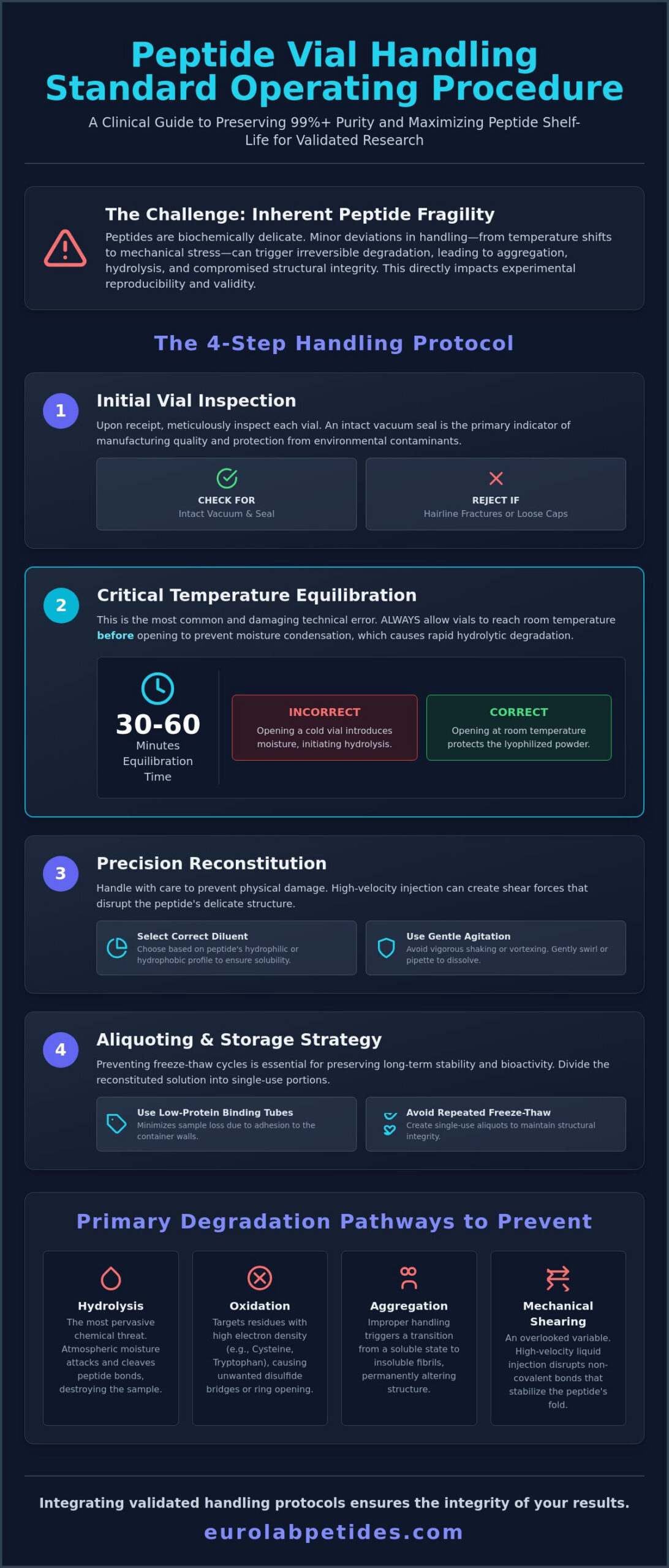
- Apply the 30-60 minute temperature equilibration rule to mitigate moisture ingress, a fundamental step in best practices for peptide vial handling.
- Optimize reconstitution efficiency by selecting diluents based on specific hydrophilic or hydrophobic profiles to ensure maximum solubility without compromising bioactivity.
- Utilize low-protein binding microcentrifuge tubes for single-use aliquots to prevent sample loss and the structural degradation caused by freeze-thaw cycles.
- Integrate validated handling protocols with high-purity analytical standards to maintain the integrity of results throughout the research lifecycle.
Understanding Peptide Fragility and Primary Degradation Pathways
Peptides are defined as short polymers of amino acids linked by covalent bonds, but their structural simplicity belies an inherent biochemical fragility. To understand what are peptides in a professional laboratory context, one must view them as delicate biomolecules whose functional efficacy is contingent upon maintaining a specific conformational state. They’re exceptionally sensitive to fluctuations in pH, thermal energy, and mechanical stress. Failure to adhere to best practices for peptide vial handling often results in the rapid degradation of these materials, rendering research data invalid. Precision in handling is not a suggestion; it’s a prerequisite for analytical accuracy.
Primary degradation occurs through several distinct pathways that compromise the sample’s purity. Hydrolysis is the most pervasive threat, particularly for lyophilized powders exposed to atmospheric moisture. When moisture enters a vial, it facilitates a nucleophilic attack on the carbonyl carbon of the peptide bond, leading to cleavage. Oxidation represents a secondary chemical threat, specifically targeting residues with high electron density. Cysteine and Tryptophan are particularly susceptible; Cysteine often forms unwanted disulfide bridges, while Tryptophan undergoes oxidative ring opening. Physical aggregation also poses a risk, where improper handling triggers the transition from a soluble monomeric state to insoluble fibrils or amorphous clumps, permanently altering the peptide’s secondary structure.
Chemical Mechanisms of Loss
Deamidation is a common spontaneous reaction where the side chain amide group of Asparagine or Glutamine is removed. This process results in a change in the peptide’s overall charge and biological activity, often dictated by the surrounding sequence and local pH environment. N-terminal degradation may also occur through diketopiperazine formation, a cyclization reaction that effectively truncates the sequence and alters its binding affinity. Hydrolysis serves as the primary chemical threat to the long-term stability of lyophilized peptide samples.
The Impact of Mechanical Shearing
Mechanical stress is a frequently overlooked variable in the laboratory. High-velocity liquid injection during reconstitution can generate significant shear forces, disrupting the delicate non-covalent interactions that stabilize a peptide’s fold. While some sequences are inherently robust, labile sequences containing proline or glycine are often more prone to structural shifts under physical duress. Maintaining strict control over these mechanical variables is essential for best practices for peptide vial handling. There is a direct, measurable correlation between the preservation of structural integrity and the reproducibility of experimental results. Without standardized physical manipulation, intra-assay variability increases, compromising the validity of in-vitro research.
Pre-Analytical Protocols: Receipt and Temperature Equilibration
Upon receipt of lyophilized peptides, the primary objective is the verification of physical integrity. Each vial must be scrutinized for hairline fractures or compromised seals that might have occurred during transit. An intact vacuum seal is a critical indicator of manufacturing excellence and environmental protection. If a vial loses its vacuum, the internal atmosphere is no longer inert, increasing the risk of premature degradation. These initial checks are foundational to best practices for peptide vial handling. Immediate triage is required to separate materials destined for immediate reconstitution from those requiring long-term archiving at sub-zero temperatures.
The most common technical error in peptide management is the premature opening of a refrigerated or frozen vial. When a cold vial is exposed to ambient laboratory air, the temperature differential causes immediate moisture condensation on the interior walls and the lyophilized cake itself. Because many peptides are hygroscopic, they rapidly absorb this moisture, initiating the hydrolytic cleavage discussed in previous sections. A strict 30 to 60 minute equilibration period is mandatory. Vials must reach room temperature before the seal is breached to ensure the internal environment remains anhydrous during the initial exposure to the atmosphere.
Mitigating Atmospheric Moisture Ingress
The physics of condensation in a vacuum-sealed environment are unforgiving. As the air inside the vial warms, any introduced water vapor transitions from a gaseous state to liquid droplets on the peptide surface. This moisture acts as a solvent for degradation. The standard operating procedure requires a gradual thermal transition. For maximum stability, vials should be placed in a desiccator during the equilibration phase. This controlled environment ensures that the external air remains dry, providing an additional layer of security against hygroscopic absorption before the reconstitution process begins.
Long-Term Archiving Standards
For materials not slated for immediate use, storage at -20°C or -80°C is necessary to preserve biochemical activity over extended durations. Laboratory freezers must be manual defrost models; frost-free units utilize temperature cycling that can inadvertently subject samples to repeated thermal fluctuations. Additionally, secondary containment is required for UV-sensitive residues. Opaque containers or amber vials protect against light-induced oxidation during storage. Understanding these rigorous storage requirements is as vital as knowing how to buy research peptides from high-stability sources. Maintaining these standards ensures that the analytical accuracy verified by third-party testing remains valid until the point of use.
Executing Precision Reconstitution and Physical Manipulation
The transition from a lyophilized state to a liquid solution is a critical juncture where the biochemical integrity of the sample is most vulnerable. Aseptic technique is mandatory to prevent microbial contamination, which can lead to enzymatic degradation of the sequence. Before the seal is breached, the vial septum must be thoroughly swabbed with 70% isopropyl alcohol. This procedure must be executed with precision to ensure no cross-contamination occurs during the introduction of the needle. Adhering to best practices for peptide vial handling during this phase ensures that the analytical purity verified at the point of manufacture is maintained throughout the experimental lifecycle.
The physical introduction of the diluent must be managed to minimize mechanical stress. High-pressure liquid injection creates shearing forces that can disrupt the delicate molecular bonds of the peptide. By utilizing the “Wall-Aimed” injection method, the diluent is directed to flow down the interior glass wall of the vial rather than striking the lyophilized cake directly. This technique allows for a gradual wetting of the material, reducing the risk of localized concentration gradients or structural denaturation. Precise physical manipulation is a non-negotiable standard for maintaining the reproducibility of in-vitro research results.
Diluent Selection and Volume Calculation
Diluent selection is dictated by the specific solubility profile of the sequence, whether it is inherently hydrophilic or hydrophobic. Sterile water or bacteriostatic water is typically utilized for basic reconstitution, though certain sequences may require the addition of dilute acetic acid or DMSO to achieve full solubility. Concentration accuracy is paramount for subsequent in-vitro dosage calculations. Researchers should consult a technical peptide reference to determine how molecular weight and sequence composition influence the required solvent volume and type. Using an incorrect diluent can lead to immediate precipitation or irreversible aggregation.
Tactical Reconstitution Steps
A methodical approach to reconstitution involves three primary steps. First, the internal pressure of the vial is equalized by injecting a volume of sterile air equal to the intended diluent volume. Second, the solvent is introduced via a slow-drip method along the interior glass wall to avoid mechanical shearing. Third, the vial is subjected to passive dissolution or extremely gentle swirling; it is never shaken. Vortexing is prohibited for most research-grade peptides because the resultant mechanical shearing forces can disrupt secondary and tertiary structures. This methodical progression ensures the sample remains stable and biologically active for the duration of the research session.
Aliquoting Strategies to Mitigate Freeze-Thaw Degradation
Reconstitution is merely the first step in a complex preservation workflow. The most significant threat to a peptide’s bioactivity in solution is the repeated transition between liquid and solid states. As water freezes, the formation of ice crystals creates localized high-concentration zones and mechanical pressures that can rupture delicate molecular structures. Adhering to best practices for peptide vial handling necessitates a “single-use” philosophy. By dividing the master solution into smaller, session-specific aliquots, the researcher ensures that each portion is subjected to only one freeze-thaw event. This protocol eliminates the cumulative structural damage that occurs when a single master vial is repeatedly accessed.
Material selection for storage containers is equally critical. Standard microcentrifuge tubes are often composed of high-binding plastics that cause significant sample loss through surface adsorption. For research applications, the use of low-protein binding (LPB) tubes is mandatory. These specialized containers are treated to minimize the non-specific binding of the peptide to the vessel walls, ensuring that the calculated concentration remains accurate. Documentation must be maintained throughout this process, with each aliquot clearly labeled to preserve the chain of custody and analytical history originating from the master vial.
Optimizing Aliquot Volume
Precision in aliquoting requires accounting for dead volume in both pipettes and storage containers. If an experimental protocol requires 100 microliters, the aliquot should be designed with a slight overfill to compensate for the liquid that inevitably adheres to the container’s geometry. Standardizing these volumes is essential for consistency in longitudinal studies where dose-response curves must be strictly maintained. Even sequences with documented stability, such as BPC-157, benefit from these rigorous aliquoting standards to ensure intra-assay reproducibility.
Storage Environment for Reconstituted Samples
Reconstituted peptides in a solution state are inherently less stable than their lyophilized counterparts. While short-term storage at 4°C is permissible for some sequences, it shouldn’t exceed 24 to 48 hours before mandatory disposal or archiving at -20°C. Monitoring for precipitation is a critical quality control step; the appearance of cloudiness or visible particulates is a definitive indicator of aggregation. For highly sensitive sequences, the addition of cryoprotectants may be necessary to inhibit crystal formation during the freezing process. To maintain 99%+ purity throughout your study, always prioritize validated research materials that meet these rigorous laboratory standards.
Integrating Handling Protocols with EuroLab Quality Standards
The EuroLab Multi-Level Quality Protocol is designed to ensure that every batch of synthetic material meets a minimum threshold of 99% purity before it’s dispatched. This benchmark is verified through rigorous High-Performance Liquid Chromatography (HPLC) and Mass Spectrometry (MS) analysis. However, the analytical accuracy established during the synthesis and testing phases is only maintained if the end-user adheres to best practices for peptide vial handling. Meticulous handling acts as the final, critical link in the quality control chain. Without it, the empirical data provided by regional manufacturing standards is compromised by environmental variables introduced in the laboratory setting. Quality is a verifiable metric that requires consistent management from production to application.
European chemical synthesis operates under stringent regulatory frameworks, including ISO 9001:2015 and the harmonized ISO 13485:2016 standards. These certifications ensure that the production environment is controlled and the resulting materials are of elite professional grade. EuroLab’s commitment to radical honesty means that every vial is accompanied by evidence of its chemical identity and purity. This transparency allows researchers to move from data to delivery with absolute security, knowing that the structural integrity of the material is guaranteed up to the point of first use. Localized logistics and regional manufacturing standards further contribute to a personality of high-end craftsmanship in the chemical synthesis space.
Verifying Purity via COA and Handling
Interpreting a Certificate of Analysis (COA) requires an understanding of how handling-induced impurities manifest on a chromatogram. For instance, Ipamorelin serves as a relevant case study for maintaining purity benchmarks in growth hormone secretagogue research. If a researcher observes secondary peaks in an HPLC report that weren’t present in the manufacturer’s validation, it typically indicates degradation from improper thermal equilibration or mechanical shearing. EuroLab provides these reports to establish an objective baseline. This allows the specialized community to verify that their best practices for peptide vial handling are successfully preserving the peptide’s biochemical profile throughout the research lifecycle.
Next Steps for Researchers
The establishment of an internal Standard Operating Procedure (SOP) is the most effective method for institutionalizing these handling standards. Researchers should begin by reviewing the latest third-party laboratory results for their current inventory to ensure all materials align with expected specifications. This methodical approach respects the high-stakes precision required for serious professional inquiry and ensures that experimental variables are minimized. To begin this process of validation, you may Review EuroLab Peptides current research inventory and COAs to confirm the analytical standards of your research assets.
Establishing Analytical Excellence Through Standardized Protocols
The transition from a lyophilized state to an active research solution represents the most significant risk to biochemical stability. By institutionalizing best practices for peptide vial handling, researchers effectively mitigate the threats of hydrolytic cleavage and mechanical shearing. These protocols ensure that the structural integrity of the sample remains intact, providing the absolute security required for high-stakes in-vitro inquiry. Meticulous thermal equilibration and the “single-use” aliquoting philosophy are not merely procedural suggestions; they’re the technical foundations of reproducible science.
Maintaining 99%+ purity requires a partnership between rigorous laboratory handling and elite manufacturing standards. EuroLab facilitates this through multi-level third-party laboratory testing and specialized European logistics designed for temperature-sensitive delivery. Every batch is verified via HPLC analysis to ensure it meets the demanding specifications of the specialized community. Secure High-Purity Research Peptides from EuroLab to anchor your next project in verifiable quality. Consistency in protocol leads to consistency in discovery.
Frequently Asked Questions
How long can lyophilized peptides be stored at room temperature during shipping?
Lyophilized peptides typically maintain their structural integrity at room temperature for approximately 14 to 28 days during transit. While short-term exposure doesn’t usually result in immediate degradation, the material should be transferred to -20°C or colder upon receipt. This ensures the 99%+ purity verified by the manufacturer remains stable throughout the research lifecycle.
Can I use a vortex mixer to speed up the reconstitution of a stubborn peptide?
Vortex mixers shouldn’t be used for the reconstitution of research-grade peptides. The high-frequency mechanical agitation generates shearing forces that disrupt non-covalent interactions, leading to irreversible aggregation. Gentle, passive dissolution or manual swirling is the only validated method for preserving the sequence’s secondary structure and ensuring reproducibility.
What is the most common sign that a peptide has degraded in its vial?
The most common physical sign of degradation is the appearance of insoluble particulates or cloudiness in a previously clear solution. In lyophilized form, a collapsed or yellowed cake suggests moisture ingress. However, significant chemical degradation like hydrolysis or deamidation can occur without visual changes, necessitating HPLC analysis for definitive validation of the sample’s purity.
Why is it necessary to allow the vial to reach room temperature before opening?
Allowing the vial to reach room temperature is essential to prevent atmospheric moisture from condensing on the peptide surface. Opening a cold vial creates a temperature differential that draws in humidity, initiating rapid hydrolytic cleavage. This step is a cornerstone of best practices for peptide vial handling and shouldn’t be bypassed if sample integrity is a priority.
How many freeze-thaw cycles can a reconstituted peptide withstand before losing bioactivity?
A reconstituted peptide shouldn’t undergo more than one freeze-thaw cycle. Repeated freezing leads to the formation of ice crystals that mechanically rupture the peptide’s structural bonds and alter its conformation. Utilizing a single-use aliquoting strategy is the only way to ensure that each sample maintains its intended bioactivity for precise in-vitro applications.
What is the difference between sterile water and bacteriostatic water for peptide handling?
Sterile water is a single-use diluent, whereas bacteriostatic water contains 0.9% benzyl alcohol as a preservative. Bacteriostatic water is utilized for multi-use vials to inhibit microbial growth, extending the shelf-life of the solution to 28 days when stored at 4°C. The choice depends on the intended duration and aseptic requirements of the experimental series.
Is it possible to re-lyophilize a peptide that has been reconstituted?
Re-lyophilizing a peptide in a standard laboratory setting is generally not recommended. The process requires specialized lyophilization equipment and precise control over vacuum and temperature parameters to avoid structural damage. Improper execution often introduces additional thermal stress and moisture, further compromising the material’s analytical purity and experimental utility.
How does light exposure affect the stability of a peptide in solution?
Light exposure, particularly in the UV spectrum, catalyzes photo-oxidation in specific amino acid residues like Tryptophan and Tyrosine. This reaction leads to the formation of reactive oxygen species and subsequent peptide bond disruption. Adhering to best practices for peptide vial handling requires the use of opaque secondary containment or amber vials for all solution-state samples.
