

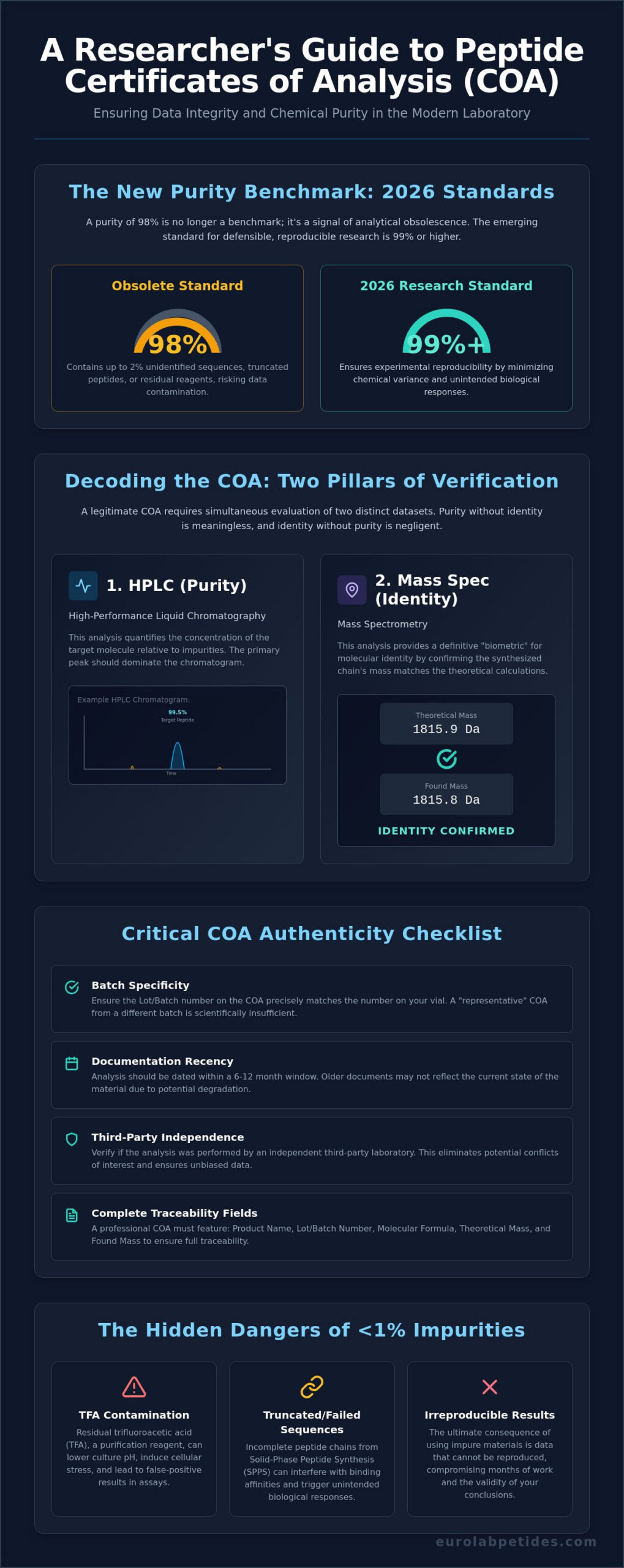
In 2026, a peptide purity of 98% is no longer the industry benchmark; it’s a signal of analytical obsolescence. For researchers, the challenge of distinguishing between high-fidelity chemical synthesis and batches compromised by trace impurities or forged documentation has never been more critical. You understand that inconsistent results across different batches often stem from a lack of rigorous verification. Mastering how to read peptide certificate of analysis reports is now a non-negotiable standard for ensuring data integrity and chemical purity in any serious laboratory setting.
This guide provides a reproducible vetting framework to interpret complex HPLC and Mass Spectrometry data with clinical precision. We’ll examine the current USP standards, specifically chapters <1503> and <503.1>, to help you verify sequence identity and quantify residual solvents. By the end of this technical analysis, you’ll possess the expertise to validate third-party laboratory independence and confirm that your research materials meet the emerging 2026 standard of 99% purity. We’ll move systematically from raw chromatogram profiles to final batch validation, ensuring your results remain reproducible and your methodology remains defensible.
Key Takeaways
- Learn how to read peptide certificate of analysis documents to confirm that batch-specific HPLC and Mass Spectrometry data align with current 2026 purity standards.
- Understand the critical distinction between High-Performance Liquid Chromatography (HPLC) for purity quantification and Mass Spectrometry (MS) for definitive sequence identity.
- Verify the authenticity of analytical reports by cross-referencing lot numbers and ensuring the documentation is dated within a 6-12 month window.
- Evaluate the impact of Solid-Phase Peptide Synthesis (SPPS) and the effective removal of residual trifluoroacetic acid (TFA) on the stability of your research materials.
- Implement a multi-level quality control protocol that utilizes third-party laboratory independence to eliminate risks associated with data contamination.
The Role of Analytical Documentation in Research Integrity
Analytical documentation serves as the primary safeguard for experimental validity. A Certificate of Analysis (COA) is a lot-specific document that details the chemical composition and purity of a specific synthesis batch. It’s not a generic specification sheet. It represents a verified snapshot of a single production run. Understanding how to read peptide certificate of analysis reports is essential for researchers who must account for every variable in a biochemical assay. Without batch-specific data, the risk of data contamination from trace impurities becomes an unquantified liability that can compromise months of laboratory work.
Chemical purity directly dictates the reliability of in-vitro observations. When a substance is less than 99% pure, the remaining 1% consists of unidentified sequences, truncated peptides, or residual reagents. These contaminants can trigger unintended biological responses or interfere with binding affinities. In modern biochemistry, high-purity peptides are defined by their ability to produce reproducible results across multiple replicates. A “representative” COA, which shows data from a previous batch rather than the current one, is scientifically insufficient. It fails to account for the inherent variability in Solid-Phase Peptide Synthesis (SPPS), where even minor fluctuations in temperature or reagent concentration can alter the final profile.
Biological Impact of Trace Impurities
Residual solvents and reagents like trifluoroacetic acid (TFA) can significantly skew cellular signaling results. TFA is often used as a counter-ion during purification, but if it’s not adequately removed, it can lower the pH of the culture medium and induce cellular stress. This stress often leads to false-positive outcomes in toxicity and longevity studies, where researchers might misattribute a biological response to the peptide itself rather than the acidic contaminant. Maintaining a 99%+ purity standard is the only way to ensure experimental reproducibility and prevent the misinterpretation of data in high-stakes research environments.
Research-Grade vs. Clinical-Grade Standards
Research peptides are synthesized strictly for laboratory development and in-vitro protocols. Because these substances are not intended for human consumption, pharmacy-grade terminology is often irrelevant for laboratory settings. Instead, professional chemical synthesis relies on ISO 9001:2015 standards to ensure quality management and technical consistency. Learning how to read peptide certificate of analysis data ensures that you can identify these rigorous manufacturing markers. While clinical-grade products focus on human safety, research-grade standards focus on analytical precision and the elimination of any chemical variance that could disrupt a controlled study.
Decoding HPLC and Mass Spectrometry Reports
High-Performance Liquid Chromatography (HPLC) remains the standard for purity quantification in synthetic biochemistry. While HPLC measures the concentration of the target molecule, Mass Spectrometry (MS) functions as the definitive biometric for molecular identity. A comprehensive understanding of how to read peptide certificate of analysis reports requires the simultaneous evaluation of both datasets. Purity without identity is scientifically meaningless, just as identity without purity is experimental negligence. Every professional COA must feature specific traceability fields: product name, lot/batch number, molecular formula, theoretical mass, and found mass. These fields ensure that the material in the vial corresponds exactly to the data on the page.
In synthetic chemistry, sequence identity refers to the verification that the synthesized chain matches the intended primary structure. This is confirmed when the analytical mass aligns with the theoretical calculations. For researchers requiring verified materials, EuroLab Peptides provides comprehensive analytical documentation for every lot to eliminate any ambiguity regarding chemical composition.
Interpreting the HPLC Chromatogram
Identifying the main product peak is the first step in how to read peptide certificate of analysis reports. The primary peak should dominate the chromatogram, typically appearing as a sharp, symmetrical spike. Any secondary peaks, often appearing as “shoulders” or minor spikes, represent impurities, truncated sequences, or residual reagents. Area % is the numerical translation of this visual data; it represents the proportion of the target peptide relative to all detected substances. Professional peak integration accounts for baseline noise to ensure that the calculated purity is an accurate reflection of the chemical reality rather than an artifact of instrument sensitivity.
Mass Spectrometry: Confirming Molecular Weight
Mass Spectrometry confirms that the synthesized material is actually the intended compound. Researchers must match the “Found” molecular weight with the “Theoretical” weight provided in the documentation. The [M+H]+ peak is the most critical signal; it represents the parent molecule plus a single proton. This verification is vital for sequences such as BPC-157, where the precise pentadecapeptide structure determines biological activity. Without MS confirmation, even a 99% pure HPLC report cannot guarantee that the substance isn’t a different peptide with similar retention properties. The MS report serves as the final proof of structural accuracy.
Critical Questions to Verify COA Authenticity
Authenticity is the cornerstone of laboratory safety and experimental validity. When researchers learn how to read peptide certificate of analysis reports, they must adopt a mindset of rigorous skepticism. A document that appears technically sound can still be analytically invalid if it doesn’t represent the specific material in your possession. Verification isn’t a formality; it’s a fundamental step in the scientific method. To ensure the integrity of your research, you must answer five critical questions before accepting any batch into your inventory.
- Does the batch number on the vial match the COA exactly? Any discrepancy in the alphanumeric string suggests a breakdown in lot traceability or the substitution of documentation from a different synthesis run.
- Is the analytical report dated within the last 6-12 months? Peptides are susceptible to degradation over time. A report exceeding this window is analytically obsolete and fails to account for potential loss of purity during storage.
- Was the testing performed by an independent, third-party laboratory? In-house testing creates an inherent conflict of interest. Only external validation provides the objective security required for high-stakes inquiry.
- Can the testing laboratory verify the report ID via their own portal? Most reputable analytical facilities provide a public-facing database where researchers can input a report ID to confirm the data hasn’t been altered.
- Does the report include the raw chromatogram data or just a summary? A summary table is insufficient. You need the visual evidence of the HPLC trace and Mass Spectrometry peaks to identify hidden impurities.
Spotting Forged or Recycled Analytical Reports
Digital manipulation is a persistent risk in the chemical supply chain. Researchers should inspect PDF documents for digital artifacts, such as inconsistent font weights or pixelation around dates and batch numbers, which suggest tampering. A significant red flag is the redaction of the testing laboratory’s name or contact information. If a supplier hides the source of their data, the data cannot be verified. Cross-referencing the batch ID with the supplier’s current inventory is a necessary step to ensure the report isn’t being “recycled” for multiple unrelated lots.
The Necessity of Third-Party Independence
In-house analysis lacks the objectivity needed for reproducible research. When you buy research peptides, transparency regarding lab partnerships is a non-negotiable metric of quality. Independent labs like MZ Biolabs or Janoshik provide a neutral layer of accountability. If you have doubts about a report’s validity, contact the analytical lab directly. Professional facilities will confirm whether a specific report ID corresponds to the data in their archives. This level of diligence ensures that your laboratory is utilizing materials that meet the highest standards of chemical synthesis.
Evaluating Synthesis Methodology and Stability Data
Synthesis methodology is the primary determinant of the final analytical profile. While the COA confirms purity, the synthesis process creates it. Solid-Phase Peptide Synthesis (SPPS) is the industry standard for producing high-fidelity sequences. However, researchers must scrutinize the removal of residual reagents, specifically trifluoroacetic acid (TFA). TFA is used during cleavage from the resin but must be exchanged for more biocompatible salts or removed entirely to prevent interference with in-vitro assays. Understanding how to read peptide certificate of analysis data involves checking for the counter-ion content, as high residual TFA can alter the osmotic environment of a cell culture and induce unintended stress responses.
The manufacturing protocol concludes with the stabilization of the peptide through lyophilization. This freeze-drying process removes water to prevent hydrolysis. Even the most pure peptide will degrade if the vial headspace isn’t managed correctly. Professional laboratories utilize vacuum sealing or nitrogen flushing to create an inert environment. Nitrogen displacement prevents the oxidation of sensitive amino acid residues, ensuring that the purity reported on the COA remains consistent during storage and transit.
Solid-Phase Peptide Synthesis (SPPS) Standards
SPPS is the gold standard for synthesizing complex peptides like Ipamorelin. High coupling efficiency, often exceeding 99% per amino acid addition, is required to prevent truncated sequences. These shortened chains appear as minor impurity peaks on an HPLC report. To reach the 2026 standard of 99% purity, multiple rounds of preparative HPLC are used to isolate the target peak. This iterative purification is what separates elite research tools from lower-tier alternatives that may contain “deletion sequences” within the final batch.
Lyophilization and Storage Protocols
Lyophilization preserves structural integrity by removing moisture through sublimation. This process prevents peptide hydrolysis, a common degradation pathway where water molecules break peptide bonds. Once lyophilized, vial headspace management becomes the final barrier against degradation. Nitrogen creates an inert atmosphere that prevents oxidation of sensitive residues like methionine or cysteine. Moisture ingress during storage leads to rapid degradation, making the quality of the vial seal as important as the purity of the powder. Researchers should evaluate a vendor’s cold-chain logistics to ensure that temperature fluctuations don’t compromise the material before it reaches the lab. For those seeking materials backed by validated synthesis protocols, you can access our validated research stacks to ensure batch-to-batch consistency and analytical transparency.
EuroLab Peptides: A Framework for Validated Procurement
EuroLab Peptides operates on a multi-level quality control protocol designed to meet the rigorous demands of the 2026 scientific community. Procurement integrity is established through the mandatory provision of batch-specific HPLC and Mass Spectrometry documentation for every unique lot number. By eliminating the reliance on “representative” reports, the brand ensures that the analytical data matches the physical material in the researcher’s laboratory. Understanding how to read peptide certificate of analysis reports becomes a straightforward process when the provider utilizes a standardized, transparent reporting format. This framework prioritizes objective metrics over subjective claims, allowing professional users to verify chemical purity and sequence identity before initiating any biochemical assays.
The logistical advantages of European-based manufacturing and distribution cannot be overstated in a field where chemical stability is paramount. Regional manufacturing ensures that synthesis occurs under strict regulatory oversight, while localized distribution reduces the transit time that often leads to peptide degradation. These manufacturing standards provide a personality of sophisticated, high-end craftsmanship in the chemical synthesis space. Researchers can audit our analytical transparency through a secure client portal, which allows for the immediate cross-referencing of batch IDs with raw chromatogram data.
Our Commitment to Radical Transparency
Our commitment to radical transparency involves the seamless integration of third-party analytical results into every product listing. Every component of our research stacks undergoes secondary validation by independent facilities to confirm that the molecular weight and purity profile align with theoretical specifications. This rigorous vetting process is essential for maintaining the integrity of in-vitro laboratory development. We don’t just provide data; we provide a verifiable audit trail. Professional users can access our secure client portal to review historical batch reports, ensuring that the materials used in longitudinal studies remain consistent across different procurement cycles.
Streamlining Research Procurement in Europe
European-based manufacturing offers significant logistical advantages for sensitive research compounds. Regional logistics minimize the duration of transit, reducing the risk of peptide degradation from temperature fluctuations or moisture ingress. This localized approach supports specialized research models, including those focused on longevity, muscle tissue, and cognitive function. By maintaining strict adherence to regional regulatory standards, EuroLab Peptides provides a reliable supply chain for the European scientific community. Researchers can efficiently source high-purity materials like the Longevity Research Stack or the Muscle Research Stack with the confidence that the cold-chain integrity has been preserved.
The final step in how to read peptide certificate of analysis documentation is the direct verification of the report ID with the testing laboratory. We encourage all researchers to audit our analytical transparency. Review our current batch reports and secure your research materials through our validated procurement framework to ensure the highest level of experimental reproducibility.
Advancing Laboratory Standards through Analytical Precision
The evolution of synthetic biochemistry in 2026 demands a shift from passive procurement to active analytical verification. Mastery of how to read peptide certificate of analysis reports allows researchers to eliminate the risks associated with batch inconsistency and trace impurities. By prioritizing lot-specific HPLC and Mass Spectrometry data, you ensure that every experimental replicate is grounded in verifiable chemical identity. Authentic documentation acts as a critical barrier against data contamination; it’s the only way to preserve the integrity of complex in-vitro models.
EuroLab Peptides remains committed to this standard of radical transparency. We provide independent third-party HPLC/MS testing on every batch to guarantee 99%+ purity for all research-grade chemicals. Our secure European-based logistics and support infrastructure further protect your materials from environmental degradation during transit. Explore our multi-level quality protocol and verified research peptides. We invite you to integrate these rigorous vetting standards into your laboratory workflow to achieve unprecedented levels of experimental precision and reproducibility.
Frequently Asked Questions
How can I verify if a Certificate of Analysis (COA) is real?
Verification is achieved by cross-referencing the report ID directly on the testing laboratory’s official portal. Reputable facilities like MZ Biolabs or Janoshik maintain public databases where researchers can input a specific alphanumeric ID to confirm the data hasn’t been altered. If a laboratory name is redacted or the ID cannot be validated through an independent source, the documentation must be considered analytically invalid.
Why is 99% purity important for in-vitro research?
High purity levels minimize the presence of truncated sequences and residual reagents that can interfere with cellular signaling. Contaminants found at lower purity levels often induce off-target biological responses or cellular stress, which can lead to false-positive results. Achieving 99%+ purity ensures that experimental observations are attributed solely to the target peptide rather than unidentified chemical artifacts.
What is the difference between TFA-salt and acetate-salt peptides?
The distinction lies in the counter-ion utilized during the final purification stage of synthesis. Trifluoroacetic acid (TFA) is the standard reagent for cleavage from the resin, but it can be cytotoxic in certain sensitive cell cultures. Acetate salts are frequently preferred for specific biological assays because they offer a more neutral pH profile and reduced toxicity compared to residual TFA concentrations.
How should I store research peptides upon arrival?
Lyophilized peptides must be stored in a climate-controlled environment, typically at -20°C for long-term stability. Protection from light and moisture is essential to prevent hydrolysis and oxidation of sensitive amino acid residues. Once a peptide is reconstituted into a solution, its stability decreases significantly; it should be utilized within a short timeframe or stored at 4°C for immediate application.
What are the red flags of a fraudulent peptide vendor?
Critical red flags include the use of “representative” COAs instead of batch-specific reports and the absence of third-party laboratory verification. Vendors who redact lab contact information or provide reports with digital artifacts, such as font inconsistencies, are likely manipulating data. Understanding how to read peptide certificate of analysis reports helps researchers identify these discrepancies before compromising their laboratory resources.
Do EuroLab Peptides provide batch-specific reports for every order?
EuroLab Peptides provides batch-specific HPLC and Mass Spectrometry reports for every lot number currently in our inventory. This protocol ensures that the analytical data corresponds exactly to the physical material delivered to the laboratory. Researchers can audit these documents through our secure portal to verify sequence identity and chemical purity before initiating any research protocols or longevity studies.
What does the ‘theoretical mass’ represent on a Mass Spec report?
Theoretical mass is the calculated molecular weight based on the peptide’s primary amino acid sequence and chemical formula. It serves as the mathematical benchmark for identifying the synthesized compound. Identity is confirmed when the “Found” mass on the Mass Spectrometry report aligns with this theoretical value, typically represented as the [M+H]+ peak, within a narrow margin of error.
Are research peptides legal to purchase for laboratory use in Europe?
Research peptides are legal to purchase in Europe strictly for laboratory development and in-vitro studies. These compounds are not intended for human consumption or medical use and must be handled according to professional laboratory standards. Compliance with regional manufacturing and distribution regulations is maintained to ensure a reliable and transparent supply chain for the European scientific community.
