

Does a single degree of temperature fluctuation or a trace amount of moisture ingress possess the capacity to invalidate an entire longitudinal study? The long term effects of peptide storage conditions represent a critical, sequence-dependent variable that directly influences biochemical stability and research reproducibility. You’re likely aware that maintaining the new 2026 industry standard of 99% purity requires more than simple refrigeration. Even minor deviations in environmental controls can trigger irreversible degradation pathways such as deamidation, oxidation, or hydrolysis, leading to the loss of expensive materials and inconsistent data sets.
This article provides a technical examination of how specific environmental variables alter the chemical composition of research peptides over durations of 6 to 24 months. We’ll bridge the gap between theoretical shelf-life and empirical stability, focusing on the chemical markers of degradation that compromise long-term inquiry. You’ll gain a comprehensive understanding of validated storage SOPs that align with the latest 2026 EMA guidelines and FDA reclassifications. The following analysis covers the distinct stability profiles of lyophilized versus reconstituted products, ensuring your laboratory maintains the rigorous precision required for sophisticated chemical synthesis and analysis.
Key Takeaways
- Analyze the thermodynamic variables that lower activation energy for degradation, ensuring environmental stressors do not compromise molecular stability.
- Compare the biochemical vulnerability of reconstituted peptides against the superior stability of the lyophilized state for multi-year preservation.
- Identify specific chemical degradation pathways, such as deamidation and oxidation, that target susceptible amino acid residues like Methionine and Asparagine.
- Establish robust laboratory SOPs to mitigate the negative long term effects of peptide storage conditions on research reproducibility and material longevity.
- Verify the importance of HPLC and MS validation alongside cold-chain logistics to maintain documented purity standards throughout the product lifecycle.
Biochemical Foundations of Peptide Stability: Why Storage Conditions Dictate Research Outcomes
The thermodynamic stability of a peptide is not an absolute value but a function of its environment. Within the Biochemical Foundations of Peptide Stability, the peptide bond exists in a metastable state, vulnerable to degradation when environmental stressors provide sufficient energy to overcome the activation barrier. Understanding the long term effects of peptide storage conditions requires an analysis of how temperature and moisture influence these reaction kinetics. When purity levels reach the 2026 benchmark of 99%, even trace contaminants or residual reagents like trifluoroacetic acid (TFA) can act as catalysts. TFA is frequently used as a counter-ion during HPLC purification; however, its presence can lower the local pH within a lyophilized cake, accelerating acid-catalyzed hydrolysis or side-chain modifications over extended durations.
The Role of Temperature in Molecular Kinetic Energy
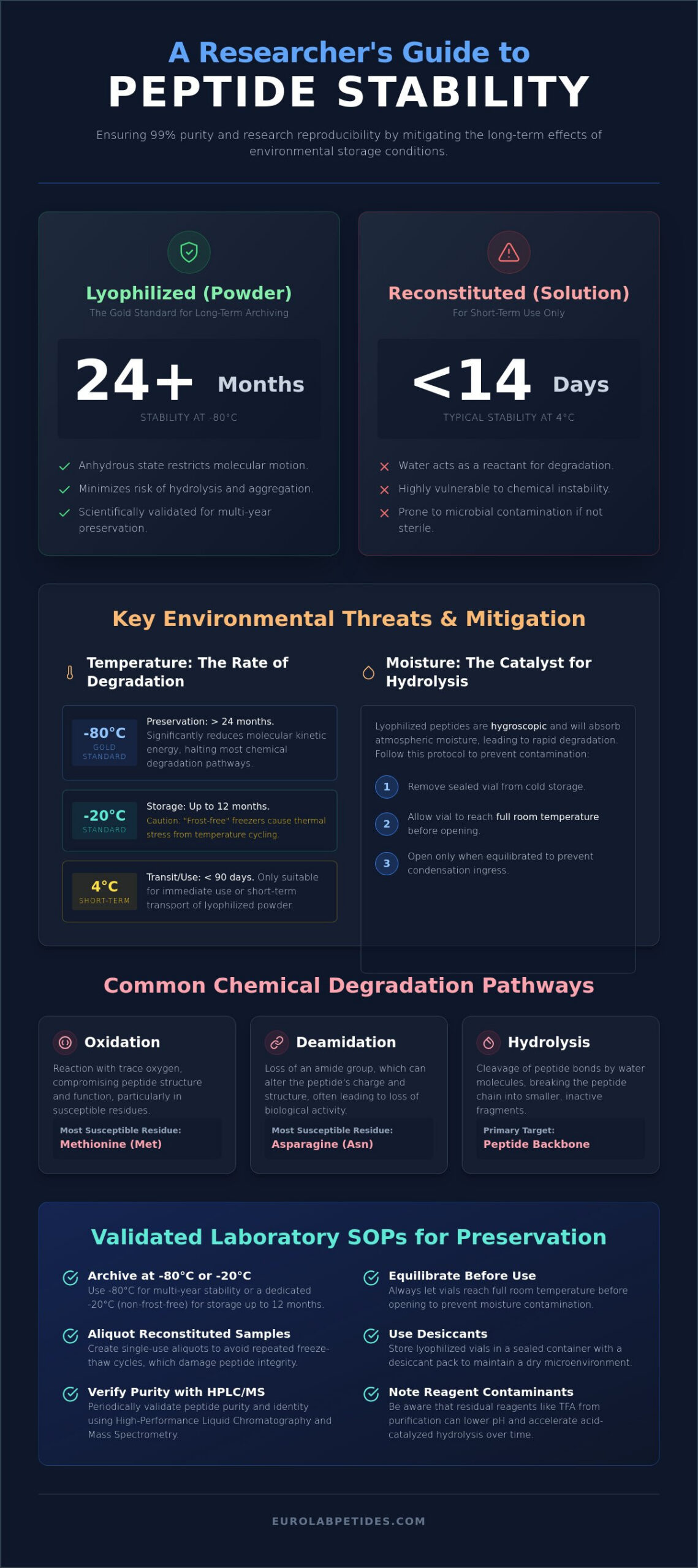
The Arrhenius equation facilitates the prediction of peptide shelf-life by correlating the rate constant of degradation with absolute temperature. For research purposes, -80°C is established as the gold standard for preservation exceeding 12 months because it significantly reduces molecular kinetic energy, effectively halting most chemical transitions. In contrast, standard -20°C freezers often utilize “frost-free” cycles. These cycles involve periodic temperature fluctuations to prevent ice buildup, which subjects the peptide to repeated thermal stress. Such cycling can lead to localized melting and refreezing, compromising the structural integrity of the lyophilized matrix and inducing aggregate formation. This thermal instability directly undermines research reproducibility by introducing unquantified sample variance before the experiment even begins.
Hygroscopy and the Threat of Atmospheric Moisture
Lyophilized peptides are inherently hygroscopic, meaning they readily absorb atmospheric moisture. This characteristic poses a severe risk of moisture-induced hydrolysis, where water molecules facilitate the cleavage of peptide bonds or the deamidation of specific residues. To prevent condensation, vials must reach room temperature before the seal is breached. Opening a cold vial in a humid laboratory environment causes immediate moisture ingress, which can lead to rapid sample degradation and weight inaccuracies. The use of desiccants within secondary storage containers provides a critical defense, maintaining a low-humidity microenvironment that preserves the anhydrous state necessary for long-term stability. Maintaining these strict protocols is essential for ensuring that the chemical identity of the sample remains consistent from the point of synthesis to the final analytical stage.
Lyophilized vs. Reconstituted: Comparative Long-Term Stability Profiles
Lyophilization, or freeze-drying, serves as the primary mechanism for preserving the structural integrity of synthetic sequences. By removing the solvent through sublimation, the peptide is transitioned into an anhydrous state where molecular motion is significantly restricted. The long term effects of peptide storage conditions are most pronounced when comparing this solid-state stability to the inherent volatility of the aqueous phase. In a solvated environment, water molecules facilitate chemical motion, acting as both a reactant in hydrolysis and a medium for intermolecular aggregation. Maintaining a peptide in its lyophilized form is the only scientifically validated method for ensuring multi-year stability.
Lyophilized Powder: The Standard for Long-Term Archiving
Lyophilized powders represent the gold standard for laboratory archiving. When stored at -80°C, high-purity research materials generally maintain biochemical stability for 24 months or longer. At a standard -20°C, this window typically narrows to 12 months, while storage at 4°C is only recommended for short-term transit or immediate use within a 90-day period. Physical indicators of degradation include clumping, which suggests moisture ingress, or yellowing, which often signifies oxidative stress. To mitigate these risks, vials should be nitrogen-purged during the sealing process to displace reactive oxygen. Applying a tertiary seal of Parafilm around the cap provides an additional barrier against atmospheric moisture during long-term storage in communal freezers.
Aqueous Stability: The Short-Term Window
Reconstitution initiates a rapid decline in the peptide’s shelf-life. Once in solution, the half-life of common research peptides can drop from years to mere weeks. The choice of diluent is critical. Bacteriostatic water, which contains 0.9% benzyl alcohol, is superior to sterile saline for multi-use vials because it inhibits microbial proliferation over a 28-day window. However, the stability of the solution is also highly pH-dependent; many sequences require a slightly acidic environment (pH 4.0 to 6.0) to prevent rapid deamidation. Utilizing high-purity Longevity & Vitality Research materials requires adherence to these storage standards to ensure data integrity.
Freeze-thaw cycles represent the most destructive force for reconstituted peptides. As the solution freezes, the formation of ice crystals creates localized high-concentration zones and exerts mechanical shear forces on the peptide chains. These forces often lead to irreversible denaturation and aggregation. To avoid this, solutions should be aliquotted into single-use volumes immediately after reconstitution. This strategy ensures that each sample is subjected to only one thaw cycle, preserving the physical and chemical properties required for accurate experimental outcomes.
Mechanisms of Chemical Degradation: Oxidation, Deamidation, and Hydrolysis
Chemical degradation is not a uniform process; rather, it’s a sequence-dependent phenomenon dictated by the specific amino acid residues within a chain. The long term effects of peptide storage conditions manifest through distinct pathways that alter both the chemical identity and the biological activity of the research material. While previous sections established the thermodynamic necessity of cold storage, this analysis focuses on the molecular transitions that occur when environmental controls fail. Primary mechanisms include oxidation, deamidation, and hydrolysis, alongside the less frequently discussed but equally critical process of racemization.
Backbone cleavage, or hydrolysis, typically occurs at specific labile sites. Sequences containing Aspartate (Asp) followed by Proline (Pro) or Glycine (Gly) are particularly susceptible to acid-catalyzed hydrolysis, even in the lyophilized state if residual moisture is present. Additionally, racemization, the shift from L-amino acids to D-amino acids, can occur under improper storage. This inversion of stereochemistry often renders the peptide unrecognizable to its target receptor, effectively neutralizing its research utility without necessarily showing a significant change in mass spectrometry results. Racemization is problematic because it fundamentally alters the three-dimensional topography of the molecule while maintaining the same molecular weight.
The Impact of Oxidation on Research Integrity
Oxidation primarily targets Cysteine (Cys), Methionine (Met), and Tryptophan (Trp) residues. Methionine is particularly vulnerable, often undergoing conversion to methionine sulfoxide. This modification increases the polarity of the side chain, which can disrupt the hydrophobic core of a folded peptide and lead to denaturation. The sulfoxide form can be further oxidized to a sulfone, an irreversible transition that serves as a definitive marker of sample age. In Cysteine-rich sequences, oxidative stress facilitates disulfide bridge scrambling, where the intended connectivity is replaced by non-native linkages. To mitigate these risks, displacing atmospheric oxygen with inert gases like argon or nitrogen during the vialing process is a non-negotiable standard for preserving high-value research materials.
Deamidation and Charge Heterogeneity
Deamidation involves the conversion of Asparagine (Asn) and Glutamine (Gln) into Aspartate (Asp) and Glutamate (Glu), respectively. This reaction proceeds through a cyclic succinimide intermediate, which is highly dependent on the local pH and temperature. Because deamidation introduces an additional negative charge, it significantly shifts the isoelectric point (pI) of the peptide. This shift is a primary cause of charge heterogeneity, which is readily detectable via high-performance liquid chromatography (HPLC) as a loss of purity. Beyond analytical metrics, the introduction of a charged residue in a binding pocket often reduces binding affinity, leading to inconsistent data in laboratory models. Understanding how the long term effects of peptide storage conditions influence these specific residues allows researchers to predict stability based on sequence alone.
Establishing Robust Laboratory Protocols for Multi-Year Peptide Preservation
The integrity of a longitudinal study depends on the standardization of intake and storage workflows. Upon receipt of new shipments, a formal SOP must be initiated to verify the Certificate of Analysis (CoA) against the 2026 purity benchmark of 99%. Cataloguing should include the batch number, synthesis date, and the date of initial storage. This systematic approach mitigates the long term effects of peptide storage conditions by ensuring that every vial’s history is documented and verifiable. The immediate transition of the bulk sample to a -80°C environment is essential to halt potential degradation pathways identified in earlier sections of this analysis.
Aliquotting: The Key to Sample Longevity
Bulk sample exposure to the laboratory atmosphere is a primary catalyst for degradation. To prevent this, the total volume should be divided into research-ready aliquots immediately after the first thaw or reconstitution. This strategy ensures that each sub-sample is subjected to only one thermal transition, effectively bypassing the mechanical shear forces of repeated freeze-thaw cycles. Labels must include the precise date of reconstitution and the specific concentration. It’s also recommended to use secondary containment, such as sealed plastic boxes with internal desiccant packs, which provides a final barrier against moisture ingress during multi-year archiving.
Vial Selection and Hydrophobic Adsorption
The choice of storage vessel material is a critical variable that determines recovery rates. Hydrophobic sequences, such as ipamorelin, exhibit a high affinity for the surfaces of standard polypropylene vials. In dilute solutions, these peptides can literally ‘disappear’ as they adsorb to the plastic walls, leading to significant concentration errors. For long-term preservation of such sensitive sequences, borosilicate glass vials or specialized low-protein-binding polypropylene are required. These materials minimize surface interactions, ensuring that the peptide remains in the aqueous phase and doesn’t adhere to the vessel walls.
Light protection is equally critical for sequences containing aromatic amino acids like Tryptophan or Tyrosine. Photosensitive peptides require amber vials or opaque secondary packaging to prevent UV-induced oxidation. By minimizing the air-to-liquid surface area within the vial, researchers can further reduce the risk of oxidative stress. Implementing these rigorous standards ensures that your Immune System Research materials maintain their structural identity over the entire duration of the study.
The EuroLab Peptides Standard: Ensuring Structural Integrity from Synthesis to Laboratory
Quality is not an abstract concept; it’s a verifiable metric defined by analytical precision. At EuroLab, every batch undergoes a rigorous multi-level quality control protocol to ensure the 2026 industry standard of 99% purity. We utilize Ultra-High-Performance Liquid Chromatography (UHPLC) and Electrospray Ionization Mass Spectrometry (ESI-MS) to verify both the chemical purity and the exact molecular weight of the sequence. This level of scrutiny is essential to mitigate the negative long term effects of peptide storage conditions. By establishing a baseline of absolute purity at the point of synthesis, we provide researchers with the empirical data necessary to track stability over multi-year durations. Our specialized lyophilization process is engineered to create a stable, anhydrous cake that maximizes shelf-life and resists the degradation pathways discussed in previous sections.
The integrity of your research depends on the stability of the material before it reaches your freezer. Cold-chain logistics are a non-negotiable component of the EuroLab standard. We maintain strict temperature controls during European and global transit to prevent thermal stress from triggering premature degradation. It’s critical to buy research peptides from sources that provide documented evidence of these storage and shipping protocols. Without this verification, the starting purity of your sample is unknown, rendering subsequent stability analyses invalid.
Regional Manufacturing and Regulatory Compliance
European-based synthesis offers a distinct advantage in terms of regulatory alignment and logistical reliability. Our operations adhere to the latest 2026 EMA guidelines, which treat synthetic peptides with the same scrutiny as complex pharmaceuticals. We practice radical transparency by providing third-party laboratory results for every batch we produce. This commitment to external validation ensures that the long term effects of peptide storage conditions are the only variables you need to account for in your longitudinal studies. Regional manufacturing also reduces the duration of environmental exposure during shipping, providing a more stable product upon delivery.
Research-Grade Consistency for In-Vitro Applications
Maintaining consistency across specialized sequences requires deep technical expertise and moral consistency. Whether your laboratory is analyzing the regenerative properties of bpc 157 or exploring metabolic pathways, the structural identity of the peptide must remain constant. We understand the high stakes of professional inquiry. Our synthesis protocols are designed to eliminate residual reagents and contaminants that accelerate side-chain modifications. This focus on chemical excellence ensures that your data remains reproducible and your research materials retain their value for years. Explore our full range of third-party tested research peptides to see how our precision manufacturing supports your scientific objectives.
Advancing Research Precision Through Standardized Stability Protocols
The long term effects of peptide storage conditions are a fundamental determinant of research reproducibility and molecular integrity. By applying the Arrhenius equation to laboratory workflows and implementing sequence-specific mitigation strategies, researchers can effectively stall the kinetics of oxidation and deamidation. Transitioning from bulk storage to research-ready aliquots in borosilicate or low-binding vessels preserves the 99% purity benchmark required for sophisticated in-vitro models. Maintaining these standards ensures that the biochemical identity of the sample remains consistent over multi-year durations.
Upholding these standards requires a partnership with a supplier that prioritizes objective data over marketing claims. EuroLab Peptides ensures structural integrity through third-party laboratory verified purity and specialized cold-chain handling protocols. Our regional European logistics minimize transit exposure, ensuring that the biochemical state of each sequence is preserved from synthesis to delivery. This methodical approach to quality assurance provides the absolute security required for high-stakes professional inquiry.
Secure high-purity research peptides from EuroLab Peptides to ensure your longitudinal data reflects the highest standards of analytical science. We’re committed to supporting your laboratory’s pursuit of rigorous, verifiable results.
Frequently Asked Questions
How long can lyophilized peptides be stored at -20°C?
Lyophilized peptides generally maintain biochemical stability for approximately 12 months when stored at -20°C. While this temperature is sufficient for mid-term archiving, a -80°C ultra-low temperature freezer is required for preservation exceeding 24 months. The long term effects of peptide storage conditions at -20°C include a gradual accumulation of degradants, especially in sequences containing labile residues like Asparagine or Glutamine.
Can I store research peptides in a standard frost-free freezer?
Storage in standard frost-free freezers is not recommended for high-purity research materials. These units utilize a heating cycle to prevent ice accumulation, which causes significant temperature fluctuations. This cycling subjects the peptide to repeated thermal stress, potentially triggering localized melting and refreezing that compromises the lyophilized matrix. A laboratory-grade, non-cycling freezer is necessary to ensure consistent environmental conditions.
What happens if a peptide is left at room temperature for a week?
The impact of room temperature exposure depends on the physical state of the peptide. Lyophilized powders may remain stable for several days during transit, but a full week at 20 to 25°C increases the activation energy for oxidation and hydrolysis. For reconstituted solutions, a week at room temperature typically results in significant degradation and microbial proliferation, rendering the sample unsuitable for precise analytical applications.
Is it better to store peptides in glass or plastic vials?
Borosilicate glass is the preferred material for long-term storage, particularly for hydrophobic sequences that exhibit high adsorption to plastic surfaces. While standard polypropylene vials are common, they can cause significant sample loss as peptides adhere to the vessel walls. If plastic must be used, selecting certified low-protein-binding polypropylene is essential to ensure maximum recovery of the research material.
How many freeze-thaw cycles can a reconstituted peptide survive?
Reconstituted peptides should ideally undergo only one thaw cycle. Each freeze-thaw event subjects the molecule to mechanical shear forces and localized concentration gradients that facilitate irreversible denaturation and aggregation. To maintain structural integrity, the solution should be aliquotted into single-use volumes immediately after reconstitution. This protocol minimizes the long term effects of peptide storage conditions on solution-phase stability.
Does light exposure significantly affect peptide stability?
Light exposure significantly accelerates the degradation of sequences containing aromatic amino acids such as Tryptophan, Tyrosine, and Phenylalanine. UV radiation catalyzes oxidative pathways, leading to the formation of sulfoxides or non-native disulfide linkages. Photosensitive peptides require storage in amber vials or opaque secondary containment to prevent these photochemical reactions from compromising the purity and biological activity of the sample.
What are the physical indicators that a peptide has degraded?
Physical indicators of degradation include clumping or a collapsed appearance of the lyophilized cake, which often signifies moisture ingress. Yellowing or browning of the powder typically points to advanced oxidative stress. In reconstituted solutions, the presence of visible particulates or a sudden change in solubility suggests significant aggregation or backbone cleavage. However, many chemical modifications are only detectable through HPLC or mass spectrometry.
How does moisture ingress occur in a sealed peptide vial?
Moisture ingress primarily occurs when a cold vial is opened before reaching room temperature, causing immediate condensation of atmospheric water onto the hygroscopic powder. It can also happen through microscopic failures in the vial seal or the permeability of certain stopper materials over time. Using Parafilm as a tertiary seal and storing vials in secondary containers with desiccants are effective methods for preventing moisture-induced hydrolysis.
