

What if the failure of your latest assay wasn’t caused by a flawed hypothesis, but rather an undetected micro-precipitation event during reconstitution? Inconsistent results often stem from partial peptide precipitation, a variable that compromises experimental integrity and leads to the loss of high-value research material. This peptide solubility guide for researchers provides a clinical examination of the thermodynamic and chemical stability required to ensure total dissolution within laboratory settings.
It’s understood that the transition from a lyophilized powder to a stable solution involves complex molecular interactions that are frequently underestimated. You’ll gain a technical understanding of how solvent-peptide interactions and specific thermal protocols dictate the preservation of secondary structures. This article details standardized reconstitution methods and the precise application of organic solvents versus aqueous buffers. We’ll analyze the molecular factors that influence aggregation and provide a framework for achieving consistent results. By following these evidence-based procedures, you can maintain 99% plus purity throughout the study lifecycle and eliminate the ambiguity that often surrounds complex peptide sequences.
Key Takeaways
- Understand the thermodynamic requirements to overcome lattice energy and achieve maximum peptide concentration in specific laboratory solvents.
- Leverage the glassy state of lyophilized powders to minimize molecular movement and prevent hydrolytic degradation during long-term storage.
- Implement precise pH adjustments to shift peptides from their isoelectric points, mitigating deamidation and ensuring sustained chemical stability.
- Utilize this peptide solubility guide for researchers to establish standardized reconstitution and storage protocols that preserve secondary molecular structures.
- Evaluate the impact of high-purity synthesis and rigorous HPLC/MS analysis on reducing catalytic impurities that accelerate molecular degradation.
Fundamentals of Peptide Solubility and Thermodynamic Stress
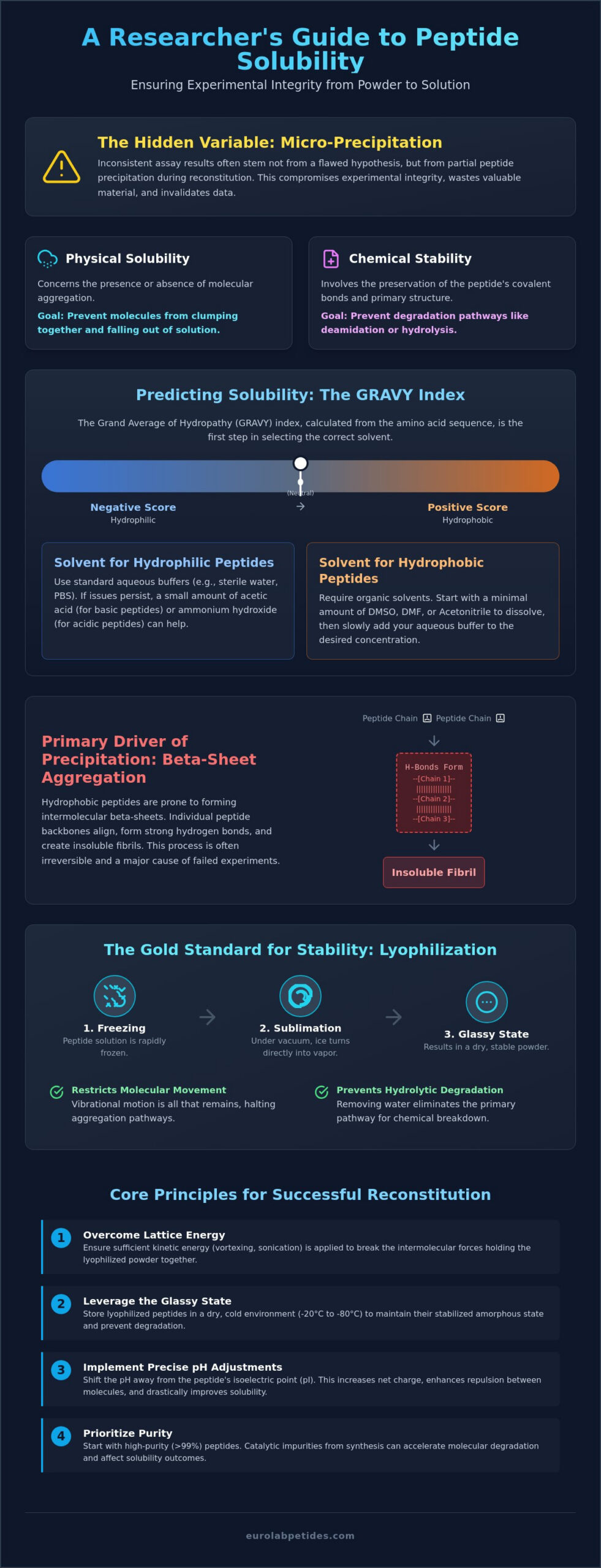
Peptide solubility is defined as the maximum concentration of a specific peptide sequence that can be successfully dissolved in a given solvent system at a specific temperature. In a laboratory context, this is rarely a static metric. This peptide solubility guide for researchers emphasizes that solubility is a thermodynamic state governed by the balance between solute-solute and solute-solvent interactions. Reconstitution requires sufficient kinetic energy to disrupt the intermolecular forces, known as lattice energy, that hold the lyophilized powder together in its solid state. If the kinetic energy provided during the mixing process is insufficient to overcome these forces, the peptide remains in a suspended or partially precipitated form, compromising the accuracy of the final concentration.
It’s critical to distinguish between physical solubility and chemical stability. Physical solubility refers to the presence or absence of molecular aggregation, while chemical stability involves the preservation of covalent bonds. All peptides are subject to entropy-driven degradation, where the thermodynamic equilibrium naturally shifts toward a more disordered state over time. Even the simplest structures, such as those discussed in foundational studies on Dipeptide solubility, must be managed with an understanding of these energetic barriers to ensure experimental reproducibility.
Impact of Amino Acid Sequence on Hydrophobicity
The primary amino acid sequence dictates the initial solvent requirements. Researchers utilize the Grand Average of Hydropathy (GRAVY) index to predict the behavior of a sequence in solution. This index is calculated by dividing the sum of hydropathy values of all amino acids by the total number of residues in the chain. A positive GRAVY score indicates a hydrophobic nature, while a negative score suggests hydrophilicity. Sequences containing more than 50% hydrophobic residues typically require specialized organic solvents. In these cases, standard aqueous buffers are often ineffective, as the hydrophobic side chains seek to minimize contact with water, leading to rapid precipitation.
Secondary Structure Vulnerabilities and Precipitation
Peptides often adopt specific conformations that influence their behavior in solution. The formation of intermolecular beta-sheets is a primary driver of irreversible aggregation. When backbones align and form hydrogen bonds with neighboring molecules, they create insoluble fibrils that are difficult to disrupt. Heat-induced unfolding further complicates this process. Exposure to elevated temperatures can cause a peptide to transition from a structured state to a disordered one, often resulting in permanent precipitation. Because structural integrity is paramount for valid in-vitro modeling, any peptide solubility guide for researchers must highlight that preventing these conformational shifts is as important as the initial dissolution itself.
Lyophilization as a Defense for Maintaining Solubility
Lyophilization, or freeze-drying, is the primary methodology employed to stabilize peptides for long-term storage and transport. This process removes water through sublimation, resulting in an amorphous solid known as a glassy state. Within this state, molecular movement is restricted to vibrational motions, effectively halting translational and rotational mobility that would otherwise lead to aggregation or chemical degradation. It is the standard. This level of stabilization is why lyophilization remains the industry requirement for shipping research peptides to ensure they arrive with their biochemical properties intact.
Maintaining the structural integrity of the peptide backbone depends on the prevention of hydrolytic degradation. Low water activity is the defining characteristic of a successful lyophilized product. By reducing the available moisture to negligible levels, the primary pathway for hydrolytic cleavage is effectively eliminated. This is a critical consideration for sequences containing labile bonds or residues prone to deamidation. When the environment is kept dry, the chemical potential for degradation is significantly lowered, allowing the peptide to remain in a stable, ready-to-dissolve state.
A standard peptide solubility guide for researchers will always prioritize the use of lyophilized powders over pre-reconstituted solutions. While aqueous solutions may exhibit significant degradation within hours or days at room temperature, lyophilized powders remain stable for years when stored under appropriate thermal conditions. Following established Peptide solubility guidelines is essential for researchers who aim to maximize the utility of their materials. Securing materials from a source that prioritizes these stabilization metrics is essential for high-stakes Longevity & Vitality Research.
The Glass Transition Temperature (Tg) in Storage
The Glass Transition Temperature (Tg) represents a critical physical threshold for lyophilized peptides. Below this temperature, the peptide cake maintains structural rigidity and high porosity, which facilitates rapid reconstitution. If the storage temperature exceeds Tg, the material transitions from a glassy state to a rubbery state. This transition increases molecular mobility and can lead to a “collapsed” cake. Such cakes often exhibit significantly reduced solubility and may contain high levels of chemical impurities due to accelerated degradation pathways. Researchers should inspect vials for any signs of shrinkage or loss of cake structure before attempting solubilisation. Understanding these thermal limits is a core component of any comprehensive peptide solubility guide for researchers.
Moisture Adsorption and Thermal Cycling
Temperature fluctuations during storage present a significant risk to peptide stability. Each time a vial is removed from cold storage, atmospheric moisture can condense on the interior surfaces if the seal is compromised or if the vial is opened before reaching room temperature. This moisture adsorption triggers premature hydrolysis, even if the peptide is subsequently returned to the freezer. Repeated freeze-thaw cycles further stress the physical integrity of the peptide backbone. To preserve optimal solubility, protocols should include the use of desiccants and the aliquoting of materials to minimize the number of thermal cycles experienced by any single sample.
Chemical Pathways: Solvent Selection and pH Optimization
Successful dissolution depends on the selection of a solvent system that aligns with the peptide’s net charge and hydropathy profile. This peptide solubility guide for researchers prioritizes the mitigation of deamidation, a primary heat-sensitive degradation pathway affecting asparagine (Asn) and glutamine (Gln) residues. In aqueous solutions, these residues are prone to hydrolysis, forming a succinimide intermediate that results in a mixture of isoaspartate and aspartate. Because this process is catalytic, the chemical environment must be strictly controlled to maintain experimental validity. It’s often necessary to deviate from physiological pH to achieve initial solubilisation before diluting into a final assay buffer.
Adjusting the pH shifts the peptide away from its isoelectric point (pI), the specific pH where the molecule carries no net electrical charge and solubility is at its nadir. Basic peptides, those with a high proportion of Arg, Lys, or His, often require a 0.1% acetic acid solution to achieve a net positive charge. Conversely, acidic peptides containing Asp or Glu residues may necessitate the addition of NH4OH to achieve a net negative charge. Following established Peptide Solubility Guidelines ensures that these adjustments are performed methodically to avoid localized concentration gradients that trigger precipitation. For highly hydrophobic sequences, organic solvents such as DMSO or DMF are required to disrupt the strong intermolecular interactions that resist aqueous dissolution.
Protocols must be tailored to the specific sequence rather than the peptide category. For instance, it’s a common misconception that all BPC-157 samples require identical solvent protocols. While many batches dissolve readily in sterile water, variations in salt content or minor conformational shifts can necessitate the use of dilute acetic acid. Precision in solvent selection is the only way to ensure 100% recovery of the research material.
The Arrhenius Equation in Solubility Prediction
The Arrhenius equation serves as a quantitative tool for predicting the rate of chemical degradation in various solvent systems. It establishes that the rate constant of a reaction is exponentially dependent on the inverse of temperature. Researchers often apply the “Q10 rule,” where the rate of degradation pathways like deamidation or oxidation effectively doubles with every 10-degree Celsius increase in temperature. The activation energy of a peptide sequence determines its sensitivity to these temperature-dependent solubility shifts during the reconstitution phase.
Handling Transient Temperature Spikes
The stability of lyophilized research compounds is generally sufficient for standard transit across Europe, where ambient temperatures remain within controlled limits. However, researchers must differentiate between “room temperature” (20-25°C) and “extreme heat” (>40°C) exposure during laboratory preparation. A cold-chain breach during transit requires a formal assessment of sample viability. If the lyophilized cake remains intact and has not reached its glass transition temperature, the solubility profile is likely preserved. If the cake has collapsed, the material should be subjected to analytical verification via HPLC to ensure it still meets the 99% plus purity threshold required for high-stakes inquiry.
Optimized Reconstitution and Storage Protocols
The preservation of peptide integrity following synthesis requires a rigorous adherence to thermal and environmental controls. A tiered hierarchy of storage temperatures dictates the rate of chemical degradation, with stability increasing as temperatures decrease: Room Temperature < 4°C < -20°C < -80°C. While lyophilized powders are stable at -20°C for several months, long-term preservation exceeding one year necessitates storage at -80°C. This peptide solubility guide for researchers emphasizes that storage conditions for reconstituted solutions are significantly more restrictive. Solutions should be categorized as short-term (use within days) or long-term (aliquoted and frozen for months), though repeated thermal cycling must be avoided to prevent structural compromise.
Environmental factors beyond temperature influence the solubility and purity of the sample. Photo-oxidation is a primary risk for sequences containing sensitive residues like tryptophan or tyrosine. Utilizing amber vials or opaque secondary containment is a non-negotiable requirement for maintaining 99% plus purity. Furthermore, vials must be allowed to equilibrate to room temperature in a desiccator before the seal is breached. Opening a cold vial in a humid laboratory environment triggers immediate hygroscopic moisture gain. This condensed water initiates hydrolytic pathways that can render a previously stable cake insoluble or chemically altered within minutes. For high-precision requirements, researchers often utilize the Muscle Research Stack to ensure all components meet these rigorous handling standards.
Step-by-Step Reconstitution Protocol
A standardized approach to reconstitution minimizes the risk of irreversible aggregation. The following protocol is recommended for optimal results:
- Step 1: Centrifuge the lyophilized vial at 10,000xg for 30 to 60 seconds. This ensures the peptide cake is consolidated at the bottom of the vial, preventing material loss on the cap or walls during opening.
- Step 2: Introduce the minimal required volume of the primary solvent, such as DMSO or a specific pH-adjusted buffer, directly onto the cake. Concentrated stock solutions are generally more stable than dilute working solutions.
- Step 3: If the peptide does not dissolve through gentle agitation, utilize sonication on ice. Pulsed intervals of 3×10 seconds are effective at disrupting recalcitrant aggregates without inducing the localized heating that triggers thermal degradation.
Handling Reconstituted (Solution) Peptides
Once a peptide is in solution, its chemical half-life decreases substantially. For example, reconstituted Ipamorelin should ideally be utilized within a 7 to 14 day window when stored at 4°C. Freezing aqueous solutions introduces the risk of ice crystal formation, which can exert mechanical stress on secondary structures and lead to precipitation upon thawing. If long-term storage of a solution is unavoidable, the use of bacteriostatic water may serve as a secondary stabilizing agent for in-vitro studies by inhibiting microbial growth that could otherwise catalyze peptide cleavage. Researchers must prioritize the use of freshly reconstituted materials to ensure the reproducibility of their analytical data.
EuroLab Peptides: Engineering Purity for Predictable Solubility
EuroLab Peptides utilizes a multi-level quality control framework to ensure that every compound exhibits predictable solubility profiles. This process begins with high-pressure liquid chromatography (HPLC) to confirm chemical purity and mass spectrometry (MS) to verify molecular weight and sequence identity. By prioritizing high-purity synthesis, the presence of catalytic impurities that traditionally accelerate deamidation or oxidation is significantly reduced. These impurities, often residual reagents or truncated sequences, can act as nucleation sites for aggregation. All products provided are strictly for in-vitro research and laboratory development; they aren’t intended for human consumption or therapeutic use.
The regional logistics network is engineered to minimize transit time across Europe. By reducing the duration of thermal exposure during shipping, the risk of the peptide cake reaching its glass transition temperature is mitigated. This logistical precision ensures that the material maintains its amorphous solid state, which is essential for rapid and complete reconstitution in the laboratory environment. Reliability in a global market is established through this commitment to localized logistics and regional manufacturing standards.
Verifiable Metrics of Quality
Each batch is accompanied by a comprehensive Certificate of Analysis (CoA) that details the primary purity percentage and the residual acetate content. Acetate content is a critical variable in this peptide solubility guide for researchers, as it influences the initial pH of the solution and the subsequent choice of buffers. Batch-to-batch consistency is ensured through independent third-party validation, where external laboratories perform redundant testing to confirm internal results. A purity level of 99% plus acts as a fundamental buffer against rapid precipitation by minimizing the molecular interference caused by synthetic byproducts.
Technical Support for Researchers
Detailed handling and solubility data are provided for every research compound in the catalog. Researchers may request stability data for specialized combinations, such as the Longevity Research Stack or the Recovery Research Stack, to assist in the design of long-term in-vitro studies. This peptide solubility guide for researchers serves as a foundational resource, but technical inquiries regarding specific sequence behaviors are always prioritized. Professional inquiry is invited to ensure that experimental protocols align with the chemical reality of the synthesized material.
Explore our catalog of third-party tested research peptides to secure high-purity tools for your laboratory requirements.
Optimizing Experimental Integrity through Molecular Stability
Achieving reproducible in-vitro results requires a meticulous approach to both thermodynamic and chemical variables. By prioritizing sequence-specific solvent selection and maintaining rigorous thermal controls, researchers can effectively mitigate the risks of irreversible aggregation and hydrolytic degradation. This peptide solubility guide for researchers establishes the technical framework necessary to ensure that analytical data reflects the true behavior of the molecule rather than artifacts of improper reconstitution. It’s the difference between experimental failure and verifiable success.
EuroLab Peptides supports these demanding laboratory standards by providing materials that undergo independent third-party lab testing via HPLC and MS analysis. Our European-based reliable logistics network is specifically engineered to minimize environmental stress during transit, ensuring that our 99% plus purity guarantee translates into predictable laboratory performance. Precise control over your research environment is the only way to eliminate the ambiguity of micro-precipitation and preserve high-value material for the duration of your study.
Secure High-Purity Peptides for Your Research and ensure your experimental protocols are supported by verifiable excellence.
Frequently Asked Questions
Do peptides degrade if they are not shipped on dry ice?
Peptides in a lyophilized state don’t necessarily undergo rapid degradation when shipped at ambient temperatures. Most sequences are stable in their glassy state for the duration of standard transit times, provided they aren’t exposed to extreme heat exceeding 40°C. The solid-state matrix restricts the molecular mobility required for chemical breakdown, though cold-chain logistics are still preferred for certain highly labile sequences to ensure maximum purity upon arrival.
How long can a lyophilized peptide remain stable at room temperature?
A lyophilized peptide can typically remain stable at room temperature (20-25°C) for approximately three to four weeks without significant loss of analytical purity. This stability is contingent upon the vial remaining hermetically sealed and protected from atmospheric moisture. If the storage duration exceeds this window, the material should be transferred to -20°C or -80°C to prevent the gradual accumulation of degradation products caused by baseline thermal energy.
What is the best solvent for highly hydrophobic research peptides?
Dimethyl sulfoxide (DMSO) is the most effective primary solvent for sequences with high hydrophobic character. It disrupts the strong intermolecular hydrogen bonds that lead to aggregation in standard aqueous buffers. This peptide solubility guide for researchers recommends dissolving the powder in a minimal volume of 100% DMSO before slowly diluting with the final assay buffer to reach the required working concentration while maintaining the peptide in solution.
Can I refreeze a peptide once it has been reconstituted in an aqueous buffer?
Refreezing a reconstituted peptide solution is generally discouraged due to the mechanical stress caused by ice crystal formation. These crystals can disrupt the secondary structure and promote irreversible aggregation upon thawing, leading to visible precipitation. If a solution must be stored, it’s better to aliquot the material into single-use volumes immediately after the initial reconstitution to avoid the detrimental effects of multiple freeze-thaw cycles.
How do I know if my peptide has been damaged by excessive heat?
Heat damage is often identified by a physical change in the lyophilized cake, such as shrinkage, discoloration, or a “melted” appearance against the vial walls. These visual cues suggest the material has exceeded its glass transition temperature, which increases the rate of chemical degradation. Absolute verification of damage requires analytical testing via HPLC or mass spectrometry to quantify the presence of deamidated or oxidized variants that compromise experimental results.
Why is moisture more detrimental to peptide stability than temperature alone?
Moisture acts as a direct reactant in hydrolytic degradation pathways, making it more hazardous than thermal stress in a desiccated environment. Even at low temperatures, the presence of water facilitates the cleavage of peptide bonds and the deamidation of residues like asparagine. Maintaining low water activity is a primary focus of this peptide solubility guide for researchers, as it effectively halts the chemical potential for these reactions to occur during storage.
Does light exposure affect the solubility of research peptides?
Light exposure can significantly alter the solubility and chemical integrity of peptides containing aromatic residues such as tryptophan or tyrosine. These amino acids are susceptible to photo-oxidation, which introduces chemical modifications that often lead to the formation of insoluble aggregates. To prevent this, research compounds must be stored in amber vials or opaque secondary containers to ensure the 99% plus purity threshold is maintained throughout the study.
What is the shelf life of a peptide stored at -20°C in lyophilized form?
The shelf life of a lyophilized peptide stored at -20°C is typically between 12 and 24 months. At this temperature, the amorphous solid state is preserved, and molecular movement is sufficiently restricted to prevent significant chemical degradation. For projects requiring storage beyond two years, transferring the material to a -80°C environment is recommended to ensure that the rate of entropy-driven breakdown remains at its absolute minimum.
