

Can you definitively confirm that a reported 98% purity level reflects the actual chemical composition of your sample, or is your research data being compromised by undetected baseline noise? For many investigators, the discrepancy between a supplier’s certificate of analysis and the actual behavior of a reagent in-vitro creates a significant risk to experimental reproducibility. This hplc analysis of peptides explained guide provides the technical framework necessary to bridge the gap between raw data and verifiable quality. It’s no longer sufficient to accept a summary figure; precise analytical validation is the only standard through which research integrity is ensured.
You understand that even minor impurities can lead to skewed results or unintended biological interactions. This article provides the methodology to master the technical nuances of High-Performance Liquid Chromatography, allowing impurities to be identified within a complex chromatogram. The mechanisms of reversed-phase separation, the impact of the June 2026 EMA guidelines on synthetic peptide standards, and the latest advancements in specialized column technology are examined in detail. By the end of this technical briefing, confidence in selecting high-purity materials will be established through objective empirical evidence rather than administrative assurances.
Key Takeaways
- Understand the core mechanism of High-Performance Liquid Chromatography to ensure precise separation and quantification of synthetic peptide sequences.
- Learn why Reversed-Phase HPLC (RP-HPLC) is the preferred analytical method within this hplc analysis of peptides explained guide for achieving high-resolution purity metrics.
- Gain the technical proficiency to interpret chromatograms by analyzing retention times and absorbance peaks to verify the chemical integrity of research materials.
- Identify critical analytical pitfalls, such as co-elution and non-UV-absorbing impurities, that can obscure the presence of contaminants in standard reports.
- Recognize the necessity of multi-level quality control protocols, including independent third-party validation, to secure absolute experimental reliability and data integrity.
What is HPLC Analysis of Peptides? Fundamentals and Mechanism
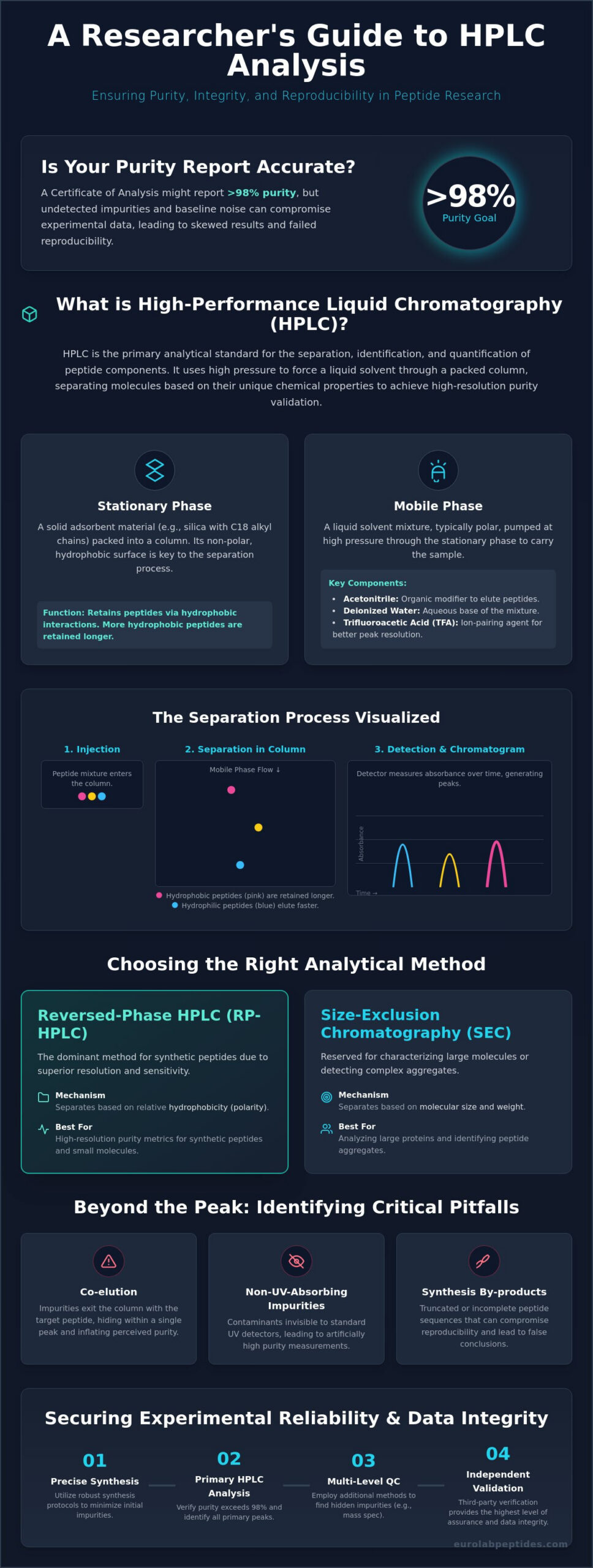
High-performance liquid chromatography (HPLC) is established as the primary analytical standard for the separation, identification, and quantification of peptide components within a complex mixture. The technique is executed by utilizing high-pressure pumps to drive a liquid solvent, known as the mobile phase, through a column packed with a solid adsorbent material, the stationary phase. This hplc analysis of peptides explained overview clarifies how individual peptide molecules are forced to interact with these phases to achieve high-resolution separation. Peptides are isolated based on their unique chemical properties, primarily relative hydrophobicity or molecular size. HPLC is the essential metric for validating peptide purity in laboratory settings.
The Role of the Mobile and Stationary Phases
The efficiency of peptide separation is dictated by the specific interaction between the polar mobile phase and the non-polar stationary phase. In standard reversed-phase chromatography, the stationary phase is composed of silica particles bonded with hydrophobic alkyl chains, such as C18. The mobile phase is typically formulated using a gradient of specific solvents:
- Acetonitrile: Utilized as the organic modifier to promote peptide elution from the column.
- Deionized Water: Serves as the aqueous base of the mobile phase mixture.
- Trifluoroacetic Acid (TFA): An ion-pairing agent utilized to improve peak resolution and stabilize pH levels during the analytical run.
The column is used as a molecular sieve where the elution of specific peptides is delayed according to their chemical affinity. Hydrophobic peptides are retained longer due to their interaction with the stationary phase, while more hydrophilic sequences elute more rapidly. This differential migration allows for the distinct isolation of the target compound from related substances.
Why HPLC is Non-Negotiable for Research Integrity
The integrity of research data is directly linked to the chemical precision of the reagents used. Peptide impurities can lead to significant artifacts in in-vitro experimental outcomes or induce cellular signaling that doesn’t reflect the target molecule’s actual function. It’s vital to distinguish between the synthesized target peptide and synthesis by-products, such as truncated sequences or incomplete deprotections. These contaminants can compromise the reproducibility of a study and lead to false conclusions. For a deeper understanding of these compounds, researchers should review What Are Peptides? A Comprehensive Guide for Researchers. This hplc analysis of peptides explained framework ensures that purity benchmarks, which typically exceed 98% in professional environments, are verified through empirical data rather than simple assumption.
RP-HPLC vs. SEC: Choosing the Right Analytical Method
Selecting the appropriate chromatographic mode is a critical decision in the validation of synthetic sequences. While several methodologies exist, Reversed-Phase HPLC (RP-HPLC) and Size-Exclusion Chromatography (SEC) serve distinct analytical functions. This hplc analysis of peptides explained guide emphasizes that RP-HPLC remains the dominant method for synthetic peptide analysis due to its superior resolution and sensitivity. In contrast, SEC is typically reserved for the characterization of large proteins or the detection of complex peptide aggregates where molecular weight distribution is the primary metric of interest. The choice of method is dictated by the peptide’s length, relative polarity, and the specific requirements of the research application.
Just as selecting the right chromatography method is essential for precision, finding the most effective digital tools for data management can streamline your workflow; to explore different software options, check out Alternative Radar for a comprehensive look at professional service alternatives.
The Mechanics of Reverse-Phase HPLC
RP-HPLC utilizes the hydrophobic interactions between the peptide solutes and the stationary phase. Columns packed with C18 or C8 silica-based resins provide the necessary surface area to facilitate these interactions. The separation is achieved through a precise gradient elution profile, where the concentration of an organic solvent is increased over time to elute peptides according to their decreasing polarity. This results in sharp, distinct peaks that allow for the quantification of even minor synthesis impurities. This method is exceptionally effective for small to medium-sized research compounds such as BPC-157 or Ipamorelin, where high-resolution separation from truncated sequences is mandatory. For those seeking a more rigorous understanding, this in-depth guide on HPLC peptide purification details the thermodynamic principles governing these separations with clinical precision.
Size-Exclusion Chromatography (SEC) in Peptide Research
SEC operates on the principle of molecular hydrodynamic volume rather than chemical affinity. It’s the preferred tool when researchers must identify the presence of peptide dimers, trimers, or larger non-covalent aggregates that may form during storage or synthesis. However, SEC possesses inherent limitations in resolving closely related synthesis impurities. While it provides valuable data on structural homogeneity, it lacks the peak capacity of RP-HPLC required for comprehensive purity assessment. For example, a single amino acid deletion might not significantly alter the molecular size, rendering SEC ineffective for purity verification. Researchers focusing on BPC-157: A Technical Guide often rely on RP-HPLC as the primary validation tool to ensure that the strict 98% purity benchmarks are met before experimental initiation. Researchers requiring absolute data security may find that utilizing a Recovery Research Stack provides the necessary analytical transparency for complex multi-peptide studies.
The following performance metrics distinguish these chromatographic modes:
- Resolution: RP-HPLC offers high peak capacity for similar-sized molecules; SEC provides low resolution for molecules with similar hydrodynamic volumes.
- Speed: RP-HPLC runs are typically optimized for 20 to 60 minutes; SEC is often slower due to restricted flow rate constraints to prevent column damage.
- Sensitivity: RP-HPLC is highly sensitive to minor chemical variations and hydrophobic shifts; SEC is sensitive only to significant changes in molecular weight.
Interpreting HPLC Chromatograms: A Guide for Researchers
The interpretation of chromatographic data is the definitive step in verifying the chemical identity and purity of a research sample. Within a standard HPLC report, the X-axis represents the Retention Time (min), which quantifies the duration between sample injection and elution from the column. The Y-axis measures Absorbance in milli-Absorbance Units (mAU). This detection is typically performed at wavelengths of 214 nm or 220 nm, where the peptide bond exhibits its maximum UV absorbance. This hplc analysis of peptides explained guide provides the technical basis for converting these visual signals into verifiable metrics of quality.
Understanding Retention Time and Peak Shape
A sharp and symmetrical peak is the primary indicator of peptide homogeneity. When a peak exhibits tailing, characterized by a gradual return to the baseline on the right side, it often signals column degradation or secondary interactions with the stationary phase. Peak broadening, on the other hand, might suggest excessive dead volume within the system or poor sample solubility. Retention time serves as a qualitative fingerprint. By comparing the elution time of the sample against a certified reference standard under identical conditions, the identity of the peptide is confirmed with high precision. Any significant shift in this time suggests a deviation in stoichiometry or a change in the chemical structure of the molecule.
Calculating Percentage Purity
The quantitative assessment of a sample is performed using Peak Area Normalization. This calculation represents the ratio of the integrated area of the target peak to the total area of all peaks detected during the analytical run. It’s essential to recognize that 98% purity means 98% of the UV-absorbing material at a specific wavelength is the target peptide. This value is relative to the detector’s sensitivity and does not include non-chromophoric impurities such as acetate or trifluoroacetate salts, which require alternative detection methods.
A rigorous analytical protocol requires the execution of a “Blank Run” prior to sample analysis. This procedure identifies baseline noise and ghost peaks originating from the solvent system, allowing for their subtraction from the final calculation. Researchers are advised to examine the raw data rather than relying solely on summary reports. Minor shoulder peaks, which appear as small protrusions on the main peak, often represent closely related synthesis by-products or truncated sequences that could compromise experimental reproducibility. Professional validation requires the following metrics to be clearly defined:
- Symmetry Factor: A metric indicating the deviation from a Gaussian peak shape, where values close to 1.0 signify optimal performance.
- Baseline Resolution: The complete separation of the target peak from adjacent impurities, ensuring no co-elution occurs.
- Signal-to-Noise Ratio: A measure used to distinguish the peptide signal from background electronic or chemical noise.
By demanding these specific parameters, researchers can ensure that their reagents meet the high-stakes demands of modern biochemical inquiry.
Beyond the Peak: Identifying Common Pitfalls in Peptide Analysis
HPLC results are frequently interpreted as absolute, yet several technical variables can lead to the misidentification of purity levels. One of the most significant risks in chromatography is co-elution. This occurs when an impurity possesses the same retention time as the target peptide, causing it to elute simultaneously and hide within the main peak. This hplc analysis of peptides explained briefing highlights that a single peak on a UV chromatogram does not guarantee a single chemical entity. Standard UV detectors at 214 nm or 220 nm are blind to non-chromophoric contaminants. Salts, specific lipids, and residual solvents do not absorb UV light and will not appear on the chromatogram, potentially leading to an overestimation of actual purity.
The Necessity of Mass Spectrometry (LC-MS)
HPLC is utilized to confirm the purity of a sample by quantifying the ratio of the target peak to impurities. However, it cannot confirm the chemical identity of the molecule. Mass Spectrometry (MS) is the mandatory orthogonal method required to verify the exact molecular weight of the peptide. By measuring the mass-to-charge ratio, MS identifies whether the synthesized sequence matches the theoretical mass. This process is vital for detecting ‘de-amidation’ or ‘oxidation’ products; these are common chemical modifications that may only cause a negligible shift in retention time but significantly alter the peptide’s biological activity. For researchers establishing procurement protocols, the How to Buy Research Peptides: A 2026 Guide provides a framework for integrating LC-MS data into standard quality assessments.
Counter-Ion Analysis and Residual Solvents
A critical distinction must be made between peptide purity and peptide content. Most synthetic peptides are provided as salts, often containing Trifluoroacetic Acid (TFA) or acetate used during the purification process. While the HPLC report might indicate 98% purity, this percentage only refers to the UV-absorbing material. It does not account for the weight of the counter-ions or residual water. A sample with 98% purity may only have 75% to 85% actual peptide content by weight. Failure to account for this discrepancy leads to inaccurate dosing in-vitro. Researchers requiring validated reagents for complex metabolic studies should examine the Advanced Metabolic Stack for comprehensive quality assurance and analytical transparency.
Technical artifacts can also complicate data interpretation. Solvent peaks often appear at the beginning of the run (the void volume) and should not be confused with impurities. Air bubbles within the high-pressure system or column bleed from an aging stationary phase can create ghost peaks or baseline instability. These artifacts must be identified through rigorous blank runs to ensure they do not compromise the final purity calculation. Professional laboratory standards require the systematic elimination of these variables to maintain research integrity.
EuroLab Peptides’ Multi-Level Quality Control and HPLC Verification
EuroLab Peptides operates under a rigorous, multi-level analytical protocol designed to ensure the highest standards of chemical fidelity. This hplc analysis of peptides explained framework is applied to every batch without exception. Quality isn’t treated as a subjective claim; it’s a verifiable metric established through a sequential testing chain. The process begins with in-house synthesis validation, where preliminary purity is assessed immediately following lyophilization. This internal data is subsequently validated through independent, third-party HPLC and Mass Spectrometry (MS) testing to eliminate any potential for reporting bias. By providing researchers with access to the raw empirical data, we establish a foundation of absolute transparency.
The EuroLab Standard: Third-Party Validation
Objective validation is a non-negotiable requirement for professional research. EuroLab Peptides partners with external laboratories to provide an unbiased assessment of each compound’s purity and molecular identity. Our benchmarks for research-grade peptides consistently exceed the industry standard of 98%. For instance, the analytical data provided for Ipamorelin: A Technical Profile demonstrates this commitment to precision. By presenting the actual chromatograms and MS spectra, we ensure that the technical specifications required for high-stakes inquiry are fully documented. This proof-first approach respects the intelligence of the scientific community and mitigates the risks associated with poor-quality reagents.
Sourcing for High-Stakes Research
Analytical rigor is the foundation of successful Longevity & Vitality Research and Tissue Repair & Recovery Research. When investigating complex pathways, the presence of even minor synthesis by-products can compromise the validity of the data. EuroLab Peptides supports the European scientific community by maintaining a sophisticated manufacturing and distribution network. Our European-based logistics are optimized to maintain the cold chain; this ensures that peptide stability is preserved from the laboratory to the end-user. This logistical precision minimizes the risk of degradation, which is a common cause of baseline noise and artifactual peaks in subsequent analysis.
All products are strictly for in-vitro research use. It’s this focus that ensures our laboratory development and quality control protocols remain aligned with the most stringent biochemical standards. The integration of advanced chromatography and mass spectrometry ensures that every sequence, from individual compounds to complex research stacks, meets the rigorous demands of modern science. Researchers are invited to verify your research reagents with EuroLab Peptides’ certified catalog to secure the analytical transparency necessary for reproducible results. Our commitment to radical honesty is backed by the objective data of technical analysis, positioning our products as elite tools for serious professional inquiry.
Securing Experimental Integrity through Analytical Precision
The establishment of a standardized protocol for purity verification is required to ensure research reliability. The mechanisms of reversed-phase separation and the critical importance of identifying co-eluting impurities have been detailed in this hplc analysis of peptides explained technical guide. Researchers are advised to move beyond summary reports and demand raw chromatographic data to confirm that reagents meet the non-negotiable 98% purity benchmark. Precision is paramount. It’s essential that orthogonal methods like mass spectrometry are integrated to verify chemical identity alongside percentage purity.
Analytical transparency is the cornerstone of high-stakes biochemical inquiry. Through the utilization of European-based quality control and independent third-party validation, the risks of contaminated data are systematically eliminated. You’re now equipped to distinguish between target peaks and synthesis artifacts, ensuring that your in-vitro studies are built on a foundation of absolute chemical accuracy. We encourage the continued pursuit of rigorous empirical standards in your laboratory development.
Explore Our Third-Party Tested Peptide Catalog to access comprehensive HPLC/MS reports and verify the integrity of your research materials.
Frequently Asked Questions
What is the difference between HPLC purity and peptide content?
HPLC purity measures the relative amount of the target peptide compared to other UV-absorbing substances detected at a specific wavelength. Peptide content represents the actual mass of the peptide molecule within the lyophilized powder, excluding non-peptide components like counter-ions and residual moisture. It’s common for a sample with 98% purity to have only 80% actual peptide content due to the presence of necessary salts like TFA or acetate.
Can HPLC detect all impurities in a peptide sample?
HPLC only detects impurities that absorb UV light at the selected analytical wavelength. Non-chromophoric contaminants, such as inorganic salts, residual solvents, or specific lipids, remain invisible on a standard chromatogram. This limitation is why this hplc analysis of peptides explained guide recommends pairing HPLC with orthogonal methods, including Mass Spectrometry and moisture analysis, to provide a complete chemical profile.
Why is 214 nm used as the standard wavelength for peptide HPLC?
214 nm is utilized because it corresponds to the maximum UV absorbance of the peptide bond’s amide groups. While higher wavelengths like 280 nm are effective for detecting aromatic amino acids such as Tryptophan or Tyrosine, 214 nm provides a more universal detection method. This ensures that all peptide sequences, regardless of their specific amino acid composition, are quantified accurately during the analytical run.
How do I read an HPLC report provided by a peptide supplier?
A standard report is interpreted by examining the main peak’s symmetry and the baseline’s stability on the chromatogram. The integration table provides the numerical percentage of the total area occupied by the primary peak relative to all detected peaks. This hplc analysis of peptides explained overview stresses that any secondary peaks or baseline fluctuations must be identified as potential synthesis by-products that compromise the reported purity.
What does a ‘shoulder peak’ on an HPLC chromatogram indicate?
A shoulder peak indicates the presence of a closely related impurity that hasn’t been fully resolved from the target peptide. These contaminants often represent truncated sequences or peptides with minor chemical modifications, such as deamidation or oxidation. Their presence suggests that the purification process failed to achieve baseline resolution, which can lead to unintended biological interactions during in-vitro research.
Is 95% purity sufficient for in-vitro research applications?
95% purity is generally considered inadequate for rigorous in-vitro research where minor impurities can induce skewed data or unintended cellular signaling. The industry standard for professional inquiry is established at 98% or higher to ensure experimental reproducibility. Lower purity levels increase the risk of artifacts, making it difficult to definitively attribute observed effects to the target peptide sequence being studied.
How often should a peptide batch be re-tested using HPLC?
Re-testing frequency depends on the chemical stability of the sequence and the specific storage conditions maintained. While most lyophilized peptides remain stable for 24 months when stored at -20°C, sequences prone to oxidation should be re-validated every 12 months. HPLC analysis is the only definitive method to confirm that no significant degradation has occurred during long-term storage before beginning a new study.
What is the role of Trifluoroacetic Acid (TFA) in HPLC analysis?
TFA acts as an ion-pairing agent that interacts with the basic groups of the peptide to improve peak resolution and symmetry. It also maintains a low pH in the mobile phase, ensuring the peptide remains in a protonated state for consistent interaction with the stationary phase. Without TFA, peaks often exhibit significant broadening and tailing, which complicates the accurate quantification of the target compound.
