
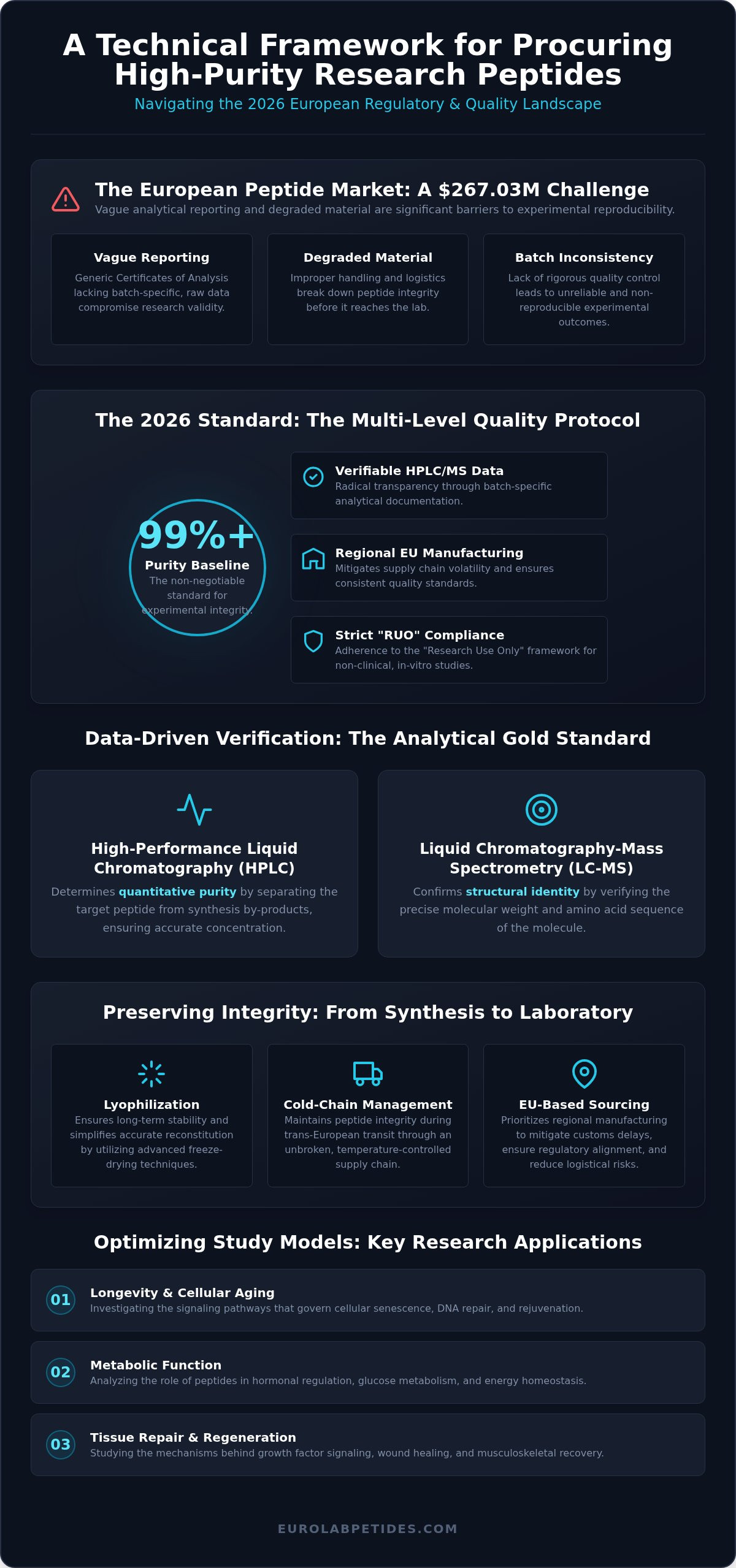
If your laboratory procurement depends on a supplier’s reputation rather than a 2026-validated Certificate of Analysis, you’re essentially conducting research on the vendor’s integrity instead of your intended biological model. In a market where the European peptide sector is valued at $267.03 million, the prevalence of vague analytical reporting and degraded material remains a significant barrier to experimental reproducibility. Most researchers find that trying to buy research peptides Europe often involves managing the friction of batch-to-batch inconsistency and the risk of customs delays inherent in non-EU sourcing.
We understand that scientific accuracy is non-negotiable; therefore, this guide establishes a definitive technical framework for identifying and evaluating high-purity laboratory reagents. You’ll gain the specific criteria required to demand 99%+ purity through verifiable HPLC and Mass Spectrometry data. This article analyzes the impact of the June 1, 2026, EMA guidelines on synthetic peptide standards, the necessity of regional manufacturing, and the logistics of maintaining cold-chain stability for predictable EU-wide delivery.
Key Takeaways
- Identify the “Multi-Level Quality Protocol” as the benchmark for laboratory procurement, ensuring purity levels exceed the 99% baseline for experimental reproducibility.
- Learn how to navigate the 2026 regulatory landscape to securely buy research peptides Europe, focusing on regional manufacturing standards and “research use only” compliance.
- Evaluate the technical necessity of lyophilization and cold-chain management in preserving peptide integrity during trans-European transit.
- Categorize research reagents by their specific physiological signaling pathways to optimize study models in longevity, metabolic function, and tissue repair.
- Implement a peer-reviewed approach to supply that prioritizes radical transparency and verifiable HPLC/MS analytical documentation for every batch.
The Landscape of Peptide Research in Europe for 2026
The European life sciences sector is currently undergoing a paradigm shift characterized by heightened analytical expectations. In 2026, the criteria to buy research peptides Europe have transitioned from simple procurement to a rigorous validation of chemical identity. This evolution is driven by a collective demand for empirical data over anecdotal claims. “Research-grade” is no longer a marketing descriptor; it’s a technical standard defined by specific purity thresholds and structural confirmation through mass spectrometry. Laboratories now prioritize vendors who provide a “proof-first” model of transparency.
International supply chain volatility has reinforced the necessity of regional sourcing. By prioritizing European manufacturing, laboratories mitigate the risks associated with transcontinental logistics and fluctuating regulatory interpretations. EuroLab Peptides addresses these challenges by providing elite tools for professional inquiry. Regional standards ensure that every reagent meets the exacting requirements of the specialized community, providing a level of craftsmanship in chemical synthesis that is difficult to replicate in less regulated markets. This commitment to excellence ensures that the integrity of the research model remains the primary focus.
Regulatory Compliance: Research Use Only (RUO)
The sale and acquisition of peptides for laboratory development operate within a strictly defined “Research Use Only” framework. This classification establishes a clear boundary: these compounds are intended exclusively for in-vitro applications and non-clinical studies. Moral consistency in labeling is a non-negotiable standard for reputable suppliers. It’s essential that the ethical framework of chemical supply in the EU is upheld through transparent communication. Products are not marketed for human consumption, a policy that aligns with the rigorous enforcement actions seen throughout 2026 against the indirect advertising of medicinal products. This clarity protects both the supplier and the researcher from the legal ambiguities of the grey market.
The Role of Peptides in Modern Scientific Inquiry
Peptides are short-chain amino acid signaling molecules that play a fundamental role in physiological regulation. The precision of Peptide synthesis is the primary determinant of experimental reproducibility. Even a minor sequence error can render a longitudinal study invalid. For those seeking a deeper understanding of these molecules, refer to our resource: What Are Peptides? A Comprehensive Guide for Researchers. Sequence precision is the baseline for all modern inquiry, ensuring that the biochemical response observed in the lab is a direct result of the intended peptide interaction. Without this precision, data becomes noise, and research resources are effectively wasted.
Criteria for Evaluating High-Purity Research Peptides
Procurement of reagents for in-vitro studies requires a transition from trust-based selection to data-driven verification. When researchers seek to buy research peptides Europe, the primary metric of concern is the purity profile. By 2026, a 99% purity rating is no longer a premium specification; it’s the absolute baseline for experimental integrity. Anything less introduces uncontrolled variables that can compromise the validity of metabolic pathway analysis or longitudinal signaling studies. Achieving this standard requires a Multi-Level Quality Protocol that extends beyond basic synthesis validation to include rigorous post-production characterization.
Analytical validation must be batch-specific to be considered valid. A common red flag in supplier-provided Certificates of Analysis (COAs) is the presence of generic dates or the absence of raw chromatograms. Every laboratory purchase needs to be accompanied by documentation that links the specific vial to its unique testing cycle. Without this direct correlation, the risk of using degraded or misidentified material increases significantly. This level of accountability ensures that the chemical identity of the peptide is a verifiable metric rather than an anecdotal claim.
For research teams looking to maintain this level of accountability while sourcing internationally, they can check out Peptides From China to connect with synthesis facilities that provide transparent, batch-specific data.
Analytical Validation: HPLC and LC-MS
Quantitative purity is determined through High-Performance Liquid Chromatography (HPLC). This process separates the target peptide from synthesis by-products, ensuring the concentration is accurate. However, HPLC alone doesn’t confirm the structural identity of the molecule. For that, Liquid Chromatography-Mass Spectrometry (LC-MS) is essential. LC-MS verifies the molecular mass and amino acid sequence, providing a molecular fingerprint that confirms the synthesis matches the theoretical design. This level of characterization aligns with the EMA guideline on synthetic peptides, which became effective on June 1, 2026, and emphasizes the rigorous control of impurities throughout the manufacturing lifecycle. Independent third-party testing remains the only objective standard for this validation, as it removes the inherent bias of in-house reporting.
Advanced Screening: Bioburden and Endotoxins
Beyond chemical purity, advanced screening for bioburden and endotoxins is critical for high-stakes research. Elemental impurities or residual solvents from the synthesis process can act as confounding factors in cellular assays, potentially skewing results in tissue repair or recovery studies. Ensuring sterility through meticulous laboratory handling and multi-level filtration prevents the introduction of exogenous contaminants. Many laboratories now require high-purity analytical data as a prerequisite for procurement to ensure that in-vitro metabolic pathways are not influenced by manufacturing residues. This focus on advanced screening reflects a broader shift toward radical honesty and accountability in the European chemical supply chain, where quality is presented as a verifiable, empirical result.
Primary Research Applications in the European Market
The European research environment demands a systematic categorization of reagents based on their physiological signaling pathways. This methodical approach allows for high-stakes precision in experimental design, moving beyond the consumer-facing labels that often obscure technical utility. Researchers who buy research peptides Europe prioritize reagents that demonstrate high stability for use in long-term longitudinal studies. The integrity of these molecules is preserved through advanced lyophilization, ensuring they retain their structural conformation during extended observation periods. This stability is vital for maintaining the consistency of empirical data across multiple experimental phases.
Modern laboratory development often utilizes specialized research stacks to facilitate complex multi-variable investigation. These stacks, including the Recovery Research Stack and the Muscle Research Stack, provide a standardized combination of reagents to study synergistic biological effects. A critical tool in tissue repair and recovery research is the pentadecapeptide described in BPC-157: A Technical Guide to the Pentadecapeptide for Research Applications. By employing these standardized toolsets, laboratories can reduce the noise associated with variable procurement and focus on the biochemical interactions within their specific models.
Weight Management and Metabolic Research
Investigation into metabolic regulation frequently focuses on GLP-1 analogues and novel metabolic regulators like SLU-PP-332. These compounds are utilized to observe lipid metabolism and glucose signaling in-vitro. Tesamorelin is another critical reagent in this space, often studied for its role as a growth hormone secretagogue and its influence on lipid distribution. For a detailed technical profile of related secretagogues, researchers can refer to Ipamorelin: A Technical Profile for Growth Hormone Secretagogue Research. Precision in these metabolic models depends on the absolute chemical identity of the secretagogue used, where even minor sequence errors can invalidate a study.
Longevity and Tissue Repair Models
Cellular senescence studies represent a significant portion of the European research market. Reagents like Epitalon and GHK-Cu are routinely employed to investigate telomere maintenance and cellular signaling in aging models. Tissue repair mechanisms are examined through the lens of inflammation markers and growth factor modulation. Utilizing the Longevity Research Stack allows for a comprehensive cellular inquiry, providing researchers with a validated set of tools to explore vitality and immune system research within a controlled laboratory setting. Every reagent batch used in these studies must meet the 99% purity baseline to ensure that observations are not skewed by manufacturing impurities or residual solvents.
Logistics and Handling: Ensuring Peptide Stability
The maintenance of peptide stability is a technical requirement that begins at the point of synthesis and continues through to final laboratory reconstitution. When researchers buy research peptides Europe, the logistical chain must be evaluated as rigorously as the chemical purity itself. Lyophilization, or freeze-drying, is the industry standard for ensuring long-term molecular integrity. This process removes water through sublimation under vacuum, which effectively halts the primary pathways of degradation: hydrolysis and enzymatic proteolysis. By presenting the reagent in a stable, solid state, the shelf life is significantly extended compared to solution-based alternatives.
Effective trans-European logistics rely on a robust cold-chain infrastructure. While lyophilized peptides are more resilient than liquid counterparts, they remain sensitive to thermal fluctuations during transit. Monitoring storage temperatures is essential to prevent unintended peptide hydrolysis. In the 2026 market, the use of temperature-controlled packaging and rapid transit times is a non-negotiable standard for professional-grade suppliers. Proper handling doesn’t end at delivery; it extends to how the reagent is managed within the laboratory environment to avoid mechanical degradation.
Step-by-Step Laboratory Storage Protocol
Short-term and long-term storage requirements are dictated by the intended timeline of the research model. For immediate use, lyophilized vials can be stored at 4°C for several weeks; however, long-term preservation requires temperatures of -20°C or -80°C to minimize molecular motion. Light exposure and temperature fluctuations are significant catalysts for degradation. Vials should be kept in opaque containers to prevent photolysis. Maintaining a sterile environment during handling is equally critical to avoid the introduction of proteases that could degrade the material upon reconstitution. Researchers should always aliquot reconstituted solutions to prevent repeated freeze-thaw cycles, which are detrimental to molecular stability.
EU-Wide Shipping and Customs Efficiency
Navigating the European single market provides a distinct advantage in reagent delivery speed and reliability. Utilizing domestic EU shipping reduces the risk of thermal degradation that frequently occurs during prolonged customs inspections for non-EU imports. This efficiency ensures that the “proof-first” quality validated at the manufacturing site is the same quality that arrives at the laboratory. For a broader overview of procurement standards, consult our How to Buy Research Peptides: A 2026 Guide to Purity, Sourcing, and Laboratory Standards. Professional researchers prioritize localized logistics to ensure that the integrity of their SLU-PP-332 or longevity stacks is not compromised by avoidable environmental stressors.
To secure reagents that meet these rigorous logistical and purity standards, researchers can source high-purity peptides directly from EuroLab.
EuroLab Peptides: A Peer-Reviewed Approach to Supply
The operationalization of the standards discussed throughout this guide is realized through the EuroLab Multi-Level Quality Protocol. This framework isn’t a secondary feature; it’s a non-negotiable requirement for every reagent synthesized within our facilities. For researchers who intend to buy research peptides Europe, the primary objective is the elimination of procurement uncertainty. We address this through radical honesty, providing full, verifiable analytical data for every batch produced. This approach replaces the “trust-based” model of the past with a “proof-first” methodology, where quality is presented as a verifiable metric rather than a marketing claim.
Regional manufacturing excellence is the foundation of our sophisticated chemical synthesis. By maintaining production within the European single market, EuroLab ensures that every process adheres to localized regulatory compliance and high-end craftsmanship. This partnership is built on professional efficiency and scientific rigor, recognizing that the specialized community we serve requires reagents that function as elite tools for serious inquiry. Our commitment to moral consistency in labeling and technical nomenclature establishes immediate professional credibility, positioning our products at the intersection of biochemistry and analytical science.
The EuroLab Quality Benchmark
The EuroLab benchmark integrates meticulous in-house verification with independent, third-party analysis. This multi-level screening process is designed to detect even trace impurities that could skew in-vitro metabolic pathway studies. We don’t rely on anecdotal evidence; instead, we prioritize objective empirical data. Every vial is linked to a batch-specific Certificate of Analysis that includes raw chromatograms from HPLC and LC-MS testing. This level of accountability supports the reproducibility of European scientific research, ensuring that experimental data is a true reflection of the intended biological interaction. By providing this transparency, we empower researchers to focus on their longitudinal studies without the confounding variable of reagent degradation.
Securing Your Research Materials
Streamlined procurement for professional laboratory environments is essential for maintaining the momentum of scientific discovery. EuroLab’s commitment to the 2026 standards of purity and transparency ensures that every laboratory purchase meets the 99% purity baseline required for high-stakes precision. It’s our goal to provide a methodical progression from data to delivery that respects the user’s intelligence. Our logistical protocols are optimized for trans-European delivery, utilizing cold-chain management to prevent hydrolysis during transit. This creates a predictable and reliable sourcing environment for longevity and metabolic research. Researchers can now access the full catalogue of research peptides for European laboratories to secure validated reagents for their next experimental phase.
In addition to standard lyophilized reagents, laboratories investigating alternative delivery models can utilize the high-purity softgels and sprays developed by Biomod Peptides.
Advancing Experimental Reproducibility through Analytical Rigor
The integrity of life sciences research in 2026 relies on a transition from procurement based on trust to procurement based on verifiable data. As established, the 99% purity baseline and the utilization of batch-specific HPLC/MS documentation are essential for maintaining the validity of in-vitro models. When you choose to buy research peptides Europe, the focus must remain on regional manufacturing and robust cold-chain logistics to prevent molecular degradation during transit. This “proof-first” methodology ensures that your laboratory reagents act as precise tools for scientific inquiry rather than uncontrolled variables.
EuroLab Peptides provides the technical infrastructure necessary to support high-stakes research across longevity, metabolic, and tissue repair fields. By integrating independent third-party validation with strictly research-grade synthesis, we deliver the transparency required for professional accountability. It’s our priority to ensure that your materials arrive with their structural integrity fully intact, supporting the long-term viability of your longitudinal studies.
Secure high-purity research peptides from EuroLab Peptides and ensure your data remains a true reflection of your experimental design. We look forward to supporting your next breakthrough with the precision your research deserves.
Frequently Asked Questions
Is it legal to buy research peptides in Europe for laboratory use?
Yes, it’s legal to buy research peptides Europe under the “Research Use Only” (RUO) framework. These compounds are intended exclusively for in-vitro applications and laboratory development, governed by chemical safety laws like REACH. While the European Medicines Agency implemented new guidelines for synthetic peptides on June 1, 2026, these regulations apply to medicinal products rather than reagents used in non-clinical settings. Reputable suppliers maintain strict labeling to ensure compliance with these boundaries.
What is the difference between 98% and 99% peptide purity in a research setting?
The 1% difference represents a significant reduction in synthesis by-products and unknown impurities that can act as confounding variables. In high-stakes research, 99% purity is the baseline for ensuring that the observed biological response is a direct result of the target peptide signaling. Using lower purity reagents introduces the risk of cellular interference from residual solvents or truncated sequences, which can compromise the reproducibility of your experimental data.
How can I verify the third-party testing results provided by a supplier?
Verification is performed by cross-referencing the batch number on the Certificate of Analysis with the independent laboratory’s database. Reputable suppliers provide raw HPLC and Mass Spectrometry data that include specific timestamps and equipment calibration details. You can contact the testing facility directly to confirm the authenticity of the report. This “proof-first” approach ensures that the chemical identity of the peptide is empirically validated by an objective entity.
Can research peptides be shipped across all EU member states safely?
Research peptides are shipped safely across the European single market using established cold-chain logistics and rapid transit protocols. Domestic EU shipping avoids the prolonged customs inspections and thermal stressors frequently encountered with non-EU imports. This regional efficiency ensures that the stability of the reagent is maintained from the manufacturing site to the laboratory. Localized logistics are a critical shorthand for reliability in the 2026 research market.
What happens if a peptide vial is exposed to room temperature during shipping?
Lyophilized peptides are generally stable at room temperature for short durations; however, prolonged exposure can catalyze molecular degradation through hydrolysis or oxidation. If a vial is subjected to excessive heat, its structural conformation and chemical potency may be compromised. Professional suppliers utilize temperature-controlled packaging to mitigate this risk. Maintaining the cold chain is essential for ensuring that the reagent arrives within the specified stability parameters required for accurate research.
Why are some peptides sold as lyophilized powder instead of liquid solutions?
Lyophilization is the industry standard for preserving the primary sequence and secondary structure of the peptide. Liquid solutions are highly susceptible to enzymatic degradation and hydrolysis, making them unsuitable for long-term storage or trans-European transit. By removing moisture through sublimation, the peptide is rendered into a stable powder that resists biochemical breakdown. This solid state is necessary to maintain the 99% purity levels required for sophisticated laboratory development.
How do I interpret an HPLC chromatogram from a peptide supplier?
An HPLC chromatogram illustrates quantitative purity by displaying the area under the primary peak relative to any secondary peaks. The primary peak represents the target peptide, while smaller peaks indicate synthesis impurities or residual by-products. A high-purity reagent shows a single, sharp peak with minimal baseline noise. Interpreting this data allows researchers to verify that the concentration of the target molecule meets the rigorous standards necessary for metabolic or tissue repair studies.
Are EuroLab peptides intended for human clinical trials?
No, EuroLab peptides are strictly for in-vitro research and laboratory development. They are not intended for human clinical trials, medical use, or any form of human consumption. All products are labeled for research use only to maintain compliance with EU chemical supply frameworks. Our reagents, such as those in the Longevity Research Stack, are synthesized as elite tools for serious professional inquiry within controlled laboratory environments.
