
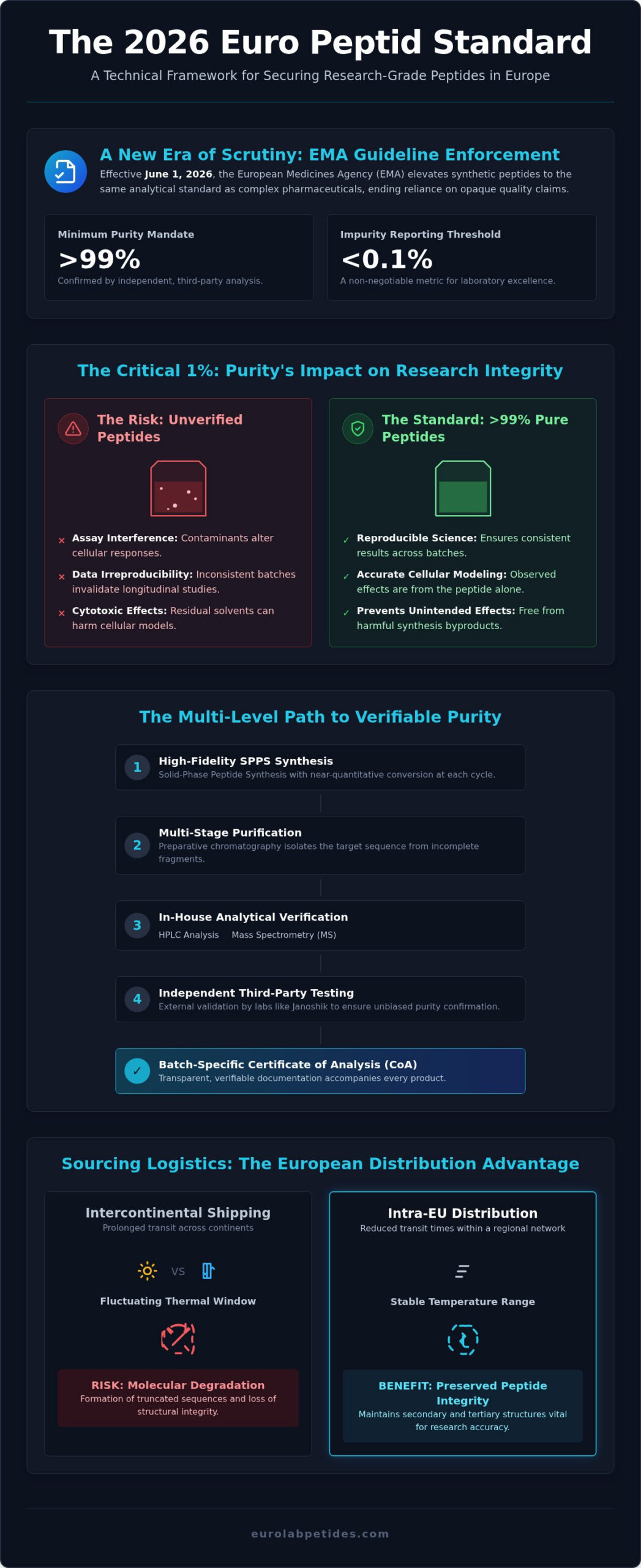
As of June 1, 2026, the European Medicines Agency now enforces the “Guideline on the Development and Manufacture of Synthetic Peptides,” which treats these compounds with the same analytical scrutiny as complex pharmaceuticals. This regulatory shift means that the 0.1% reporting threshold for impurities is no longer a suggestion but a verifiable metric for laboratory excellence. For specialists investigating peptides for cognitive function research, the days of relying on anecdotal quality claims or opaque international certificates of analysis are over.
You likely recognize that inconsistent batch purity and the risk of molecular degradation during long-distance transit remain significant threats to the integrity of your longitudinal data. This guide establishes a technical framework for securing research-grade materials that meet the 2026 Euro Peptid standard through rigorous third-party validation. We’ll detail the specific HPLC and Mass Spectrometry documentation required for modern compliance, the impact of localized logistics on peptide stability, and how to interpret the latest EMA impurity qualification benchmarks to ensure absolute precision in your laboratory environment.
Key Takeaways
- Analyze why the final 1% of purity in solid-phase peptide synthesis (SPPS) is critical for preventing assay interference and ensuring data reproducibility.
- Identify the specific analytical benchmarks and HPLC-MS verification required when sourcing high-stability peptides for cognitive function research.
- Minimize molecular degradation risks by leveraging regional European distribution to reduce the thermal window during sensitive chemical transit.
- Establish a verification protocol based on batch-specific Certificates of Analysis and transparent third-party testing data from independent laboratories like Janoshik.
- Understand the rigorous multi-level quality control processes that define the 2026 Euro Peptid standard for professional biochemical distribution.
The Evolution of European Peptide Research Standards
By 2026, the landscape of biochemical procurement has undergone a fundamental transformation. The European Medicines Agency (EMA) guidelines that became effective on June 1, 2026, shifted the responsibility of quality assurance from vague manufacturer claims to standardized analytical metrics. Previously, researchers often faced a choice between high-cost pharmaceutical channels or high-risk international markets. Today, specialized research chemical suppliers have bridged this gap by adopting clinical-grade synthesis protocols for non-clinical applications. This evolution ensures that laboratories can access high-purity compounds without the logistical instabilities associated with intercontinental shipping.
Defining ‘Euro Peptid’ in a Global Research Context
The distinction between European synthesis standards and unregulated international markets is primarily defined by analytical transparency. In many global regions, purity claims are self-reported and rarely verified by independent bodies. This creates significant risks for sensitive laboratory assays where even minor contaminants can alter cellular responses. Regional regulatory adherence ensures that every step of the procurement process, from chemical precursor sourcing to final lyophilization, follows established safety and quality protocols. Euro Peptid is defined as a verifiable benchmark for research-grade compounds that mandates a minimum of 99% purity confirmed through independent, batch-specific third-party analytical verification.
Regional sourcing is also a technical necessity for maintaining structural integrity. When amino acid chains travel across continents, they’re frequently exposed to fluctuating temperatures and prolonged transit times. These variables can induce molecular degradation or lead to the formation of truncated sequences. By utilizing intra-EU distribution networks, laboratories ensure that the product remains within a stable temperature range. This preserves the secondary and tertiary structures of the molecules, which is vital for the accuracy of peptides for cognitive function research.
Current Trends in In-Vitro Molecular Studies
There’s a documented surge in demand for high-purity peptides within longevity and metabolic pathway research. European laboratories are increasingly focusing on how specific sequences influence cellular signaling and protein expression. These studies require a level of precision that only advanced Peptide synthesis can provide. When researchers utilize peptides for cognitive function research, the absence of residual solvents and TFA (trifluoroacetic acid) is critical to prevent unintended cytotoxic effects in cellular models.
High-purity amino acid chains enable more accurate cellular modeling by ensuring that observed biological changes are the result of the peptide itself rather than impurities. For researchers who require a foundational understanding of molecular structures before beginning their assays, What Are Peptides? offers the necessary biochemical context. As in-vitro discovery advances, the reliance on these rigorous European standards will continue to grow, providing the empirical foundation required for reproducible science.
Technical Specifications of High-Purity Peptide Synthesis
High-purity synthesis is achieved through Solid-Phase Peptide Synthesis (SPPS), a methodical process involving the sequential coupling of N-protected amino acids onto an insoluble polymeric support. Each cycle of deprotection, activation, and coupling must reach near-quantitative conversion to ensure the final product’s integrity. In 2026, the success of peptides for cognitive function research depends on this iterative precision. As amino acid sequences increase in complexity or hydrophobicity, the probability of truncated sequences or deletion mutations rises, making the purification phase essential. The transition from crude synthesis to a research-grade compound requires multiple stages of preparative chromatography to isolate the target sequence from incomplete fragments.
Purity metrics are not mere marketing figures; they’re verifiable metrics of chemical safety. The remaining 1% of a 99% pure batch often contains synthesis byproducts like diastereomers or residual solvents. In sensitive in-vitro assays, these contaminants can induce cytotoxic responses or interfere with ligand-receptor binding kinetics, leading to compromised data. Achieving the “Euro Peptid” standard requires the rigorous removal of these impurities to ensure that observed biological effects are solely attributable to the peptide sequence.
Analytical Methodology: HPLC and Mass Spectrometry
High-Performance Liquid Chromatography (HPLC) remains the definitive tool for quantitative purity analysis in 2026. By measuring the absorbance of the peptide at specific wavelengths, HPLC chromatograms provide a visual and quantitative profile that identifies trifluoroacetic acid (TFA) residues, ensuring these counter-ions are maintained below the 1.0% qualification threshold established by the 2026 EMA guidelines. Mass Spectrometry (MS) complements this by confirming the exact molecular weight, ensuring the synthesized chain matches the intended primary sequence. Adherence to Europe’s New Peptide Market Guidelines necessitates that these analytical reports are batch-specific and readily available for laboratory audit.
Stability and Purity Benchmarks for 2026
Stability is dictated by the physical state of the compound and its exposure to environmental variables. Lyophilized (freeze-dried) peptides in a vacuum-sealed environment exhibit significantly higher resistance to hydrolytic degradation compared to solution-state counterparts. Standardized protocols for 2026 require storage at -20°C for long-term research stability, which often extends the shelf life to 24 months. For instance, BPC-157 serves as a benchmark for synthesis consistency due to its robust pentadecapeptide structure and predictable stability profile. Researchers should always verify that their materials are delivered in a stable, lyophilized format to ensure the longevity of their peptides for cognitive function research. For laboratories requiring verified analytical documentation, reviewing current batch certifications is a necessary step in the procurement process.
Sourcing Logistics: The Advantage of European Distribution
Sourcing logistics represent a critical variable in biochemical stability that researchers often overlook. The procurement of peptides for cognitive function research requires a logistical strategy that prioritizes molecular stability over simple cost efficiency. Regional distribution within the European Union minimizes the thermal window, which is the duration during which a compound is exposed to ambient temperatures that exceed its optimal storage parameters. While intercontinental shipping often involves multiple cargo transfers and prolonged customs inspections, intra-EU transit typically facilitates delivery within 24 to 48 hours. This reduction in transit time is essential for maintaining the structural integrity of fragile amino acid chains.
Supply chain continuity is another significant factor for laboratories engaged in long-term longitudinal studies. Relying on intercontinental suppliers introduces variables such as geopolitical trade shifts and global freight disruptions that can jeopardize the consistency of a research project. Regional sourcing ensures a more predictable inventory flow, allowing for the procurement of consistent batches that match previous analytical profiles. Additionally, the environmental impact of regional sourcing is substantially lower; reducing the air freight distance for chemical distribution aligns with the broader sustainability mandates currently being adopted by European research institutions.
Mitigating Degradation via Optimized Transit
Specialized packaging protocols are implemented to protect peptides from UV exposure and kinetic stress. High-purity compounds are sensitive to light induced degradation, necessitating the use of opaque, vacuum-sealed containers. During transit, kinetic stress from turbulence or rough handling can impact the physical state of the lyophilized cake. Last-mile delivery speed is particularly crucial for non-lyophilized compounds or those in solution-state, where hydrolytic degradation occurs at an accelerated rate. By evaluating the risk profile of trans-border research chemical shipping, it’s clear that localized distribution provides the highest level of protection against these environmental stressors.
Navigating EU Laboratory Supply Regulations
Compliance with European chemical safety standards is a non-negotiable requirement for research-only materials. This involves adherence to the Classification, Labelling and Packaging (CLP) Regulation, ensuring that all materials are accurately documented for laboratory use. There is a sharp distinction between industrial-grade peptides, which may have lower purity thresholds, and research-grade sourcing that meets the 99% Euro Peptid standard. For a detailed breakdown of these benchmarks and how to verify supplier credentials, researchers should consult How to Buy Research Peptides. This guide provides the regulatory context necessary for ensuring that all laboratory procurement aligns with the latest 2026 European standards.
Criteria for Selecting a Reliable European Peptide Supplier
In 2026, the selection of a biochemical supplier must be predicated on empirical validation rather than reputational tenure. For laboratories procuring peptides for cognitive function research, the primary metric of reliability is the provision of batch-specific Certificates of Analysis (COA). A COA that lacks a corresponding batch number or displays a generic, non-current date is an immediate indicator of analytical negligence. Ethical distribution requires a strict adherence to ‘Research Use Only’ (RUO) labeling, ensuring that the materials are utilized exclusively for in-vitro or laboratory applications in compliance with European chemical safety standards. Institutional reputation within the European research community is built through this radical transparency and the consistent availability of technical support for reconstitution and handling.
A reliable supplier provides comprehensive documentation regarding molar mass, solubility parameters, and optimal reconstitution buffers. This ensures that the structural integrity of the amino acid chain is maintained during the transition from lyophilized powder to liquid phase. Without these technical specifications, the risk of improper handling and subsequent molecular degradation increases, potentially compromising the validity of the laboratory’s findings.
Interpreting Independent Third-Party Verifications
Transparency is established through partnerships with independent analytical laboratories such as Janoshik. Modern verification protocols utilize unique IDs or QR codes that allow researchers to cross-reference a COA against the lab’s internal database. When evaluating these reports, several red flags must be identified:
- Missing HPLC chromatograms or Mass Spectrometry spectra.
- Obscured batch numbers that prevent traceability.
- Reports that don’t specify the purity percentage to at least two decimal places.
Blind testing protocols, where samples are submitted to third-party labs without supplier identification, serve as the ultimate feedback loop for establishing accountability. These objective data points eliminate the risk of bias and ensure that the peptides for cognitive function research meet the 99% purity benchmark required for high-stakes precision studies.
Batch Consistency and Transparency Protocols
Synthesis precision must be maintained across every production cycle. It’s insufficient to test a “master batch” and apply those results to subsequent iterations. Each unique synthesis cycle requires its own analytical verification to account for variables in precursor purity or environmental conditions during lyophilization. For example, the Ipamorelin technical profile demonstrates how batch-specific consistency is documented to ensure reproducible results in growth hormone secretagogue research.
A reliable partner integrates customer-led testing into their quality control framework, acknowledging that external validation is a non-negotiable standard. To ensure your laboratory is utilizing compounds that meet these rigorous 2026 benchmarks, you can view our latest batch-specific analytical reports to verify the current metrics of our inventory.
EuroLab Peptides: Excellence in Biochemical Distribution
EuroLab Peptides functions as a specialized distributor for European institutions requiring absolute analytical rigor in their biochemical procurement. The company operates under the ‘Euro Peptid’ standard, which prioritizes verifiable data over marketing claims. All materials are distributed strictly for in-vitro laboratory use; this policy reinforces ethical research standards and ensures compliance with regional safety regulations. This commitment to professional inquiry is supported by a logistical infrastructure that preserves molecular stability through localized EU distribution. By removing the variables of international transit, researchers can maintain the integrity of their longitudinal data sets.
The EuroLab Multi-Level Quality Protocol
The quality assurance framework begins with preliminary in-house purity screening to verify basic sequence identity and chemical composition. Following this internal audit, every batch undergoes mandatory third-party HPLC and Mass Spectrometry analysis at independent facilities such as Janoshik. This multi-level validation provides institutional researchers with transparent access to raw analytical data, ensuring that every vial meets the precise requirements for peptides for cognitive function research. EuroLab maintains a non-negotiable threshold where any batch demonstrating a purity level below the 99% benchmark is immediately rejected and excluded from distribution. This methodology respects the intelligence of the specialized community and provides the empirical results necessary for formal certifications.
Comprehensive Research Stacks for Target Inquiries
To support advanced cellular modeling and systemic metabolic studies, EuroLab provides specialized research stacks designed for target inquiries. These include the Longevity Research Stack, the Cognitive Research Stack, and the Advanced Metabolic Stack. These synergistic peptide combinations facilitate the investigation of complex metabolic pathways and protein expression in ways that single-compound studies cannot achieve. For instance, the Cognitive Research Stack is optimized for researchers investigating neural signaling pathways using peptides for cognitive function research. For additional scientific context on the biochemical mechanisms of these sequences, the review on Nootropics provides an authoritative analysis of cognitive enhancers in a research setting. Other available offerings include the Recovery Research Stack and materials for Tissue Repair & Recovery Research, which provide the high-purity tools required for serious professional inquiry into inflammation and cellular regeneration.
Advancing Laboratory Precision through Regional Standardization
The 2026 European research landscape requires a transition from anecdotal quality claims to verifiable analytical metrics. Prioritizing regional distribution and multi-level quality control protocols allows laboratories to eliminate the variables of molecular degradation and inconsistent batch purity. The integration of independent Janoshik-verified testing ensures every sequence meets the 99% purity threshold required for high-stakes inquiry. This data-first approach provides the absolute security necessary for professional users managing complex biochemical assays.
For specialists utilizing peptides for cognitive function research, success is predicated on the empirical reliability of the chemical substrate. Materials are strictly for in-vitro research use only to maintain the ethical and regulatory integrity of the laboratory. This meticulous approach to procurement transforms sourcing from a logistical hurdle into a foundational element of scientific excellence. By removing the uncertainties of intercontinental transit and opaque third-party data, researchers can focus exclusively on cellular modeling and metabolic discovery.
Secure High-Purity Research Peptides from EuroLab to ensure your next study is backed by the highest standards of European biochemical distribution. We’re committed to supporting your institutional discovery with unmatched technical precision.
Frequently Asked Questions
What does ‘Euro Peptid’ signify in the research chemical industry?
‘Euro Peptid’ signifies a technical benchmark characterized by 99% purity and absolute analytical transparency within the European research community. This standard aligns with the 2026 EMA guidelines that mandate the reporting of peptide-related impurities above 0.1%. It ensures that biochemical compounds meet the rigorous demands of specialized laboratory inquiry through standardized synthesis and verification protocols.
How can I verify the purity of peptides bought from a European supplier?
Purity is verified through the examination of batch-specific High-Performance Liquid Chromatography (HPLC) and Mass Spectrometry (MS) data. Researchers should utilize the unique QR codes or ID numbers provided by the supplier to cross-reference the Certificates of Analysis directly on the independent testing laboratory’s official database. This process eliminates the risk of utilizing forged or generic documentation.
Why is third-party testing like Janoshik essential for research peptides?
Independent testing by laboratories like Janoshik provides an objective layer of accountability that removes manufacturer bias from the quality equation. This is vital for peptides for cognitive function research, where even minor impurities above 0.5% must be identified and qualified. Third-party validation ensures that the observed biological changes in a study are solely attributable to the target peptide sequence.
What are the storage requirements for maintaining peptide stability in a lab?
Lyophilized peptides should be stored at -20°C in a vacuum-sealed, light-protected environment to prevent hydrolytic degradation and oxidation. Once a compound is reconstituted in a sterile buffer, it should be maintained at 4°C and utilized within a restricted timeframe, typically not exceeding 14 to 21 days. Adherence to these parameters is necessary to preserve the primary molecular structure during the assay period.
Are EuroLab Peptides products intended for human use?
No, EuroLab Peptides products are strictly for in-vitro research use only and are not intended for human consumption or medical applications. The company maintains a rigorous non-human consumption policy to ensure compliance with regional regulatory standards and ethical distribution practices. These materials are positioned as elite tools for serious professional inquiry within a controlled laboratory environment.
What analytical documentation should accompany a research peptide order?
Every order must be accompanied by a batch-specific Certificate of Analysis that includes both an HPLC chromatogram and MS spectra. These documents verify the molecular weight and primary sequence accuracy, ensuring the material meets the 2026 European standards for substance use in a research context. Missing or obscured analytical data is considered a significant red flag in biochemical procurement.
How does regional European shipping affect peptide structural integrity?
Regional shipping minimizes the “thermal window,” which reduces the risk of molecular degradation caused by prolonged exposure to ambient temperatures. Intra-EU logistics facilitate 24 to 48-hour delivery cycles, preserving the fragile amino acid bonds necessary for reliable results in peptides for cognitive function research. This localized approach is a critical shorthand for reliability in a market often fraught with international transit variables.
What is the difference between pharmaceutical-grade and research-grade peptides?
Pharmaceutical-grade peptides are manufactured under cGMP conditions for clinical use, while research-grade peptides are synthesized for in-vitro laboratory applications. Although both grades may share the 99% purity benchmark, research-grade materials are specifically optimized for sensitive laboratory assays. These products are strictly labeled for non-clinical inquiry to maintain the boundary between research chemicals and therapeutic agents.
