

The 2026 implementation of the EMA/CHMP/CVMP/QWP/367182/2025 guideline has redefined the benchmarks for synthetic peptide purity, rendering anecdotal vendor claims obsolete in the professional laboratory environment. When you look to buy research peptides Europe, the margin for chemical variance is non-existent. You likely understand the frustration caused by batch-to-batch inconsistency or the discovery of co-eluting impurities that compromise your in-vitro data. These variables don’t just delay your timelines; they threaten the fundamental reproducibility of your research framework.
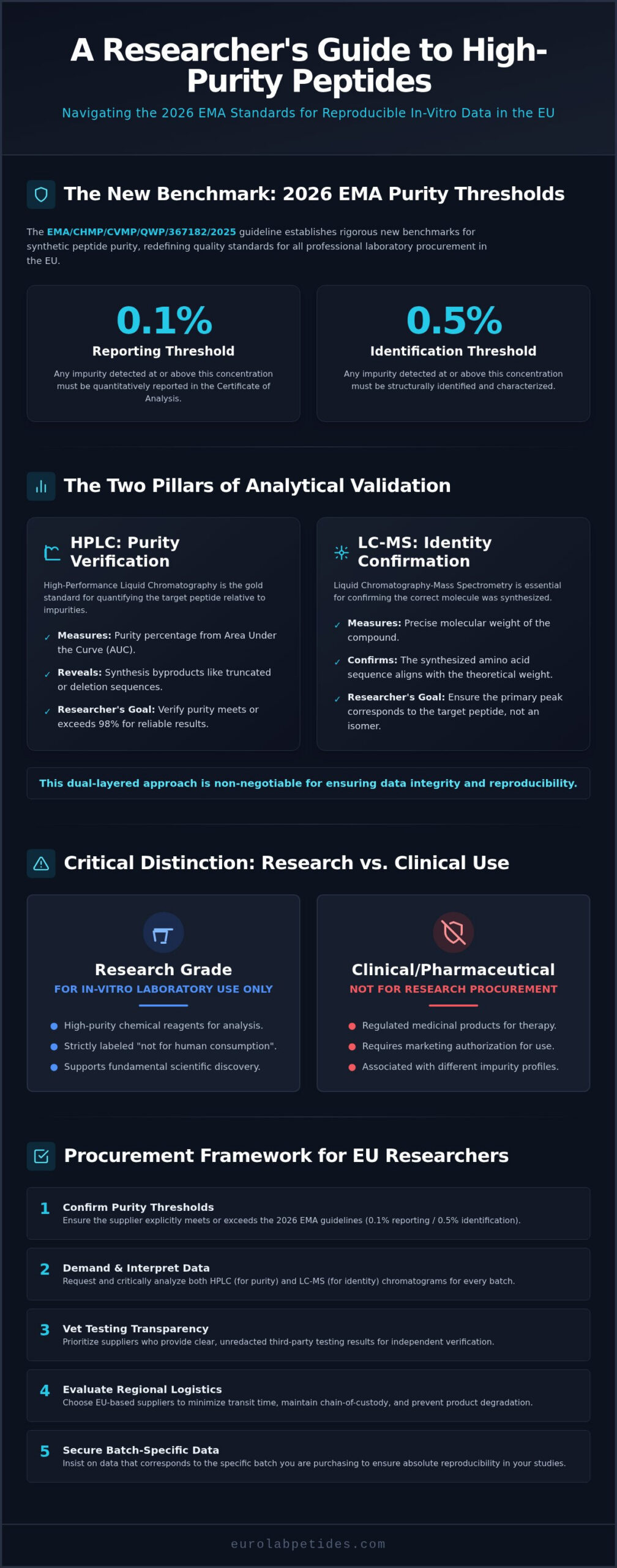
This technical guide establishes a rigorous methodology for identifying and procuring high-purity peptides that meet the current 0.1% reporting and 0.5% identification thresholds. We’ll analyze the critical components of a valid Certificate of Analysis, evaluate regional logistics for maintaining chain-of-custody, and detail the analytical metrics necessary for secure laboratory procurement. By the end of this analysis, you’ll possess a standardized framework for verifying external validation and ensuring stable, reproducible results within the EU.
Key Takeaways
- Identify the specific purity thresholds established by the 2026 EMA guidelines to ensure your laboratory reagents meet the highest technical standards.
- Master the interpretation of HPLC and LC-MS data to verify molecular identity and purity before initiating in-vitro research protocols.
- Establish a rigorous vetting process for third-party testing transparency when you choose to buy research peptides Europe for laboratory development.
- Evaluate the impact of lyophilization and regional shipping standards on product stability to prevent degradation during transit within the EU.
- Utilize a step-by-step procurement framework to secure batch-specific data, ensuring absolute reproducibility in tissue repair and longevity studies.
The Landscape of Research Peptides in Europe: 2026 Standards
Research-grade peptides are synthesized chemical reagents utilized exclusively within controlled laboratory environments for analytical and developmental inquiry. Unlike pharmaceutical-grade compounds intended for therapeutic application, these substances are manufactured as high-purity tools for in-vitro experimentation. When laboratory professionals seek to buy research peptides Europe, the 2026 regulatory environment dictates a reliance on the EMA/CHMP/CVMP/QWP/367182/2025 guideline as a voluntary quality benchmark. Sourcing reagents within the European Union is essential to maintain logistical stability and bypass the degradation risks inherent in long-haul international transit. Regional manufacturing standards ensure that the chemical integrity of the compound is preserved from synthesis to delivery.
In-Vitro Research vs. Clinical Application
A binary distinction is maintained between clinical pharmaceuticals and research reagents. Research peptides aren’t medicinal products; they lack marketing authorization for human or veterinary use and are strictly labeled “not for human consumption.” This boundary is enforced through rigorous internal protocols at EuroLab Peptides, where materials are provided solely for in-vitro laboratory development. Legal and ethical compliance in the EU requires that these chemicals are used only in legitimate scientific contexts. By adhering to these strict definitions, researchers ensure that their data remains untainted by the regulatory complexities or impurity profiles associated with lower-tier, non-specialized suppliers.
The Role of Peptides in Modern Scientific Inquiry
Peptides are short chains of amino acids linked by peptide bonds, serving as the primary architecture for mapping complex cellular signaling pathways. Current trends in European biochemical research focus heavily on metabolic investigation, longevity models, and tissue repair studies. For example, specific sequences like BPC-157 are frequently employed in tissue repair research to observe regenerative signaling in isolated cell cultures. Precision in the amino acid sequence is a non-negotiable requirement for reproducible data. High-purity reagents facilitate several critical research outcomes:
- Accurate mapping of metabolic pathway investigation.
- Consistent cellular response data across longitudinal longevity studies.
- Verification of signal transduction mechanisms in tissue repair models.
- Elimination of baseline noise caused by co-eluting impurities.
The decision to buy research peptides Europe from a verified regional partner ensures that the molecular identity of each reagent is confirmed through rigorous analytical validation, supporting the integrity of the entire research framework.
Analytical Validation: Understanding HPLC and LC-MS in Peptide Synthesis
Analytical integrity serves as the primary safeguard for reproducible in-vitro data. When you buy research peptides Europe, the verification of chemical purity must rely on objective instrumentation rather than vendor assertions. High-Performance Liquid Chromatography (HPLC) remains the gold standard for determining the percentage of the target peptide relative to synthesis byproducts. However, purity alone doesn’t confirm molecular identity. Liquid Chromatography-Mass Spectrometry (LC-MS) is utilized in tandem to verify that the synthesized amino acid sequence aligns precisely with the theoretical molecular weight. This dual-layered approach is necessary to meet the 2026 reporting thresholds of 0.1% for co-eluting impurities.
Interpreting HPLC Chromatograms for Researchers
HPLC is a technique used to separate, identify, and quantify each component in a mixture. In a professional HPLC chromatogram, the primary peak’s area under the curve (AUC) determines the purity percentage. Researchers must carefully scrutinize the baseline to distinguish between electronic “noise” and significant secondary signals that indicate truncated sequences or deletion peptides. A purity threshold of 98% isn’t just a benchmark; it’s a requirement for reliable cellular signaling data. Reagents falling below this metric can introduce exogenous variables that skew metabolic pathway investigation. You can verify our batch-specific chromatograms to ensure your research environment remains controlled and predictable.
Mass Spectrometry and Molecular Weight Validation
LC-MS provides a definitive molecular fingerprint by measuring the mass-to-charge ratio of the ionized molecules. This validation confirms the specific amino acid chain length, ensuring the sequence isn’t missing a single residue. While HPLC measures how much of “something” is in the vial, LC-MS identifies exactly what that “something” is. Sophisticated testing also screens for residual solvents from the synthesis process, heavy metals, and endotoxins. These contaminants can induce inflammatory responses in tissue models, leading to false-positive results in recovery, muscle tissue, and inflammation research.
Independent third-party validation is a non-negotiable standard for eliminating manufacturer bias. A transparent Certificate of Analysis (COA) must be batch-specific, featuring a unique lot number that corresponds to the testing date. It’s not enough to see a static image of a report; the data should be verifiable through the testing facility’s own records. This rigorous oversight ensures batch-to-batch consistency across complex research stacks. By prioritizing these analytical metrics, laboratory professionals maintain the high-stakes precision required for modern biochemical inquiry.
Evaluating Supplier Integrity: Red Flags and Quality Benchmarks
Identifying a reliable synthesis partner requires more than reviewing a digital storefront. Integrity in this sector is quantified through the transparency of analytical data and the consistency of the supply chain. A primary red flag is the absence of batch-specific Certificates of Analysis (COAs) or the provision of generic, outdated reports. When you buy research peptides Europe, each reagent must be accompanied by an independently verifiable document that matches the specific lot number printed on the vial. Static images of testing results are insufficient; the data must be cross-referenced with the third-party laboratory’s database to ensure the report hasn’t been modified or falsified.
Lyophilization and Stability During Transit
Lyophilization, or freeze-drying, is the standard methodology for preserving the primary structure of delicate peptide chains. This process removes moisture through sublimation, creating a stable, porous cake that resists enzymatic degradation and hydrolysis. While many vendors claim their products are “room temperature stable,” this is often an oversimplification. Stability is a function of time and thermal exposure. Lyophilized peptides are significantly more resilient than their reconstituted counterparts, yet prolonged exposure to temperatures exceeding 25°C during transit can compromise the secondary structure. For a comprehensive analysis of these variables, refer to our technical guide on how to buy research peptides.
Logistical Reliability in the European Market
Logistical security within the EU is a critical component of the procurement process. Standardized professional packaging is required to protect glass vials from mechanical stress while maintaining a neutral, laboratory-appropriate profile. Effective batch control requires a tracking system that documents the chain of custody from the point of synthesis to the final delivery at the laboratory. This traceability is vital for institutional researchers managing large-scale projects. EuroLab Peptides provides a Bulk Tier Program specifically designed for institutional research budgets, facilitating the procurement of uniform batches for multi-phase studies. Using localized logistics minimizes the time reagents spend in transit, reducing the risk of product degradation.
Localized European support is essential for resolving technical inquiries. Scientific inquiry demands precise information regarding solubility, counter-ion content, or reconstitution buffers. A partner that understands regional regulatory nuances and provides direct technical communication ensures that your research momentum isn’t stalled by administrative or logistical hurdles. This professional efficiency projects a persona of radical accountability, positioning the supplier as a meticulous partner in serious scientific inquiry.
Step-by-Step Checklist for Procuring Research-Grade Peptides
Procuring high-purity reagents requires a systematic approach to eliminate variables that compromise experimental outcomes. When laboratory professionals buy research peptides Europe, they must follow a structured validation protocol to ensure chemical integrity and data reproducibility. Adhering to a methodological checklist minimizes the risk of product degradation and ensures compliance with 2026 analytical standards.
- Step 1: Define the Research Objective. Select the reagent based on the specific signaling pathway or cellular model under investigation. For instance, BPC-157 is frequently utilized in tissue repair models due to its documented regenerative signaling properties in isolated cell cultures.
- Step 2: Request Batch-Specific Data. Do not accept generalized reports. Verify the latest HPLC and LC-MS data against the specific lot number of the vials intended for shipment to confirm a minimum 98% purity threshold.
- Step 3: Evaluate Storage Format. Prioritize lyophilized powder over pre-mixed solutions. Lyophilization preserves the primary peptide structure, whereas pre-mixed solutions are susceptible to rapid hydrolysis and peptide cleavage.
- Step 4: Confirm EU Logistics. When you buy research peptides Europe, verify that the supplier utilizes regional shipping hubs. This ensures transit times across major EU hubs remain within the 48 to 72 hour window, protecting temperature-sensitive compounds.
- Step 5: Execute a Small-Scale Pilot Study. Conduct an initial validation study to confirm that reagent performance aligns with the provided analytical data before scaling to larger research stacks.
Initial Reagent Selection and Verification
Correct reagent selection involves matching peptide profiles to specialized in-vitro research stacks. Researchers investigating cellular senescence often utilize a Longevity Research Stack, while those focusing on protein synthesis pathways may require a Muscle Research Stack. Cross-referencing supplier data with established biochemical databases like UniProt ensures sequence accuracy. Researchers must verify the trifluoroacetic acid (TFA) content in peptide salts. Excessive TFA levels can induce cytotoxicity in sensitive cell cultures, which skews in-vitro results and leads to non-reproducible data.
Finalizing the Procurement Process
Professional procurement demands financial transparency and secure payment methods that integrate with laboratory accounting systems. Once the reagents arrive, they must be stored at -20°C or -80°C to prevent degradation. Reconstitution should only occur immediately prior to use, utilizing sterile, deionized water or specialized buffers. Establishing a long-term sourcing partnership with a verified European laboratory ensures batch-to-batch consistency and provides access to technical support for complex inquiries. To begin your procurement process with verified analytical backing, you can access our technical research categories today.
EuroLab Peptides: Standardizing Excellence in European Research Supplies
EuroLab Peptides operates as a specialized synthesis partner for the European scientific community, providing reagents that adhere to the most rigorous analytical standards. The procurement process is governed by a multi-level quality control protocol that integrates in-house analytical verification with independent third-party testing. For laboratory professionals who intend to buy research peptides Europe, this framework ensures that each reagent meets the stringent purity benchmarks required for high-stakes experimentation. Manufacturing is centralized within the region to align with European regulatory standards and to mitigate the risks associated with global supply chain volatility.
Rapid access to core reagents is maintained through localized EU logistics. High-purity compounds such as Ipamorelin are handled within a secure chain of custody, ensuring that lyophilized powders remain stable during transit. By utilizing major EU hubs, delivery timelines are minimized, which is critical for projects requiring immediate reagent replacement or scale-up. This logistical precision ensures that the chemical integrity of the compound is preserved from the point of synthesis to laboratory arrival.
Specialized Research Stacks for Targeted In-Vitro Inquiry
Specialized research categories are organized to support specific investigative goals. The Longevity Research Stack is designed for cellular senescence and aging pathway investigation, providing a standardized suite of reagents for longitudinal studies. For researchers focused on cellular energetics, the Advanced Metabolic Stack offers specialized tools for metabolic pathway investigation. Other categories include Weight Management Research and Tissue Repair & Recovery Research. These pre-configured stacks facilitate complex laboratory development by ensuring that all components share a uniform purity profile and batch-specific validation, which is essential for maintaining a controlled research environment.
Our Commitment to Radical Transparency
Quality is treated as a verifiable metric rather than an abstract claim. A comprehensive database of analytical results is maintained, allowing researchers to access batch-specific HPLC and LC-MS reports to verify molecular identity and purity. This radical honesty extends to our technical support, where specialized inquiries regarding chemical specifications or molecular identity are addressed by professionals with deep biochemical expertise. When you buy research peptides Europe through EuroLab Peptides, you’re engaging with a partner that prioritizes empirical evidence and regional manufacturing excellence. For the 2026 research cycle, our systems provide the efficiency and precision required for serious scientific inquiry, ensuring that every procurement decision is backed by transparent, objective data.
Securing Analytical Integrity in 2026 Procurement
The 2026 landscape for biochemical inquiry demands a shift from trust-based procurement to data-driven validation. Analytical precision isn’t optional; it’s the foundation of reproducible science. By prioritizing multi-level HPLC and LC-MS verification protocols, you ensure that every reagent meets the 98% purity threshold essential for cellular signaling studies. When you choose to buy research peptides Europe, regional manufacturing and localized logistics become critical safeguards against product degradation and chain-of-custody failures.
EuroLab Peptides remains committed to providing strictly in-vitro laboratory research materials backed by independent third-party laboratory validation. This methodology eliminates supplier bias and provides the radical transparency required for institutional and independent studies alike. Secure, stable, and verified reagents allow you to focus on the data that matters most. We invite you to view our full catalog of third-party tested research peptides and establish a procurement framework built on absolute technical security. Your commitment to rigorous standards ensures the integrity of the next generation of scientific discovery.
Frequently Asked Questions
Is it legal to buy research peptides in Europe for laboratory use?
Purchase of peptides for in-vitro laboratory research is lawful across the European Union provided the compounds are not marketed for therapeutic use. When you buy research peptides Europe, regional compliance requires adherence to labeling standards, specifically “not for human consumption.” While the EMA sets medicinal frameworks, researchers must verify national regulations within their specific jurisdiction to ensure laboratory development remains within legal boundaries. This distinction is vital for maintaining the integrity of the research environment.
What is the standard purity level required for reliable in-vitro research?
A minimum purity threshold of 98% is the established standard for ensuring reproducible in-vitro data. Reagents falling below this metric introduce exogenous variables, such as truncated sequences or deletion peptides, which compromise cellular signaling studies. Following the 2026 EMA quality benchmarks, professional laboratories prioritize compounds that meet these specific purity metrics to eliminate baseline noise in metabolic and tissue repair models. High-purity reagents are essential for maintaining precision in modern biochemical inquiry.
How do I interpret an HPLC purity report from a peptide supplier?
Interpretation requires analyzing the Area Under the Curve (AUC) for the primary peak relative to secondary signals. The chromatogram must display a dominant peak representing the target peptide, with the baseline scrutinized for co-eluting impurities. When you buy research peptides Europe, the HPLC report should specify the wavelength used and the column type, allowing for independent verification of the purity percentage calculated by the integration software. This analytical transparency is necessary for confirming reagent quality and experimental reliability.
Why are peptides sold strictly for research and not human consumption?
These compounds are synthesized as high-purity chemical reagents intended for laboratory development and analytical inquiry. They lack the clinical safety data and regulatory marketing authorization required for human or veterinary administration. Selling strictly for in-vitro research ensures that these substances remain within the scientific domain, preventing the misuse of experimental tools that haven’t undergone the multi-phase clinical trials necessary for pharmaceutical classification. This boundary is strictly enforced to protect the integrity of scientific inquiry and research protocols.
What is the shelf life of lyophilized peptides when stored correctly?
Lyophilized peptides typically maintain chemical stability for up to 24 months when stored at -20°C in a desiccated environment. For long-term preservation exceeding two years, storage at -80°C is recommended to minimize the risk of peptide cleavage or oxidation. Once reconstituted, the shelf life significantly decreases to approximately 7 to 14 days, as aqueous environments accelerate hydrolysis and enzymatic degradation of the primary amino acid structure. Proper storage protocols are essential for preserving the molecular integrity of reagents.
How does EuroLab Peptides ensure batch-to-batch consistency?
Batch-to-batch consistency is ensured through a multi-level quality control protocol involving standardized synthesis parameters and rigorous analytical validation. Each lot undergoes in-house HPLC and LC-MS testing followed by independent third-party laboratory verification. This redundant testing cycle ensures that every batch aligns with the theoretical molecular weight and meets the 98% purity requirement, providing researchers with the stable reagents necessary for longitudinal studies. Consistency is maintained through meticulous adherence to regional manufacturing standards and objective data analysis.
What are the shipping times for research peptides across the EU in 2026?
In 2026, standardized logistics across major EU hubs facilitate shipping times of 48 to 72 hours for most regional destinations. This accelerated transit window is critical for maintaining the stability of temperature-sensitive reagents. By utilizing localized hubs in Germany, France, and the Netherlands, transit durations are minimized, ensuring that the chain of custody remains secure and that product degradation risks are effectively mitigated during the delivery process. Localized logistics are a cornerstone of reliable research procurement within Europe.
Do EuroLab Peptides products come with a Certificate of Analysis (COA)?
Every reagent provided is accompanied by a batch-specific Certificate of Analysis (COA). This document includes comprehensive HPLC and LC-MS data, documenting the purity percentage and molecular identity of the specific lot. Transparency is maintained by including unique lot numbers that allow for independent verification through external laboratories. Providing these certificates is a non-negotiable standard for EuroLab Peptides, ensuring that laboratory professionals have the empirical evidence required for their research records and experimental validation.
