

A single mathematical discrepancy in microgram-level concentration calculations can invalidate months of in-vitro research and deplete high-purity chemical stocks. In the high-stakes environment of biochemical analysis, the margin for error during reconstitution is effectively zero. Maintaining the structural integrity of lyophilized sequences requires more than basic laboratory awareness. It demands a rigorous adherence to biochemical stability and aseptic precision.
Establishing standardized peptide handling and safety protocols is the only verifiable method to prevent degradation caused by thermal fluctuations or improper solvent selection. You’ll master the mathematical frameworks required for precise molarity and the rigorous laboratory standards necessary to maintain experimental integrity. This technical guide provides a methodical progression from initial dissolution to long-term storage, ensuring your research inputs remain within the 99% purity benchmarks established by external validation. We will examine the specific thermodynamics of peptide solubility, clear formulas for concentration, and the localized logistics required for cold chain maintenance in a professional European research setting.
Key Takeaways
- Understand the biochemical role of lyophilization and why temperature equilibration is mandatory to prevent moisture-induced degradation.
- Implement rigorous peptide handling and safety protocols by mastering concentration formulas that convert milligram mass into precise microgram-level research data.
- Standardize volumetric accuracy through the U-100 syringe framework to ensure consistent delivery of reconstituted solutions.
- Adopt the “Slow Drip” method during laboratory dissolution to protect delicate molecular bonds from mechanical stress and shear force.
- Verify the analytical starting point of your research by utilizing 99%+ purity inputs validated by third-party HPLC and MS reporting.
Theoretical Foundations of Peptide Stability and Storage
The integrity of a synthetic sequence is fundamentally dependent on its physical state and environmental exposure. Lyophilization, a process of dehydration via sublimation under vacuum, is the primary methodology employed to ensure long-term stabilization. By removing aqueous content, the kinetic energy available for hydrolytic cleavage is significantly reduced. This dehydrated state is essential for maintaining the Theoretical Foundations of Peptide Stability, as it prevents the spontaneous degradation of the amide bonds that constitute the peptide backbone.
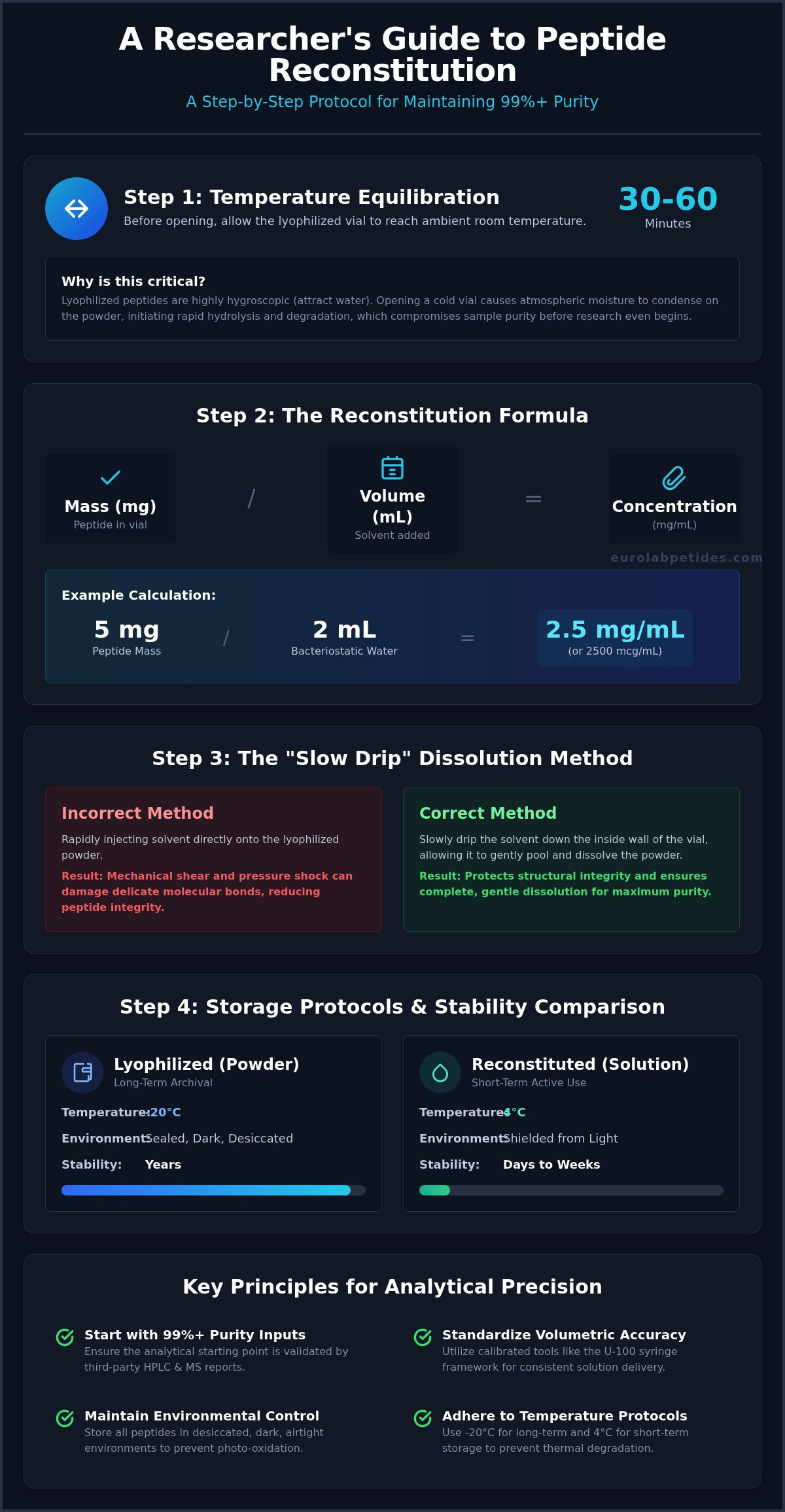
Rigorous peptide handling and safety protocols dictate that lyophilized vials remain sealed until they reach ambient temperature. Peptides are inherently hygroscopic, meaning they readily attract and hold water molecules from the surrounding environment. If a vial is opened immediately after removal from sub-zero storage, atmospheric moisture will condense on the cold surface of the powder. This moisture ingress initiates rapid hydrolysis, which can compromise the purity of the research input before the first experiment begins. A minimum equilibration period of 30 to 60 minutes is required to mitigate this risk.
Storage temperature benchmarks are standardized based on the intended duration of use. For archival or long-term storage exceeding several months, a constant temperature of -20°C is required to halt molecular motion. Short-term storage for active research cycles is typically conducted at 4°C, provided the environment is desiccated and shielded from light. Exposure to ultraviolet radiation and fluctuations in pH can catalyze the oxidation of sensitive residues, such as methionine or cysteine, leading to structural alterations that invalidate analytical results.
Lyophilized State vs. Solution Lability
Stability is drastically altered once a peptide is transitioned from a lyophilized powder to a liquid solution. In this reactive state, the sequence exhibits high biochemical lability, which is defined as the inherent susceptibility of a molecular structure to undergo rapid chemical alteration or degradation when exposed to thermal agitation or solvent-based catalysis. While a powder may remain viable for years at -20°C, a reconstituted solution often degrades within days or weeks, depending on the sequence complexity and buffer composition. Thermal agitation and UV exposure accelerate these degradative pathways, necessitating immediate use or precise secondary storage protocols.
Environmental Control Protocols
Maintaining a controlled environment is a non-negotiable requirement for experimental precision. Storage must be standardized in desiccated, dark environments to prevent photo-oxidation and moisture-induced aggregation. Vials should be stored in secondary airtight containers equipped with desiccant packs to ensure the internal atmosphere remains moisture-free. These safeguards are critical for researchers who require a baseline understanding of molecular behavior, as detailed in our guide on What Are Peptides? A Comprehensive Guide for Researchers. Failure to adhere to these environmental controls results in unpredictable lability, which undermines the reliability of every subsequent data point in the research cycle.
Mathematical Framework for Precise Reconstitution
Reconstitution is a quantitative procedure that requires absolute mathematical fidelity to ensure experimental reproducibility. The fundamental equation governing this process is Concentration (C) = Mass (m) / Volume (V). Within the framework of peptide handling and safety protocols, mass refers to the lyophilized peptide content in milligrams, while volume represents the quantity of bacteriostatic water or acetic acid solvent introduced. Precise calculation prevents the common pitfall of sub-therapeutic or toxic concentrations in in-vitro assays.
Managing the internal environment of the vial is the first step in the mathematical execution. Most research-grade vials are vacuum-sealed during the lyophilization process. When introducing a solvent, the pressure differential can cause a rapid influx of liquid, potentially damaging the peptide’s delicate molecular structure through mechanical shear. Standardized protocols require the slow, controlled introduction of the solvent to equalize pressure gradually. This meticulous approach is supported by the Standard Operating Procedures for Laboratory Dissolution, which emphasize the chemical reagents and stability required for analytical accuracy.
Universal Reconstitution Ratios
While concentration requirements vary by assay, a 1:1 ratio (1mL of solvent per 1mg of peptide) is often utilized as a baseline for simplicity. However, high-concentration protocols may be necessary for small-volume assays where total liquid volume must be minimized. The following table provides standardized values for common vial masses:
- 2mg Vial: Reconstituted with 1mL solvent yields 2,000mcg/mL (20mcg per 0.01mL).
- 5mg Vial: Reconstituted with 2mL solvent yields 2,500mcg/mL (25mcg per 0.01mL).
- 10mg Vial: Reconstituted with 2mL solvent yields 5,000mcg/mL (50mcg per 0.01mL).
Unit Normalization and Dilution Logic
Precision at the microgram level is non-negotiable for sequences with high biological activity, such as BPC-157. Researchers must normalize units by converting milligrams to micrograms: 1mg equals exactly 1,000mcg. This conversion allows for the calculation of “mcg per tick mark” on a graduated syringe. On a standard U-100 syringe, each individual graduation represents 0.01mL of solution. If a 5mg vial is reconstituted with 2mL of solvent, each tick mark represents exactly 25mcg of the peptide.
Cumulative errors in serial dilution sequences often stem from improper unit normalization. To maintain the 99%+ purity standards required for serious inquiry, researchers should utilize high-precision inputs from reliable sources like EuroLab Peptides to ensure the starting mass is analytically verified before the first solvent drop is added. This mathematical rigor transforms a qualitative procedure into a verifiable metric of laboratory excellence.
Syringe Calibration and Volumetric Accuracy
Precise volumetric displacement is the final variable in maintaining experimental integrity. Within the framework of peptide handling and safety protocols, the U-100 insulin syringe has emerged as the laboratory standard for micro-volume delivery. This standard dictates that 100 units are exactly equivalent to 1.0mL of solution. It’s critical to understand this ratio because even minor deviations in the draw can lead to significant fluctuations in the concentration delivered to cellular models. Syringes are typically manufactured in 0.3mL, 0.5mL, and 1.0mL capacities, with graduation clarity increasing as total volume decreases. For high-precision research requiring volumes under 30 units, the 0.3mL syringe is preferred due to its expanded graduation scale, which allows for more accurate visualization of the plunger apex.
U-100 vs. U-40 Syringe Standards
Analytical errors often occur when researchers fail to distinguish between U-100 and U-40 syringe calibrations. While both may appear physically similar, a U-40 syringe is calibrated for a concentration of 40 units per mL. Utilizing a U-40 syringe with calculations intended for a U-100 standard results in a 2.5x dosing discrepancy, which invalidates the quantitative data of the study. Researchers don’t always account for the “dead space” factor, which is the residual volume remaining in the syringe hub and needle after the plunger is fully depressed. High-precision protocols often utilize low-dead-space (LDS) syringes to minimize peptide waste and ensure that the volume drawn is the volume delivered.
Calculating Incremental Dosage Units
The conversion of desired mass into syringe units requires a standardized mathematical approach to prevent over-concentration. The formula utilized for this calculation is: (Desired Mass / Concentration) * Syringe Scale. This ensures that the volumetric draw is precisely aligned with the established molarity of the reconstituted solution.
Consider a practical laboratory scenario: a researcher requires a 250mcg dose from a 5mg vial reconstituted with 2mL of solvent. As established in previous sections, this solution has a concentration of 2,500mcg per mL. Using a U-100 syringe (where the scale is 100 units per 1mL), the calculation is as follows: (250 / 2500) * 100 = 10 units. Drawing the solution to the 10th graduation mark ensures the delivery of exactly 250mcg of the peptide sequence.
Verification protocols must be implemented to ensure the draw is measured at the plunger apex, which is the top ring of the black rubber stopper, rather than the tip of the dome. This distinction is vital for maintaining the 99%+ purity standards required for serious research inquiry. By standardizing these volumetric procedures, researchers eliminate the variables that lead to cumulative error in long-term in-vitro studies.
Standard Operating Procedures for Laboratory Dissolution
Transitioning from mathematical calculation to physical execution requires a sterile environment and mechanical precision. Aseptic preparation begins with the decontamination of all work surfaces using 70% ethanol or an equivalent antimicrobial agent. Personal protective equipment (PPE), including powder-free nitrile gloves and laboratory coats, must be utilized to prevent the introduction of exogenous proteins or contaminants. These peptide handling and safety protocols ensure that the high-purity inputs remain uncompromised during the critical transition from lyophilized powder to liquid solution.
The physical introduction of the solvent is a high-risk phase for molecular integrity. Researchers must employ the “Slow Drip” method to prevent peptide shearing, a form of mechanical degradation caused by high-velocity liquid impact. Instead of injecting the solvent directly onto the lyophilized cake, the needle should be angled so the liquid flows down the interior glass wall of the vial. This technique allows the solvent to hydrate the peptide gradually. Managing the internal vacuum is equally critical. The pressure differential should be equalized by allowing the vacuum to draw the solvent in slowly, rather than depressing the plunger with force, which could introduce atmospheric contaminants if not controlled.
Once the solvent is introduced, homogenization must be achieved through gentle swirling. Mechanical agitation, such as shaking or vortexing, is prohibited as it causes the denaturation of the peptide sequence and the formation of insoluble aggregates. A clear, colorless solution is the required analytical benchmark for successful dissolution. If the solution remains turbid after gentle swirling, it may indicate a pH imbalance or the presence of hydrophobic residues requiring specialized buffer adjustments.
Aseptic Handling Protocols
Maintaining absolute purity requires strict adherence to sterile technique at every contact point. The vial septum must be sterilized with 70% isopropyl alcohol and allowed to air-dry completely before needle penetration. Single-use, sterile needles are mandatory for every extraction to eliminate the risk of cross-contamination or the introduction of particulate matter. For detailed specifications on sourcing materials that meet these rigorous requirements, consult our guide on How to Buy Research Peptides: A 2026 Guide to Purity, Sourcing, and Laboratory Standards. Utilizing verified inputs from EuroLab Peptides ensures the starting material adheres to the 99%+ purity standards necessary for reproducible research.
Post-Reconstitution Integrity Maintenance
Reconstituted peptides exhibit significantly higher lability than their lyophilized counterparts. Solutions must be stored in a temperature-controlled environment between 2°C and 8°C. For instance, the standard shelf-life of reconstituted BPC-157 remains stable at these temperatures for a limited duration, typically not exceeding 14 to 21 days for optimal research precision. Researchers should monitor vials daily for precipitation, cloudiness, or discoloration, as these are primary indicators of peptide degradation or microbial growth. If any visual change in clarity is observed, the solution must be discarded to prevent the generation of invalid experimental data. Accurate labeling with the date of reconstitution and the calculated concentration is a non-negotiable standard for laboratory accountability.
Ensuring Analytical Precision with EuroLab Peptides
The reliability of any biochemical assay is contingent upon the analytical purity of the starting material. While rigorous peptide handling and safety protocols mitigate degradation during reconstitution, they cannot compensate for sub-standard initial mass or chemical impurities. EuroLab Peptides establishes a baseline of experimental security by adhering to a 99%+ purity standard for all lyophilized sequences. This metric is not a marketing assertion but a verifiable result of multi-level quality control protocols.
Every batch undergoes independent third-party validation using High-Performance Liquid Chromatography (HPLC) and Mass Spectrometry (MS). HPLC confirms the chemical purity by separating the peptide from any residual synthesis byproducts, while MS verifies the molecular weight to ensure the sequence identity is correct. For researchers focused on growth hormone secretagogue activity, sourcing high-purity Ipamorelin is essential for maintaining the precision of in-vitro metabolic models. These analytical benchmarks provide the high-stakes precision required for professional inquiry.
Regional logistics play a decisive role in maintaining this integrity. EuroLab utilizes localized European distribution channels to ensure cold chain integrity from the point of synthesis to the laboratory receiver. By minimizing transit times and utilizing temperature-monitored shipping, the risk of thermal agitation during global transit is effectively eliminated. This proof-first flow respects the user’s requirement for absolute security in their research inputs.
Mass Verification and Certificates of Analysis
The accuracy of concentration calculators is rendered obsolete if the actual mass within a vial deviates from the label. EuroLab prioritizes exact mass measurement, ensuring that a 5mg vial contains the precise amount of lyophilized powder required for mathematical consistency. Every product is accompanied by a Certificate of Analysis (COA) that documents the specific purity and mass of that production cycle. It’s mandatory for researchers to verify Batch Numbers against COA data to ensure the analytical inputs align with the peptide handling and safety protocols established in their laboratory SOPs.
The EuroLab Research Advantage
Integrating high-purity peptides into specialized research frameworks, such as metabolic or longevity research stacks, requires a partner that understands the rigorous demands of the scientific community. Technical support is provided to professional researchers across the European Economic Area, facilitating the use of these tools in serious inquiry. By providing empirical data and formal certifications, EuroLab projects a persona of radical accountability in the chemical synthesis space. To advance your experimental precision, secure high-purity research peptides from EuroLab.
Advancing Laboratory Standards for Synthetic Sequences
Maintaining the structural integrity of synthetic sequences requires the seamless integration of mathematical rigor and aseptic physical handling. Experimental reproducibility is fundamentally dependent on the elimination of variables such as moisture ingress, thermal agitation, and volumetric inaccuracy. By standardizing peptide handling and safety protocols, researchers ensure that the biochemical lability of their subjects is managed within a controlled, analytical framework. The transition from lyophilized powder to reactive solution must be executed with the same level of precision that characterizes the initial chemical synthesis.
Achieving these benchmarks is only possible when starting with verified inputs that have undergone stringent quality assurance. Every batch provided by EuroLab is validated through independent HPLC and MS analysis to guarantee 99%+ purity standards for all research peptides. Secure, tracked shipping across Europe ensures that cold chain integrity is maintained from the point of synthesis to the laboratory bench. To secure the analytical precision required for your next inquiry, Order Third-Party Tested Research Peptides at EuroLab. Professional success in in-vitro research begins with a commitment to these rigorous technical standards.
Frequently Asked Questions
How much bacteriostatic water should be added to a 5mg peptide vial?
The volume of bacteriostatic water added to a 5mg vial is determined by the required final concentration of the assay. A volume of 2mL is frequently utilized to achieve a concentration of 2,500mcg/mL, which facilitates precise measurement on a standard syringe. While 1mL can be used for higher concentrations, larger volumes reduce the margin of error during extraction. Adhering to established peptide handling and safety protocols ensures the solvent volume remains consistent across experimental replicates.
What is the difference between mg and mcg in peptide concentration?
Milligrams (mg) and micrograms (mcg) represent the mass of the lyophilized peptide, where 1mg is exactly equivalent to 1,000mcg. Most research-grade peptides are supplied in milligram quantities, but in-vitro assays typically require microgram-level precision. Failure to normalize these units leads to significant concentration errors. Accurate conversion is the mathematical foundation of all laboratory protocols, ensuring that the calculated molarity of the solution aligns with the intended experimental parameters.
Can sterile water be used instead of bacteriostatic water for reconstitution?
Sterile water may be utilized for reconstitution if the solution is intended for immediate, single-use application. However, bacteriostatic water containing 0.9% benzyl alcohol is mandatory for any vial intended for multi-dose extraction over several days. The benzyl alcohol acts as a preservative to inhibit microbial proliferation. Utilizing sterile water in a multi-use context increases the risk of contamination, which can degrade the peptide sequence and invalidate the resulting research data.
How do I calculate the number of units on an insulin syringe for a 100mcg dose?
Calculating units on a U-100 syringe requires the formula: (Desired Dose / Concentration per mL) * 100. If a 5mg vial is reconstituted with 2mL of solvent, the concentration is 2,500mcg/mL. For a 100mcg dose, the calculation is (100 / 2500) * 100, resulting in exactly 4 units. Standardizing this calculation prevents the over-concentration of cellular models and ensures that peptide handling and safety protocols are maintained throughout the serial dilution process.
What happens if a peptide vial is shaken after adding the solvent?
Shaking a peptide vial after solvent introduction causes mechanical denaturation and the formation of insoluble aggregates. Peptides are held together by delicate hydrogen bonds and disulfide bridges that are susceptible to kinetic energy. Shaking introduces air bubbles and surface tension changes that can shear these bonds, rendering the peptide biochemically inactive. Homogenization must be achieved exclusively through gentle swirling to maintain the structural integrity and analytical purity of the reconstituted sequence.
How long can a reconstituted peptide solution be stored in the refrigerator?
A reconstituted peptide solution typically maintains its biochemical integrity for 14 to 21 days when stored at 2°C to 8°C. This shelf-life is sequence-dependent; for instance, reconstituted BPC-157 is stable within this range but will begin to degrade if exposed to thermal fluctuations. Solutions should never be frozen after reconstitution, as the formation of ice crystals can cause physical damage to the peptide backbone. Any solution exhibiting cloudiness or precipitation must be discarded.
Why does the peptide calculator require the syringe size (U-100 vs. U-40)?
Syringe size must be specified because the volumetric displacement per unit differs between U-100 and U-40 standards. A U-100 syringe is calibrated for 100 units per 1.0mL, whereas a U-40 syringe is calibrated for 40 units per 1.0mL. Using a calculator or protocol intended for U-100 with a U-40 syringe results in a 2.5x dosing error. Specifying the syringe standard is a critical step in ensuring the delivered mass aligns with the research design.
Is it necessary to equalize the pressure in the vial during reconstitution?
Equalizing the internal pressure of the vial is mandatory to prevent the “spraying” effect of the solvent. Most lyophilized peptides are vacuum-sealed, which can cause a rapid, uncontrolled influx of liquid that shears the molecular bonds. By allowing the vacuum to draw the solvent in slowly and then introducing an equivalent volume of air into the headspace, the internal environment is stabilized. This controlled approach protects the peptide from mechanical stress and ensures aseptic integrity.
