

A tissue-repair result may sound like evidence for TB-500 even when the study tested a different molecule. That distinction matters when assessing TB-500 for research in tissue models. TB-500 is commonly described as a synthetic fragment related to thymosin beta-4 (Tβ4), but findings from studies of the full-length protein do not automatically establish what the fragment does. Overlapping terminology and broad repair claims can make the evidence difficult to interpret.
This article explains the terminology and biological context, then examines what tissue-model studies can show about specific mechanisms and endpoints, and where their limits begin. It separates in-vitro findings from animal-model evidence and research on full-length Tβ4, so conclusions remain tied to the molecule and model actually studied. It also explains why identity, purity, consistency, and batch-specific analytical information matter when interpreting results. EuroLab Peptides’ in-house and independent third-party testing relates to material quality and consistency, not proof of a particular experimental outcome. All products are designated for in-vitro research and laboratory development only.
Key Takeaways
- Separate TB-500 terminology from full-length thymosin beta-4 when interpreting tissue-model findings.
- Distinguish proposed actin-related mechanisms from measured endpoints such as cell migration or angiogenesis.
- Assess TB-500 for research in tissue models by checking the model, peptide identity, endpoint, and study limitations.
- Frame in-vitro investigations around a clear model rationale, appropriate controls, predefined endpoints, and transparent reporting.
- Use identity, purity, consistency, and test documentation to evaluate research materials, while keeping quality data distinct from experimental outcomes.
What Does TB-500 Mean in Tissue-Model Research?
In tissue-model research, TB-500 is a research material discussed in laboratory investigations of cellular or tissue-level processes. The name is often used for a synthetic fragment associated with thymosin beta-4 (Tβ4), but the label alone does not establish a precise molecular identity or prove that a study tested that fragment. When assessing TB-500 for research in tissue models, start with the material described in the methods, not assumptions based on a product name or broad biological claim.
This distinction affects how findings should be interpreted. A cell-culture experiment reports an endpoint in a specific in-vitro system. An animal study uses a more complex biological model, while a clinical claim concerns people and requires a different evidence base. These categories are not interchangeable. A laboratory finding may support a question for further investigation, but it does not establish an effect in an organism or a clinical outcome.
How Is TB-500 Related to Thymosin Beta-4?
Thymosin beta-4 is a distinct peptide, and sources may describe TB-500 as a synthetic fragment related to it. Treat that relationship as a claim to verify, not proof that the two names identify the same molecule. Compare each study’s stated sequence, molecular identity, and material description with its primary sources. A general overview, such as the TB-500 Wikipedia article, can provide orientation, but it is not a substitute for primary research or analytical characterization.
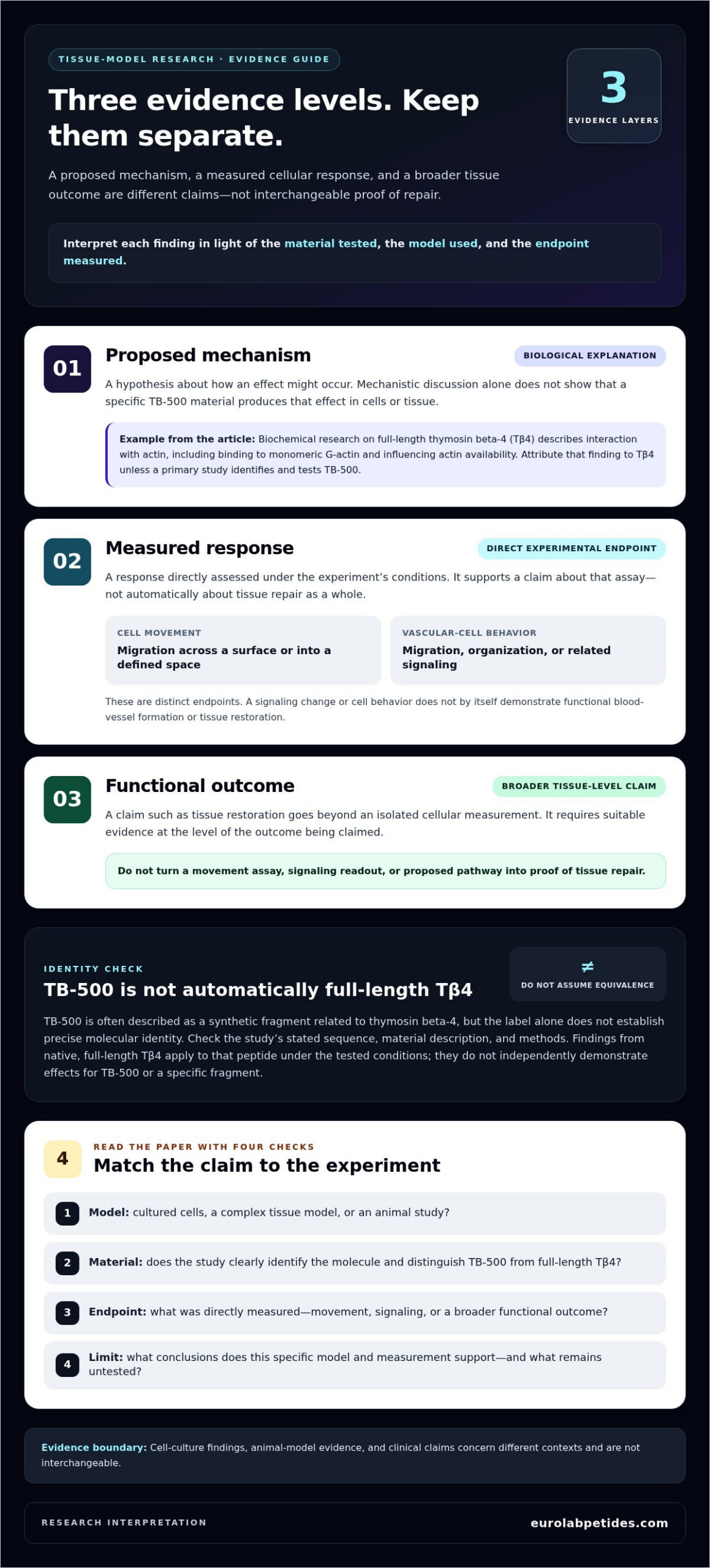
Keep the evidence streams separate. Research on native, full-length Tβ4 establishes findings about that peptide under the tested conditions. It does not independently demonstrate effects for TB-500 or a specific fragment. Before attributing a mechanism or outcome, check which molecule was used and whether the paper provides enough information to identify it. If the terminology is ambiguous, report that uncertainty rather than treating the materials as equivalent.
What Counts as a Tissue Model?
A tissue model can range from a cell-based system, such as cultured cells used to measure a defined response, to a more complex arrangement designed to represent interactions among multiple cell types or tissue features. The model sets the boundaries of the question. A migration assay, for example, measures movement under its experimental conditions, not tissue repair as a whole. Foundational terminology about peptide structure and research context is covered in this comprehensive guide to peptides.
When reviewing a paper, record the model, test material, and endpoint separately. Check whether the authors identify the sequence and distinguish TB-500 from full-length Tβ4. Note whether the evidence comes from cultured cells, a complex tissue model, or an animal study. These details help prevent findings from one experimental context being generalized to another. Clear terminology is not a technicality; it is necessary for comparing studies and assessing what their results support.
Which Cellular Mechanisms Are Examined in TB-500 Research?
Mechanistic discussions often focus on actin, cell movement, and vascular-cell behavior. These are separate lines of investigation, not interchangeable proof of tissue repair. A proposed pathway explains how an effect might occur; an experiment supports that explanation only to the extent allowed by its material, model, and measured endpoint. For TB-500 for research in tissue models, ask whether the study directly tested a clearly identified TB-500 material or discusses thymosin beta-4 biology instead.
For example, biochemical research on full-length thymosin beta-4 describes its interaction with actin, including binding to monomeric G-actin and influencing actin availability. That is a molecular-level mechanism, not evidence that TB-500 produces the same effect in cells or changes a tissue-level outcome. Unless a primary TB-500 study identifies its test material and model, attribute this finding to thymosin beta-4.
Actin Dynamics and Cell Migration
Actin forms dynamic filaments that help maintain cell shape and support movement. A cell-migration experiment may track movement across a surface or into a defined space, but its result applies to that assay and its conditions. It does not establish broader tissue repair. Check whether a paper directly measured migration after exposure to a specified TB-500 material. A proposed actin mechanism or a thymosin beta-4 result alone is not a TB-500 migration finding.
Angiogenesis and Tissue-Remodeling Signals
Angiogenesis refers to the formation of new blood vessels. In research models, investigators may measure vascular-cell migration, organization, or signaling associated with this process. Each is a distinct endpoint. A change in a signaling marker or cell behavior does not, by itself, demonstrate functional blood-vessel formation or tissue restoration. Comparative reading can help clarify how research topics are framed, but the technical guide to BPC-157 research concerns a different peptide and cannot provide evidence for TB-500.
When evaluating a mechanistic claim, separate three levels of evidence:
- Proposed mechanism: a biological explanation suggested by prior knowledge or a hypothesis.
- Measured response: an endpoint directly assessed in the experiment, such as cell movement or a signaling readout.
- Functional outcome: a broader tissue-level effect that requires suitable evidence beyond an isolated cellular measurement.
Then check the peptide identity, sequence description, controls, and assay methods in the primary paper. If the source does not provide enough detail to distinguish TB-500 from full-length thymosin beta-4, describe the mechanism as related-peptide context rather than fragment-specific evidence. Regulatory discussion, including the linked FDA Peptide Update on TB-500, is a separate topic. Regulatory status does not validate a proposed cellular mechanism. This distinction keeps mechanistic hypotheses useful without overstating what an individual experiment demonstrates.
How Strong Is the Evidence for TB-500 in Tissue Models?
Evidence strength depends on what was tested, in which model, and how the outcome was measured. The central distinction is material identity: findings from studies of full-length thymosin beta-4 (Tβ4) do not establish effects for TB-500. The research discussed here is predominantly preclinical. Evidence should therefore be assessed by category, not combined into a single claim about tissue repair.
| Model | Peptide identity | Measured endpoint | Finding | Limitation |
|---|---|---|---|---|
| In-vitro cell or tissue model | Must be verified from each study’s methods; a TB-500 label alone may not resolve sequence or identity. | The specific assay endpoint reported by the authors, such as a cellular response or signaling measure. | Interpret only the result directly reported for the tested material and conditions. | A defined laboratory response does not establish a whole-organism or clinical effect. |
| Animal model | Check whether the study tested TB-500, full-length Tβ4, or another material. | The study’s prespecified or reported biological outcome. | Any result applies to that animal model and experimental design. | It cannot be treated as equivalent to an in-vitro result or human evidence. |
| Human clinical research | Must be established in the clinical study itself. | Clinical outcomes, if assessed in a controlled study. | Clinical conclusions require evidence from the clinical study itself. | Clinical efficacy cannot be inferred from cell or animal findings. |
| Laboratory research on full-length Tβ4 | Native or full-length thymosin beta-4, not automatically TB-500. | Only endpoints directly measured in each Tβ4 study. | May inform biological context for Tβ4. | Does not establish TB-500-specific activity. |
What Can In-Vitro Findings Establish?
In-vitro results can address a defined biological question under controlled laboratory conditions. For example, a study may measure a cellular marker or a particular cell behavior. Keep the conclusion at that level: the measured response occurred, or did not occur, in the tested model under the reported conditions. Model complexity, endpoint selection, and external validity all limit how far the observation can be generalized. It is not evidence of human healing or treatment benefit.
How Should Conflicting or Limited Results Be Read?
Compare studies only after checking whether they tested the same identified peptide, used sufficiently comparable models, and measured related endpoints. Different outcomes may reflect different experimental questions rather than a true contradiction. Attribute limitations such as inadequate controls or small sample sizes only when the paper documents them. A separate peptide-specific overview, the BPC-157 technical research guide, provides comparative context without serving as evidence for TB-500.
Model-specific findings do not establish clinical efficacy. When assessing TB-500 for research in tissue models, record the model, peptide identity, endpoint, and stated limitation for each study. This makes conclusions traceable to the experiment and prevents related-peptide biology from being presented as direct evidence.
How Should Researchers Frame a TB-500 Tissue-Model Study?
A clear study starts with a narrow biological question, then aligns the model, test material, controls, and readouts with that question. This framework helps researchers assess whether a conclusion follows from the experiment or extends beyond it. For TB-500 research, give material identity particular attention: state what was tested and, where relevant, distinguish it from full-length thymosin beta-4.
Use this high-level checklist to evaluate a published or planned in-vitro investigation:
- Model rationale: Explain why the selected cell or tissue system can address the biological question, and identify what it cannot represent.
- Material identity: Report the material’s stated identity and sequence information where available. Include analytical characterization relevant to the study.
- Controls: Describe comparison groups clearly enough for readers to understand how the observed response was interpreted.
- Predefined endpoints: Specify what will be measured and how the result relates to the research question.
- Transparent reporting: Document methods, exclusions, limitations, and results in sufficient detail to support independent interpretation.
Which Study Details Should Be Reported?
Identify the model type, cell or tissue source, and experimental question. Make clear whether the paper uses a cell-based assay or a more complex tissue-model system, since those designs address different levels of biological organization. State the test material as precisely as the available evidence permits, including identity and analytical information. Describe control conditions and endpoints directly so readers can distinguish what was measured from what the authors infer.
How Can Researchers Improve Interpretability?
Define comparisons before interpreting results. For example, specify which experimental groups are being compared and which endpoint will answer the primary question. Report null findings alongside positive observations; both help show the boundaries of the evidence. In the discussion, separate observed data from proposed explanations, and do not present a potential mechanism as though the experiment directly demonstrated it. Broader material-evaluation considerations are covered in this research-peptide sourcing and laboratory standards guide.
These points support interpretation; they do not replace institutional procedures. Laboratory work should follow relevant institutional requirements, approved protocols, and applicable research standards. This article concerns in-vitro research and laboratory development only; it does not provide dosing, administration, or human-use guidance.
Reproducible interpretation depends in part on well-characterized materials. EuroLab Peptides uses in-house and independent third-party testing as part of its quality-control process to support purity and consistency. Explore research-grade peptides for laboratory work when considering material characterization for an in-vitro project.
What Quality Information Matters When Sourcing Research Peptides?
Material quality is one part of a reproducible in-vitro workflow. Identity, purity, and consistency help researchers understand what material entered an experiment and whether differences between results might relate to the material itself. These details support interpretation; they do not show that a peptide has a particular biological activity or guarantee a specific experimental outcome. For TB-500 for research in tissue models, consider quality information alongside the study model, methods, and measured endpoints.
What Can Quality-Control Testing Tell a Researcher?
Analytical testing can provide evidence about the material examined, within the scope of the methods used. Its relevance depends on what was tested and whether the result applies to the material used in the experiment. Purity information alone does not confirm every aspect of identity, and material characterization is not evidence of biological or clinical effects. Read test documentation with the specific material and batch in view.
When reviewing sourcing information, consider whether it helps answer these questions:
- Identity: Is the material identified clearly enough to distinguish it from related peptides or variants?
- Purity: Is purity information reported with enough context to interpret what was assessed?
- Consistency: Is there information that helps researchers evaluate material consistency across research workflows?
- Testing: Are the analytical methods or test results described clearly, and do they relate to the material under consideration?
- Limits: Does the documentation distinguish material characterization from claims about experimental performance?
These checks help frame the evidence, but they do not replace appropriate study controls or transparent reporting. A test result characterizes the tested material within the limits of the analysis. It cannot confirm how that material will behave in a particular cell or tissue model.
How EuroLab Peptides Approaches Research-Material Quality
EuroLab Peptides uses a multi-level quality-control process that includes in-house and independent third-party laboratory testing. This process is intended to support product purity and consistency. It provides relevant context for laboratory material selection, but it does not establish a TB-500-specific experimental finding or guarantee reproducibility. Researchers should interpret quality information alongside their own protocol, model, and endpoint.
For reliable interpretation, keep material-quality evidence distinct from biological evidence. Clear identity and relevant testing information can help researchers document what was used and assess whether materials are comparable across experiments. They cannot substitute for a well-designed study or demonstrate efficacy. Products are designated strictly for in-vitro research and laboratory development only, not for human consumption or clinical use.
To review EuroLab Peptides’ research materials, explore EuroLab Peptides.
Carry the Evidence Into Your Next Research Question
Turn careful interpretation into a research question that can be answered clearly. For TB-500 for research in tissue models, define what the selected model can measure, document the test material, and keep conclusions proportional to the observed data. That discipline makes findings easier to assess and compare, whether results support the hypothesis or point toward a different question.
Material characterization is part of that preparation, not a substitute for sound experimental design. EuroLab Peptides uses in-house and independent third-party laboratory testing as part of its quality-control process. Its products are designated for in-vitro research and laboratory development only.
For research-material information, explore EuroLab Peptides. Apply the same rigor to each decision in your workflow, and build the next study on evidence that is clearly identified, carefully reported, and open to scrutiny.
Frequently Asked Questions
Is TB-500 the same as thymosin beta-4?
No. TB-500 and thymosin beta-4 should not be treated as interchangeable names. TB-500 is commonly described as a related fragment or research material, but terminology and sequence descriptions can vary between sources. For a specific experiment, check the methods and cited references to determine what material was tested. Do not attribute a finding to TB-500 if the paper identifies only thymosin beta-4 or leaves the test material ambiguous.
Can TB-500 findings from one tissue model be applied to another?
Not automatically. A result from one cell type or model design may depend on features that another system does not share. For example, a response measured in a single cell type may not predict behavior in a multi-cell tissue model. Before comparing studies, check whether they used comparable materials and endpoints, and whether their controls address similar questions. Treat any extension beyond the studied model as a hypothesis, not an established result.
How much TB-500 is used in an in-vitro research study?
There is no single amount that applies across in-vitro models. Experimental concentrations are specific to each study’s material, model, controls, and methods, so a value from a paper should not be transferred without evaluating that context. This FAQ does not provide an experimental protocol or human-use guidance. For laboratory work, consult relevant primary literature and follow institutional procedures and applicable research standards.
What does a cell-migration result show in TB-500 research?
It shows a measured change, or lack of change, in cell movement within the assay’s defined conditions. The result alone does not demonstrate tissue repair or predict what another model would show. For example, the assay’s chosen cell type and measurement method shape how movement is recorded. Interpret the finding in light of the test material, comparison groups, and assay design, and distinguish the observed result from broader claims about its meaning.
Are there standardized in-vitro protocols for TB-500 tissue models?
The article does not establish a single standardized protocol applicable to all TB-500 tissue models. Published methods may differ in materials, model systems, controls, and readouts, so one paper’s approach should not be presented as universal. When reviewing a method, identify the specific question it addresses and whether its design supports that question. Products from EuroLab Peptides are designated strictly for in-vitro research and laboratory development, not human consumption or clinical use.
What happens if a TB-500 study reports no measurable effect?
A null result should be reported as a finding under the study’s tested conditions, not dismissed as unimportant. For example, it may indicate that the selected assay detected no change in its chosen endpoint. It does not resolve what might occur in a different model or under different conditions. Check whether the paper clearly reports its material, methods, and comparison groups, and avoid adding a mechanism that the data did not demonstrate.
